

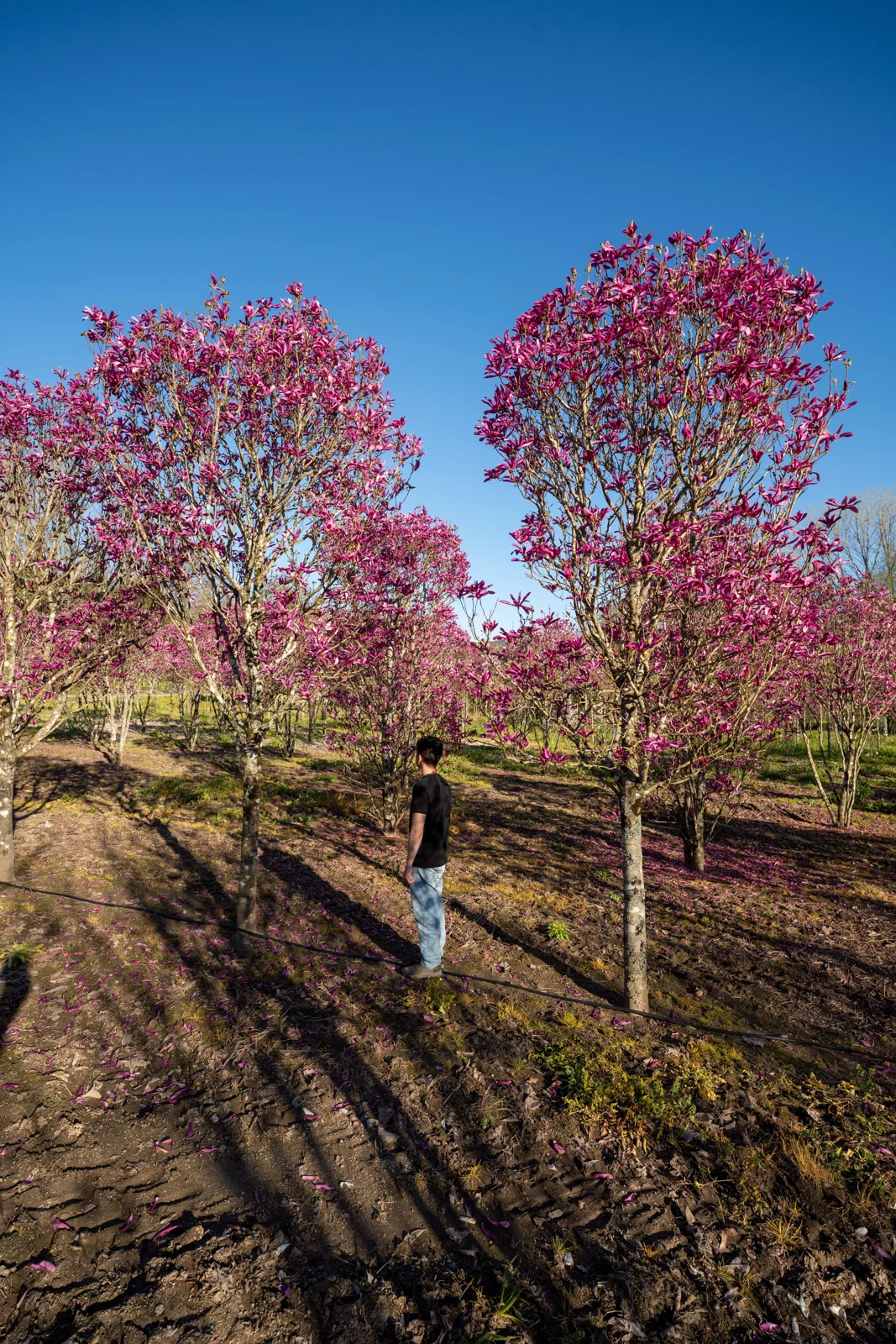
Magnolia susanMagnolia 'Susan'
A large shrub or small tree of contained size, Magnolia 'Susan' answers design situations that call for spring floral impact in a limited space, without the problems of scale and sensitivity to late frost that constrain M. x soulangeana.
- Goblet-shaped flowers of intense pinkish purple, paler inside
- Late flowering between mid-April and early May, once the frosts have passed
- Mild citrus scent that can be noticed at close range
About this species
Magnolia 'Susan' is a hybrid raised at the United States National Arboretum in the 1950s, the result of a cross between M. liliiflora 'Nigra' and M. stellata 'Rosea'. It belongs to the Little Girl series, whose main technical advance is that flowering is delayed by two to four weeks relative to M. stellata and M. x soulangeana. This gap significantly reduces…Read moreShow less
Magnolia 'Susan' is a hybrid raised at the United States National Arboretum in the 1950s, the result of a cross between M. liliiflora 'Nigra' and M. stellata 'Rosea'. It belongs to the Little Girl series, whose main technical advance is that flowering is delayed by two to four weeks relative to M. stellata and M. x soulangeana. This gap significantly reduces the risk of the flowers being destroyed by the late frosts of March and early April, a frequent problem in the magnolias most common in Portuguese gardens and public spaces.
It reaches 3 to 5 metres in height with a similar spread, with a rounded and often multi-stem habit. Growth is slow, not exceeding 20 to 30 cm a year in favourable conditions. The dense crown and short stem allow it to be used in inner courtyards, small squares, formal institutional gardens and structural planting beds where M. x soulangeana would become excessive in scale after a decade.
The flowers, goblet-shaped with six slightly twisted tepals, open in shades of fuchsia to pinkish purple between mid-April and May, with a paler inner face. They have a subtle citrus fragrance. In favourable conditions a sporadic second flowering may occur in summer. The deciduous, dark green foliage turns to coppery-yellow tones in autumn, extending the seasonal interest.
It requires acidic to neutral, well-drained soil with plenty of organic matter incorporated. It does not tolerate chalky soils, which limits its use on the compact limestones of Lisbon and the eastern Algarve unless the substrate in the tree pit is corrected. The fleshy root system is sensitive to damage during transplanting; once established, the plant should not be moved. It tolerates full sun or partial shade, and benefits from protection against strong winds. It withstands minimum temperatures of around -30 °C, so winter cold is not a limitation anywhere in mainland Portugal. Tolerance of summer water stress is moderate, and it needs supplementary watering in the dry months throughout the south and interior of the country.
In plant-health terms, it has good general resistance, with no serious problems documented. Susceptibility to powdery mildew can give the foliage an untidy look in late summer, but does not compromise the viability of the plant. In a project, it is positioned as a compact alternative to M. x soulangeana in spaces where the scale of the latter is incompatible with the brief, while keeping the same ornamental register of a deciduous, spring-flowering magnolia.
Advice on this species
Want to know more about Magnolia susan?
Tell us about your project and we will advise on this species — where it does well, what size makes sense and what to expect once it is planted.
- Own production
- Mature specimens
- Reply within 1–2 days
No obligation · tailored quote