

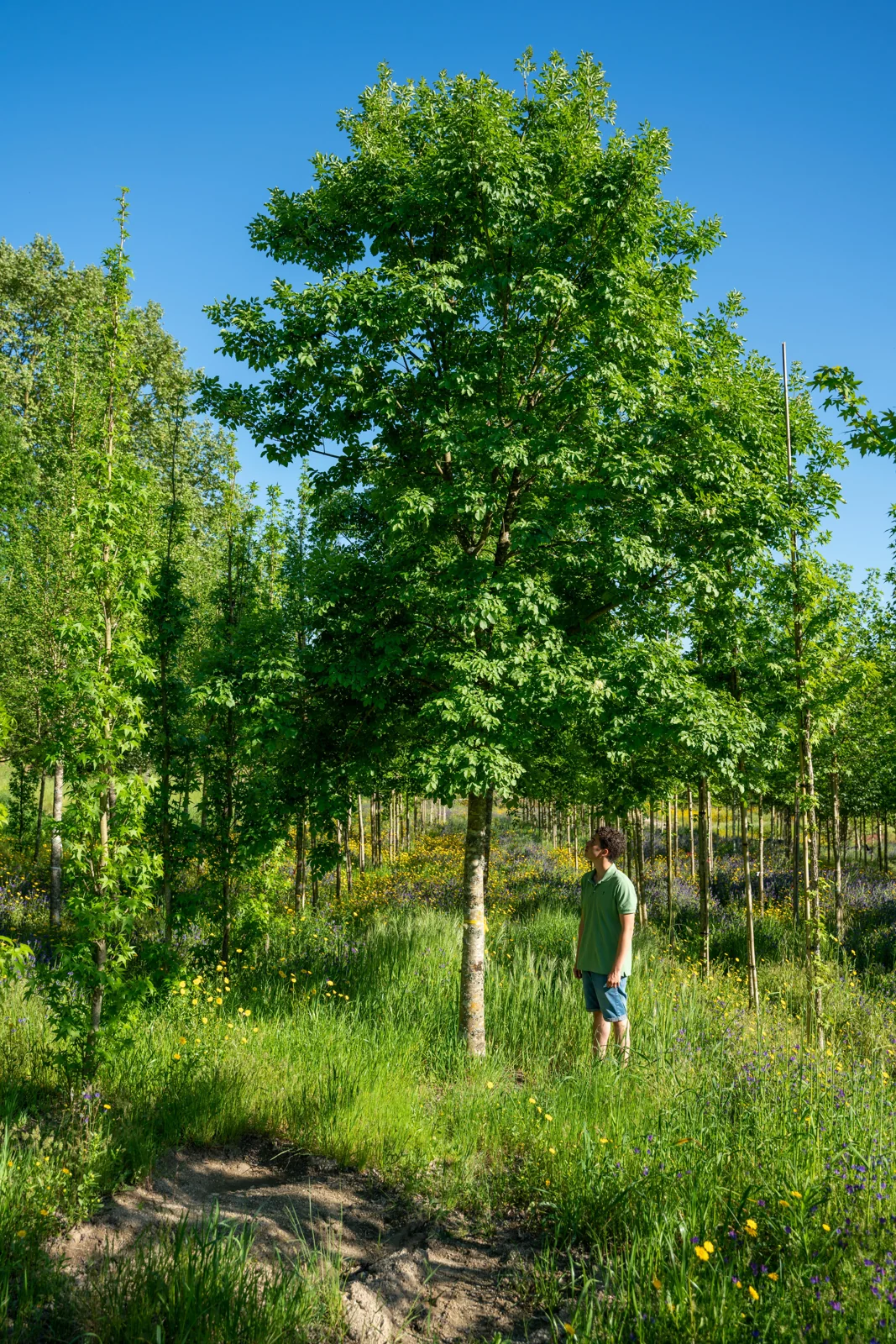
Fraxinus ornusManna ash
An ash that differs from other ashes in the abundant, scented white flowering that covers the crown in late spring. Its light, Mediterranean character combines the ornamental value of a flowering tree with the robustness needed for urban spaces and gardens exposed to heat.
- Creamy-white terminal panicles, intensely scented and opening after the foliage
- Sap traditionally collected to produce ‘manna’, an exudate naturally rich in mannitol
- An unusual combination of ornamental flowering, drought tolerance and adaptation to chalky soils
About this species
Fraxinus ornus, known as flowering ash or manna ash, is a deciduous tree native to central and southern Europe and western Asia. It has a more contained, ornamental growth than the large forest ashes, generally reaching 8 to 15 metres in height and 8 to 12 metres in width. The crown develops from oval to rounded, with irregular, relatively open branching that filters the light without creating an excessively heavy mass.Read moreShow less
Fraxinus ornus, known as flowering ash or manna ash, is a deciduous tree native to central and southern Europe and western Asia. It has a more contained, ornamental growth than the large forest ashes, generally reaching 8 to 15 metres in height and 8 to 12 metres in width. The crown develops from oval to rounded, with irregular, relatively open branching that filters the light without creating an excessively heavy mass.
The leaves are opposite and compound, normally made up of seven finely serrated leaflets. The foliage is a matt green, sometimes slightly bluish, and takes on yellow tones in autumn. The brown to purplish buds, covered in a grey velvety texture, make it possible to tell it apart from Fraxinus excelsior even before bud burst. The bark stays smooth and grey for many years, reinforcing the clean appearance of the formed trunks.
The flowering is the main distinguishing feature of the species. In May or June, after the leaves have appeared, the branch tips are covered in large upright panicles, formed of numerous creamy-white flowers with narrow petals. The whole produces a light, almost feathery appearance and gives off an intense scent. Unlike the discreet, predominantly wind-pollinated flowering of many ashes, the flowers of Fraxinus ornus are visually expressive and visited by insects.
After flowering, clusters of narrow, winged samaras form, known as ‘keys’, which extend the texture of the crown through the summer. The name manna ash relates to the sugary sap that can be obtained through incisions in the trunk during hot, dry periods. As it crystallises, this exudate forms the traditional ‘manna’, naturally rich in mannitol and historically produced mainly in the Mediterranean region.
It prefers full sun and well-drained, neutral to alkaline soils, performing particularly well on chalky ground. Once established, it withstands heat, dry periods, wind, air pollution and the proximity of paving. This combination allows it to be used where a flowering tree is wanted with greater tolerance of Mediterranean conditions than species associated with permanently moist soils. During the establishment of mature specimens, deep watering remains essential to restore the root system.
In the face of ash dieback caused by Hymenoscyphus fraxineus, Fraxinus ornus has shown comparatively more tolerant behaviour than Fraxinus excelsior, with infections observed that are mostly limited to the foliage. This difference adds to its interest for diversifying tree planting, although it should not be interpreted as immunity.
It is suitable for parks, squares, car parks, streets, Mediterranean gardens and large estates, working as a single specimen, an avenue tree or a transitional element between a formal composition and a more naturalistic planting. A mature specimen from Diaplant immediately brings a balanced crown, an already defined trunk structure and a quantity of flowering wood able to produce a white, scented display from the first seasons after planting.
Advice on this species
Want to know more about Fraxinus ornus?
Tell us about your project and we will advise on this species — where it does well, what size makes sense and what to expect once it is planted.
- Own production
- Mature specimens
- Reply within 1–2 days
No obligation · tailored quote