

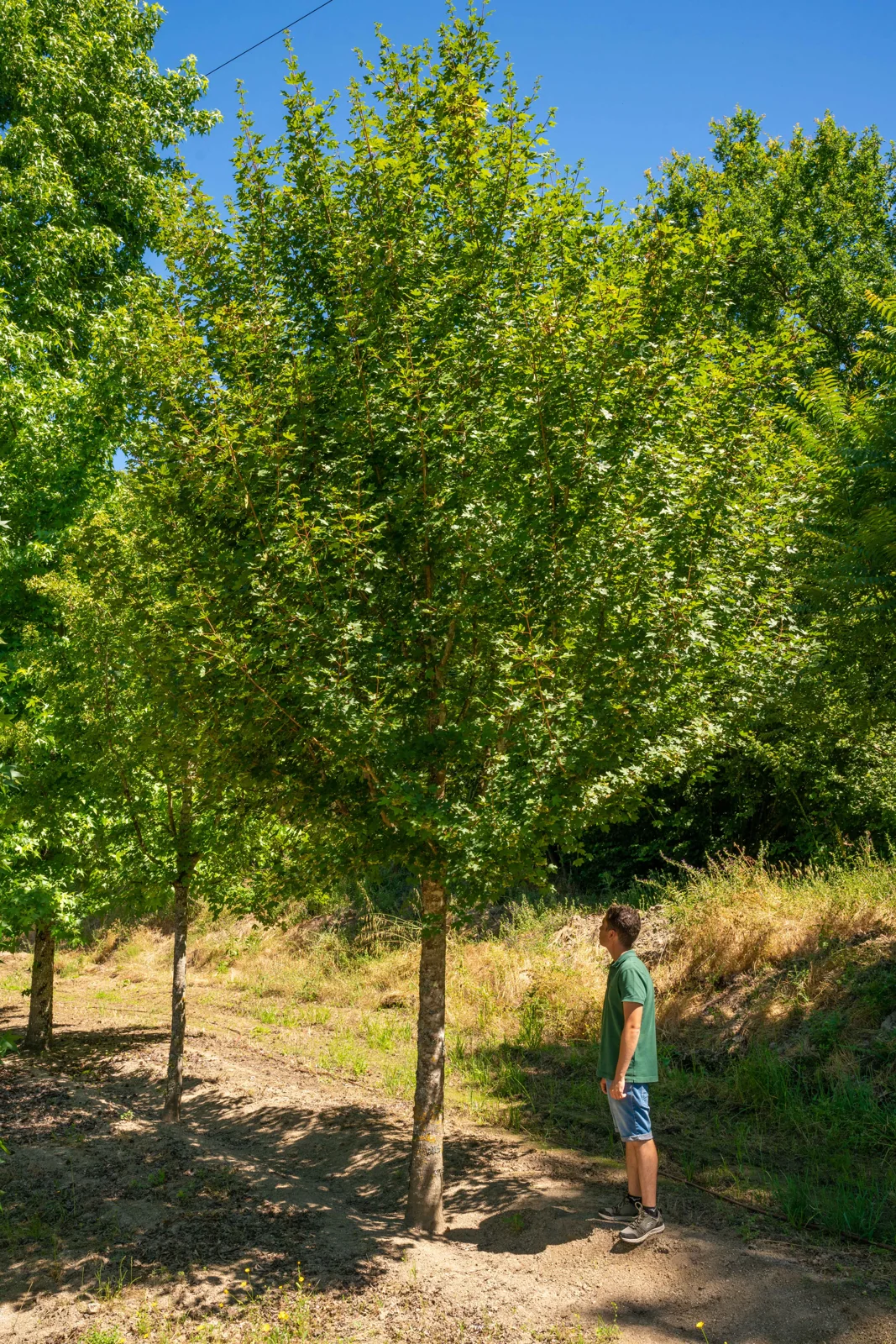
Acer campestre 'Elsrijk'Field maple
A selection of field maple, it is distinguished by a crown that is narrower, more regular and more densely closed than the common form of the species. The combination of predictable architecture, tolerance of paving and high urban resilience has made it a European benchmark for street planting.
- Densely branched crown, oval to broadly conical, more regular than the species
- Highly adaptable to paving, wind, urban conditions and de-icing salt
- Foliage with low susceptibility to powdery mildew, ending in golden-yellow autumn colour
About Acer campestre
‘Elsrijk’ was selected by C. P. Broerse at the municipal nursery of Amstelveen, in the Netherlands, in 1953. It forms a tree about 10 to 12 metres tall and 6 to 8 metres wide, oval at first and progressively more conical and broad.Read moreShow less
‘Elsrijk’ was selected by C. P. Broerse at the municipal nursery of Amstelveen, in the Netherlands, in 1953. It forms a tree about 10 to 12 metres tall and 6 to 8 metres wide, oval at first and progressively more conical and broad.
The leaves, with three to five lobes, are smaller than those of the species, forming a dark green, compact and uniform surface. In autumn, the crown turns into a golden-yellow mass that often persists for several weeks. Small yellowish-green flowers appear in May, followed by the characteristic samaras borne in pairs.
The cultivar develops a strongly branched root system with numerous fine roots, and adapts well to the proximity of paving when it has an adequate volume of soil. Its resistance to wind, frost, urban pollution and de-icing salt reinforces its use as an avenue tree. Its low susceptibility to powdery mildew helps keep the foliage clean through the summer.
It grows in sun or partial shade and accepts clay, loam or sandy soils, acidic to chalky, provided they are not both very poor and excessively dry. Once established, it tolerates heat and periods of moderate drought. Deep watering during the first years remains decisive in forming a balanced crown.
It is particularly suited to narrow streets, avenues, car parks, industrial areas and avenue plantings where formal repetition and predictable behaviour are needed. A mature specimen from Diaplant immediately brings a well-defined trunk and a dense crown, making it possible to establish from the outset the rhythm of the avenue planting, the urban scale and functional shade.
Advice on this species
Want to know more about Acer campestre 'Elsrijk'?
Tell us about your project and we will advise on this species — where it does well, what size makes sense and what to expect once it is planted.
- Own production
- Mature specimens
- Reply within 1–2 days
No obligation · tailored quote