

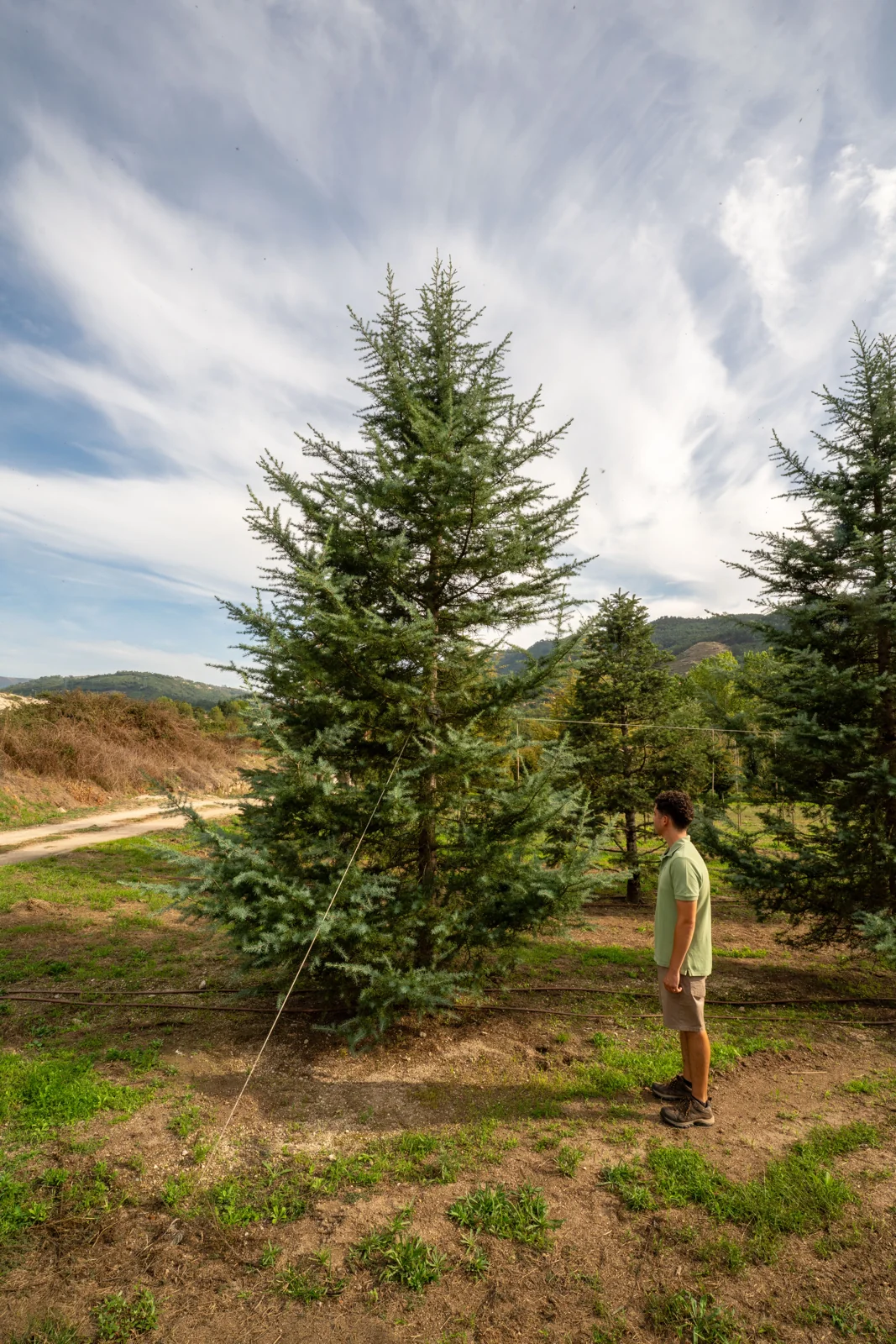
Cedrus deodaraDeodar cedar
A large evergreen conifer, it stands out for its extraordinary grey-blue to silvery-blue foliage and for its progressively broad, layered architecture. The crown, pyramidal at first, becomes more open and sculptural with age, giving mature specimens a monumental presence.
- Needles of intense grey-blue to silvery-blue colour
- Main branches arranged in broad horizontal tiers
- Evergreen silhouette of strong architectural expression all year round
About this species
It has a dominant central leader and a conical crown when young, formed by ascending branches densely clothed in foliage. With age, the main branches extend horizontally and the crown becomes broader, more open and irregular, acquiring a monumental architecture. It can reach approximately 15 to 20 metres in height and 8 to 12 metres in spread, occasionally more in favourable conditions.Read moreShow less
It has a dominant central leader and a conical crown when young, formed by ascending branches densely clothed in foliage. With age, the main branches extend horizontally and the crown becomes broader, more open and irregular, acquiring a monumental architecture. It can reach approximately 15 to 20 metres in height and 8 to 12 metres in spread, occasionally more in favourable conditions.
The needles are stiff, relatively short and grouped in dense tufts along the branches. The colour varies between grey-blue and silvery blue, generally more intense on the young shoots and in bright positions. This cool tone makes it possible to create strong contrasts with green, golden or reddish foliage.
The female cones develop upright on the upper branches. They are green or purplish at first and turn brown as they mature, breaking up while still on the tree to release the seeds. On mature specimens, these cones add to the botanical interest and the characteristic identity of the genus Cedrus.
It grows best in full sun and in deep, well-drained soils, adapting to different textures and pH values. Once established, it shows good resistance to cold, summer heat and periods of drought. It needs space to keep its lower branches and fully express its architecture, and is suited to parks, large gardens, monumental entrances, lawns and extensive green areas.
Mature specimens from Diaplant immediately bring a scale and presence that this conifer would take decades to reach. The established trunk, the already defined tiers of branching and the extensive mass of blue foliage turn each tree into a permanent focal point, capable of structuring the whole surrounding space.
Advice on this species
Want to know more about Cedrus deodara?
Tell us about your project and we will advise on this species — where it does well, what size makes sense and what to expect once it is planted.
- Own production
- Mature specimens
- Reply within 1–2 days
No obligation · tailored quote