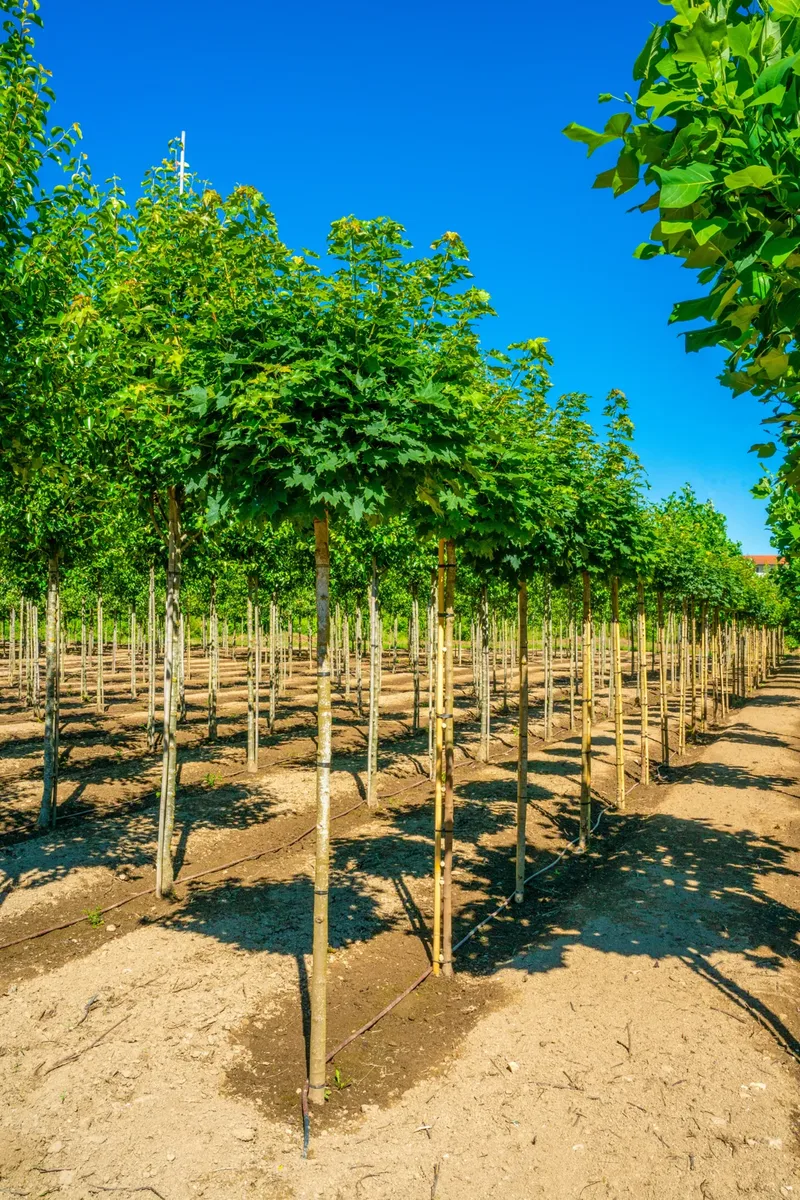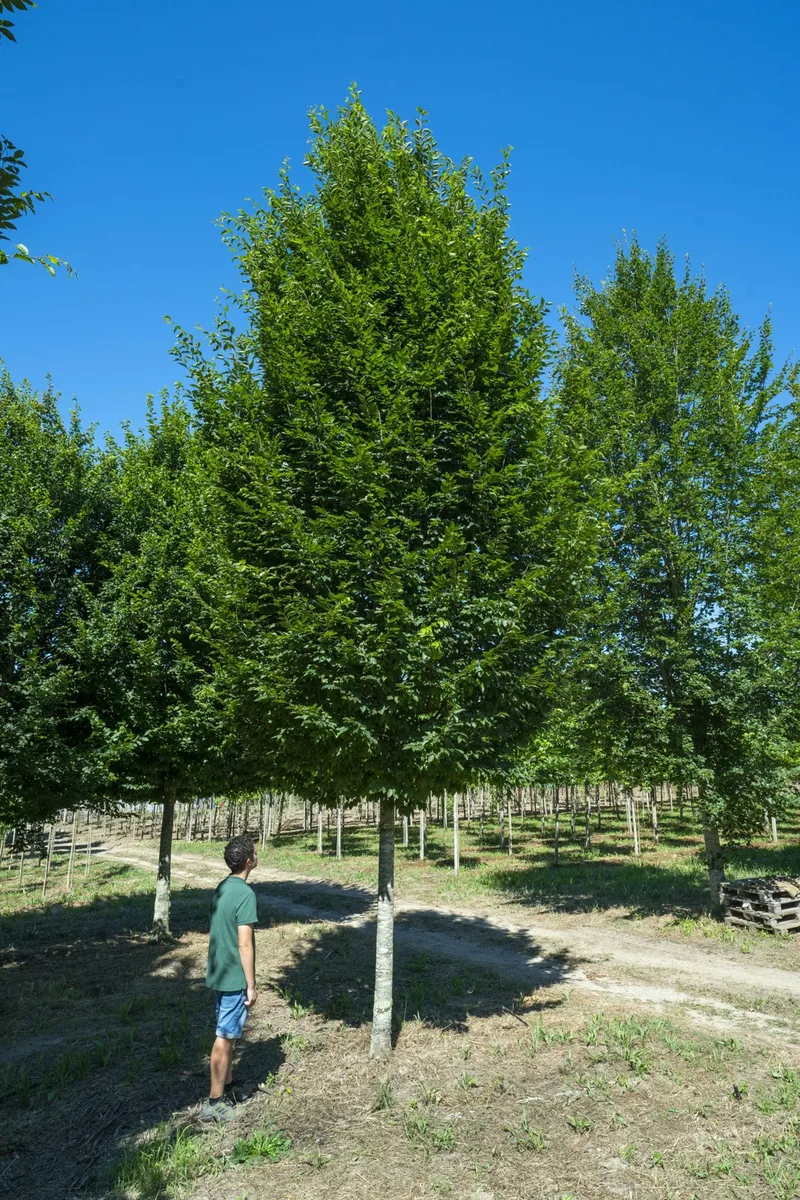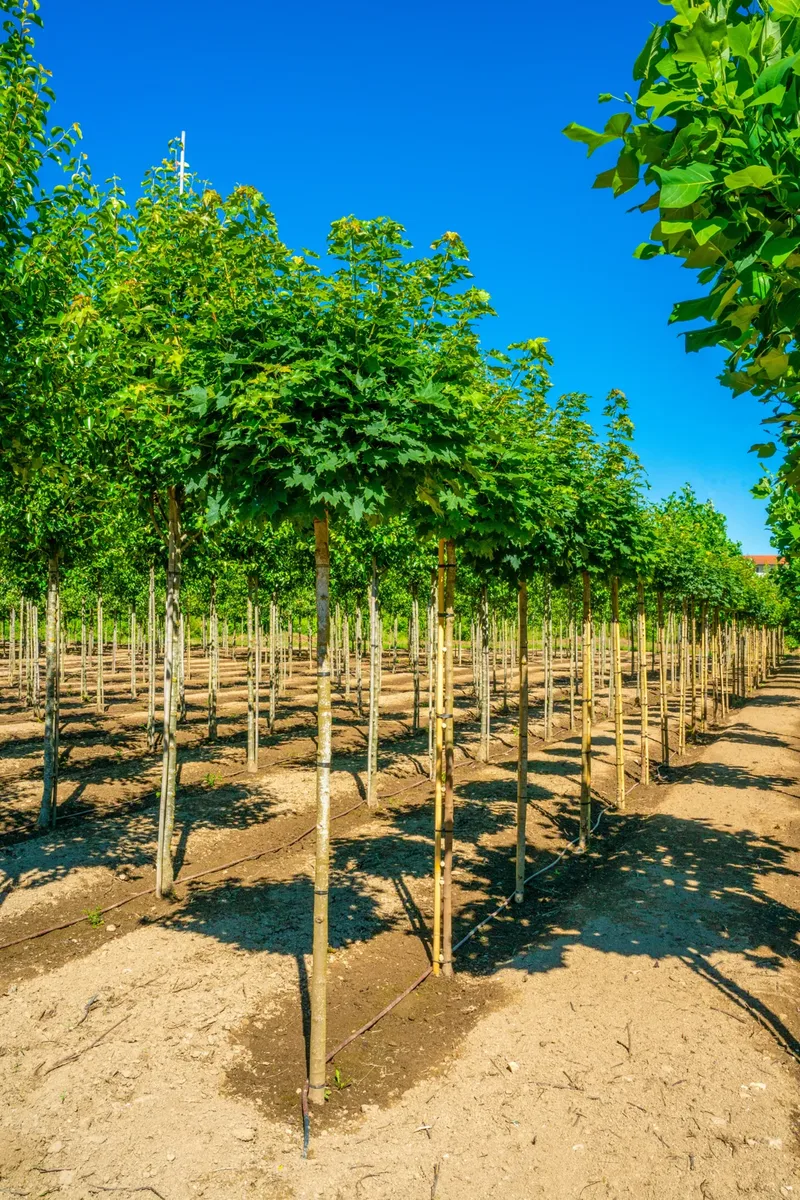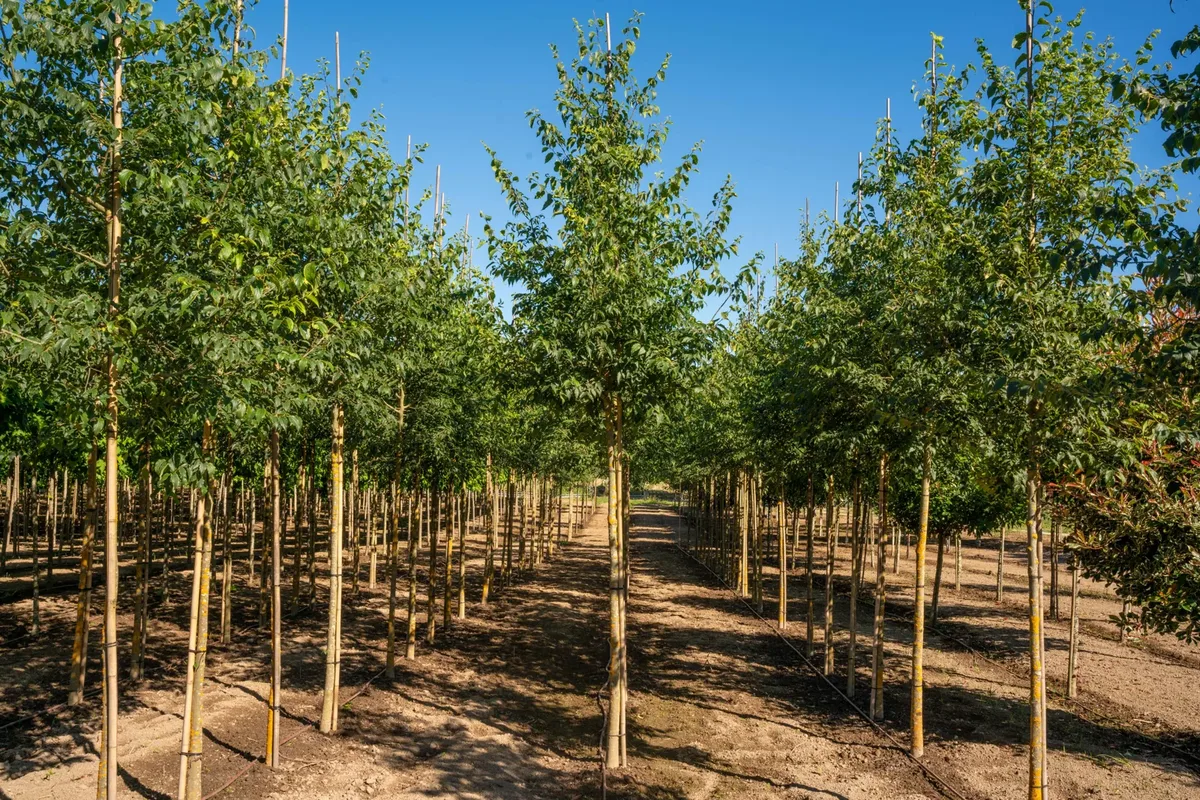
Celtis australis in a plot, Diaplant nursery.
The quality of a mature tree depends on the roots, the rootball, the trunk, the crown and its suitability for the project. Find out what should be looked at.
The quality of a mature tree cannot be confirmed by height, trunk girth or crown density alone.
You need to look at the roots, the rootball, the root collar, the trunk and the structure above ground. It also matters to know the production history and to understand whether the specimen suits the project. A tree can be of good nursery quality and still not suit the place where it is to be planted.
The assessment starts with the technical sheet, but it should end with looking at the real tree.
Measurements do not show the whole specimen
Height and girth give a frame for the size. Crown width helps to predict the immediate effect and the space needed. For container-grown plants, the volume of the container gives an indication of the scale of production.
None of these measurements describes the distribution of the branches or the quality of the roots.
Two trees with a girth of 30–35 cm can have different crowns, rootballs and degrees of maturity. One may have a balanced structure; the other may concentrate much of its weight on one side. The same goes for the roots, which are not visible in a general photograph.
Measurements are needed to specify, transport and price. They should not be confused with a complete quality grading.
Production history
A mature tree should have a history that matches its size.
With field production, it matters to know whether it was transplanted during the cycle and whether it had time to recover between operations. Transplanting helps to concentrate roots near the trunk and prepares the future rootball.
At Diaplant, the trees in the mature range spend at least six years in our fields and are transplanted at least twice. The number should not be read in isolation. The species, the interval and the tree’s response are just as important.
The formation of the crown is also assessed. A tree that reached its size quickly, without structural follow-up, may need corrections that should already have been made when the branches were smaller.
The base of the trunk and the root collar
The root collar is the transition zone between the trunk and the main roots. It should be identifiable and lie close to the soil surface.
When it is buried by a build-up of soil or substrate, it becomes harder to assess the structure of the base and to set the correct planting level. Roots circling next to the trunk can also go unnoticed.
On a field-grown tree, the surface of the rootball does not always coincide exactly with the root collar. The position needs to be confirmed before the specimen is planted.
The base should show a natural transition to the structural roots. Changes, wounds or constrictions are analysed in the context of the species and the plant’s history.
The rootball
In a good-quality rootball, soil and roots stay cohesive during lifting, transport and planting.
Its size should suit the size of the tree and the species. A very small rootball may hold little functional root; a larger rootball is not necessarily better if it is poorly rooted or cannot be transported safely.
The team checks cohesion, moisture, the presence of fine roots and the integrity of the wrapping. The hessian and the mesh should do their job of holding the volume together without damaging the trunk.
Weight and geometry also have implications for the project. Technical quality includes being able to lift, transport and place the tree without destroying the rootball.
The root system in a container
For container-grown trees, the inspection has other critical points.
The mass of substrate should be rooted enough to hold together, but the plant should not have stayed in the container so long that the roots form circles, kinks or an excessive concentration at the edge.
The root collar needs to be visible and the roots should spread outwards from the base. When there are roots going round the trunk or growing downwards in a compact mass, establishment in the soil can be compromised.
A vigorous crown does not allow you to conclude that the roots are well formed. The container has to be inspected directly whenever possible.
The trunk
The trunk should have a form that fits the species and the type of tree.
On a standard tree, the taper, the continuity of the leader and the crown height are looked at. On multi-stems, the way the several stems are set and their structural relationship are assessed.
Pruning wounds, staking marks or transport injuries are not all equally important. What matters is the size, the location, how they are developing and the capacity to compartmentalise. A small wound that is recovering is different from an extensive injury or damage near the base.
On grafted trees, the graft union should be consolidated and show compatibility between the rootstock and the cultivar.
The crown
A good-quality crown does not have to be perfectly symmetrical.
What it should have is a distribution of branches consistent with the form and the intended use. The team looks at the continuity of the leader where it is needed, and at competing branches, crossings, weak unions and imbalances of weight.
Density is interpreted according to the species. A naturally open crown should not be penalised for not looking compact. The same principle applies to weeping, columnar or irregular habits.
Orientation is also considered. A tree with a crown more developed on one side can be very suitable if that side is turned towards the area where shade or framing is wanted.
Vigour and maturity
Strong growth is generally a positive sign, but it is not enough.
A tree that is excessively vigorous after many years in the same plot may be too settled, with much of its root system outside the zone of the future rootball. It may need to be transplanted again before it leaves.
Reduced growth can also be read in several ways. It may be the result of a slow species, recent recovery, field conditions or a physiological problem.
The assessment compares the vigour observed with the expected behaviour and with the tree’s history. Maturity refers to the consolidation of the whole and not just to age.
Health and visible signs
Leaves, branches, trunk and soil are looked at before selection.
Discolouration, leaf loss, necrosis, exudations, cankers, rots or the presence of organisms need to be interpreted. Not every symptom rules the tree out, but none should be ignored.
The time of observation influences the reading. During dormancy, the structure of the crown is more visible in deciduous species. In the growing season, it is easier to assess density, colour and response to heat.
When the choice is made outside the season in which a given attribute shows itself, the photographic history can complete the assessment.
Individual quality and uniformity of the batch
In an avenue planting or a formal composition, quality includes the relationship between the trees.
Crown heights, girth size, form and vigour should be close enough to produce continuity. The specimens do not need to be identical, but strong differences can become more obvious after planting.
In a garden, the opposite may be wanted. A tree with a singular form can be the focal point of the composition.
The criterion depends on the project. A specimen should not be rejected for lack of uniformity when its individuality is precisely what is being sought.
Suitability for the place
A technically well-grown tree can be the wrong choice.
The crown may be too wide for the space, the species may not tolerate the drainage of the ground or the rootball may exceed the capacity of the access routes. There may also be incompatibility with paving, buildings, wind or water availability.
The quality assessment ends with this question: does the specimen have the conditions to go on developing in the intended place?
This analysis includes the tree and the project. Separating the two parts reduces the choice to a comparison of measurements.
The advantage of selecting at the nursery
In the field, you can see the specimen from several angles, compare trees of the same species and confirm the real scale.
The visit lets you see differences that do not appear in a list: direction of the crown, texture of the branching, relationship between trunk and volume, singularity and compatibility between trees in a batch.
It also makes it possible to discuss logistics and prepare the future orientation. A tree can be marked according to the side that should face the view, the façade or the seating area.
Selecting specimens
The Diaplant team supports the technical and visual selection of trees, relating nursery quality to the conditions of the project.
Book a visit to the nursery Discover the production
Related content
- When is a tree ready to leave the field?
- How to choose a specimen at full scale in the nursery
- Girth, girth size, height and pot volume
- How to choose the right tree for each place
Sources and supporting references
- European Arboricultural Standards (2022). European Tree Planting Standard.
- European Arboricultural Standards (2025). European Tree Pruning Standard, February 2025 version.
- Watson, G. W.; Sydnor, T. D. (1987). “The Effect of Root Pruning on the Root System of Nursery Trees”. Journal of Arboriculture, 13(5), 126–130. DOI: 10.48044/jauf.1987.027.
- Allen, K. S. et al. (2017). “A Review of Nursery Production Systems and Their Influence on Urban Tree Survival”. Urban Forestry & Urban Greening, 21, 183–191. DOI: 10.1016/j.ufug.2016.12.002.
Tags