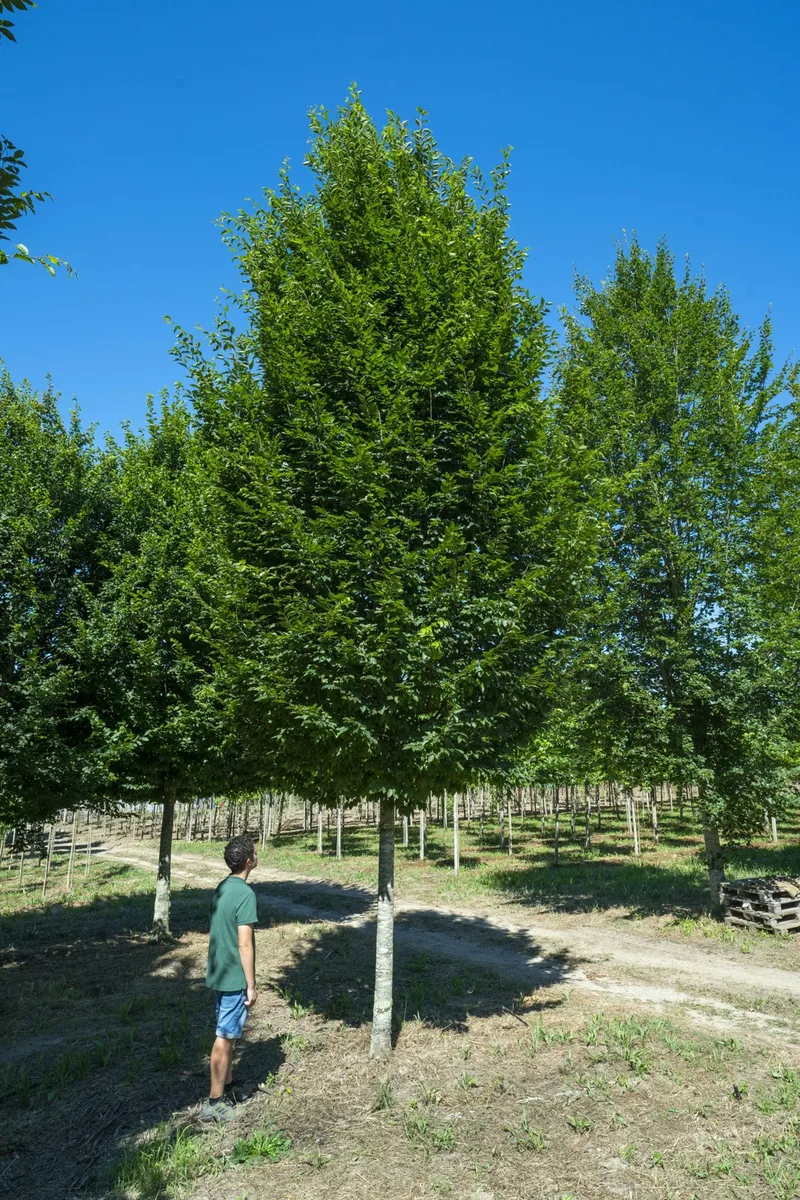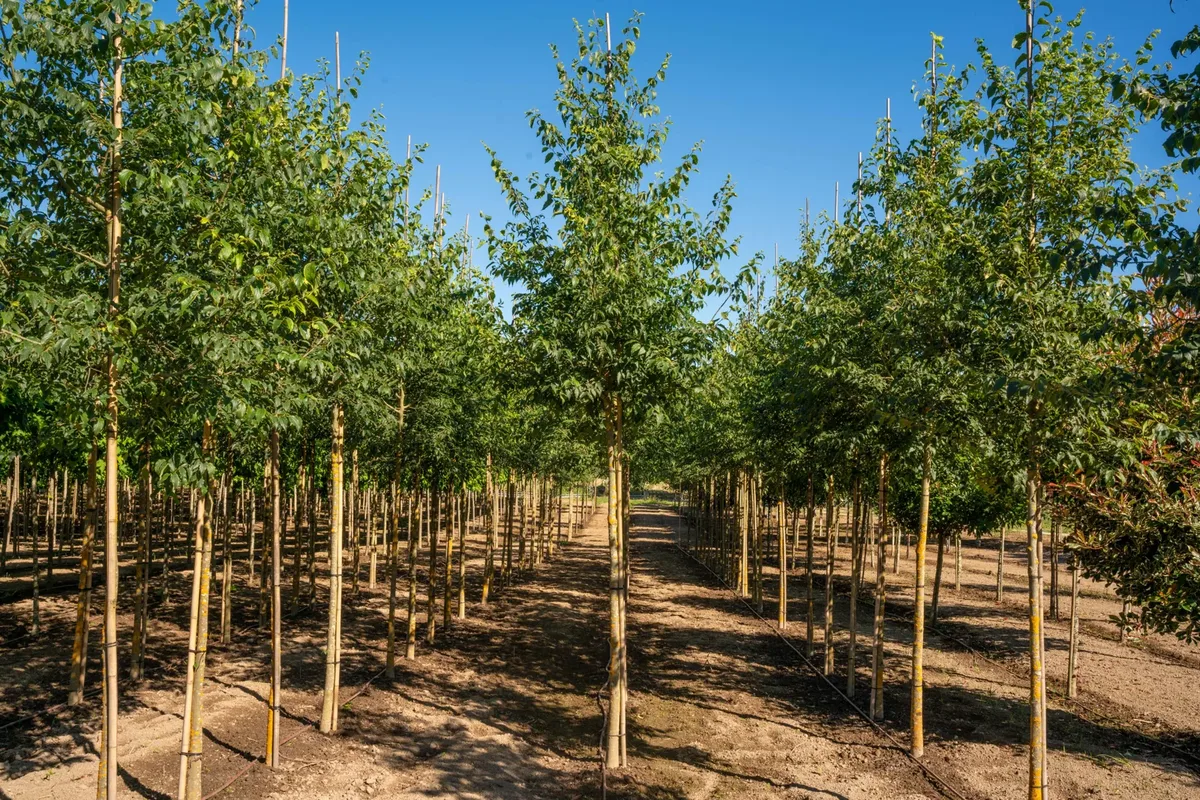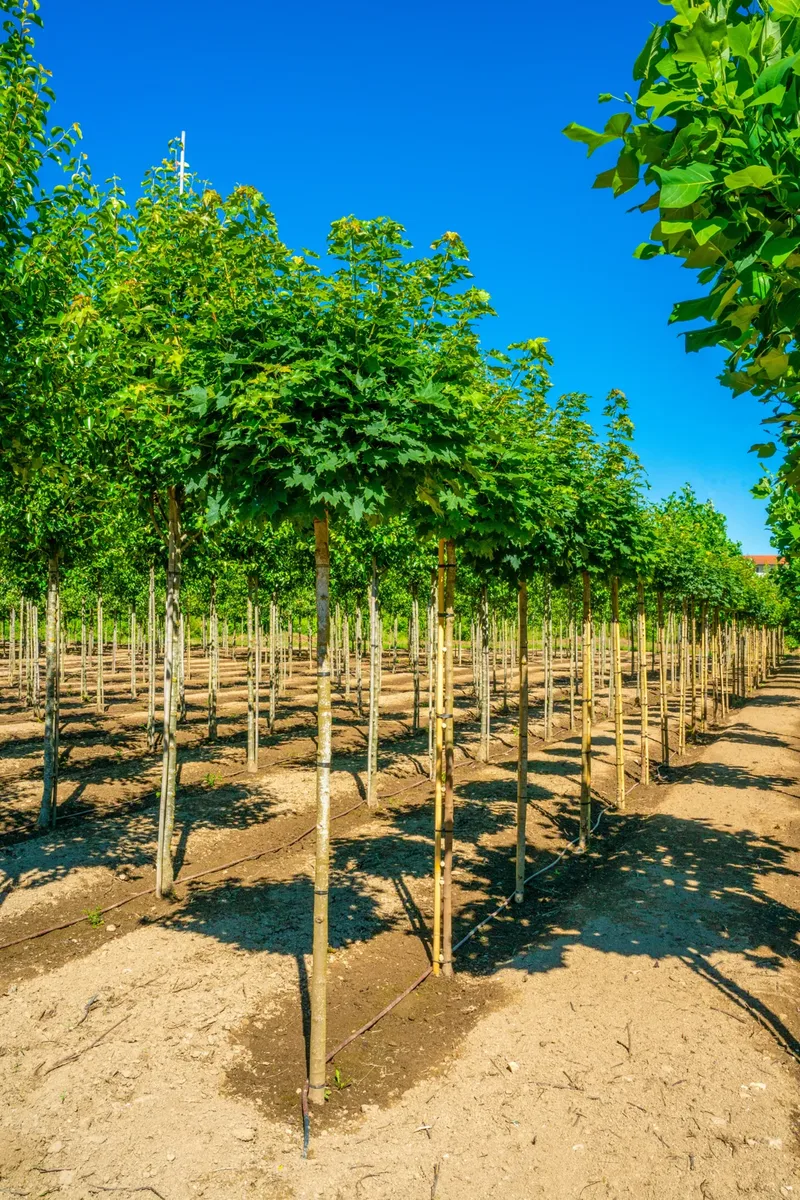
Production plot, Diaplant nursery.
A mature tree is formed over years of production, transplanting, pruning and selection. Discover the work done in the nursery before planting.
When we look at a mature tree in the nursery, the first thing we see is its size. The height, the trunk, the crown spread and the presence it already has. But that is only the most obvious part of the process.
A mature tree is formed over several years. In that time it is transplanted, pruned, observed and, often, kept in the field for longer than first planned. The aim is not simply to make it grow. It is to make sure the root system is ready to go with the future rootball, that the crown gains a balanced structure and that the specimen can be transported and planted without losing the quality built up in the nursery.
At Diaplant, the trees in the mature range spend at least six years in the company’s fields and are transplanted at least twice. In the most mature batches, the cycle can, as a general rule, reach five transplantings over 15 to 20 years of production. Sales begin, on average, from ten years of age, but each species and each specimen takes the time it needs.
Size is not enough to judge a tree
Two trees of the same species can have the same height and the same girth and still show important differences.
One may have a well-distributed crown, a well-formed trunk and a densely rooted rootball. The other may have grown fast, but without the same preparation. Age does not settle the difference either. A tree can be many years old and never have had the training it needs.
So when we talk about mature trees, we are not using a rigid botanical category. We are assessing the specimen as a nursery plant and as an element of a project. What interests us is maturity, proportion, root preparation, crown structure and the way the tree is likely to respond after planting.
It is this reading of the whole that determines whether a specimen is ready.
The work starts long before the sale
Producing mature trees means taking decisions many years ahead.
Choosing the species and cultivar is only the beginning. We also need to understand what form is to be developed and what kind of use the tree may eventually serve. A tree for avenue planting is not formed in the same way as a parkland tree. A multi-stem calls for a different reading from a standard tree, and a low, natural crown does not follow the same path as a tree prepared to leave clear passage underneath.
In practice, the team follows the architecture natural to each species and intervenes only where necessary. Imbalances are corrected, badly placed branches are removed and the structure is guided. The aim is not to make every tree the same. It is to avoid problems that would later require bigger cuts or compromise the form of the specimen.
Growing in the open field
Diaplant grows most of its trees in the open field.
The trees grow directly in the soil and are exposed to the natural conditions of each season. This way of growing makes it possible to develop medium-sized and large specimens, but it calls for regular monitoring. A tree left too long in the same place can become too settled, send roots far beyond the zone of the future rootball or develop an unbalanced crown.
That is why growth is not judged on speed alone. A tree that grows a lot may look ready and yet not be prepared to leave the field. We look at vigour, structure, the response to previous pruning and the behaviour of the roots.
If the specimen is too settled, it may need transplanting again. If the crown has not yet reached the intended balance, it stays in production for longer. If the species has a naturally slower pace, we respect that time.
Preparing the root system
Much of the quality of a mature tree lies below ground.
When it grows freely, the tree sends roots beyond the volume that can be transported. At lifting, only part of that system goes with the specimen. To concentrate more roots within the area of the future rootball, we transplant the trees repeatedly within the nursery.
During transplanting, some of the longest roots are cut and the tree is replanted in another plot. In many species, that cut stimulates new roots to form closer to the trunk. That concentration is what we are looking for.
At Diaplant, two transplantings are the minimum preparation. In the most mature batches, the process can, as a general rule, reach five cycles, always at intervals adjusted to the species and to the tree’s recovery. Species with more delicate root systems or a tendency to develop taproots, such as several Quercus, call for shorter cycles. Liquidambar and Platanus, with more fibrous systems, normally allow longer intervals. Betula develop long roots quickly and lose a lot of moisture during transplanting. Magnolias are also sensitive to root cutting and need attention to the balance between the roots retained and the leaf density of the crown.
For that reason, there is no single calendar for all trees. The decision depends on the species, the size, the vigour and the way the specimen responded to the previous cycle.
Nor does transplanting more often mean, in itself, producing a better tree. The operation has to be done at the right time, at an appropriate size and with enough time for recovery.
Forming the crown
While the roots are being prepared, work continues on the top growth.
Formative pruning is used to guide the structure, correct crossing branches and reduce competition between branches. When these corrections are made early, bigger cuts are avoided later.
In a standard tree, it may be necessary to maintain the continuity of the central leader and set the height of the crown. In a parkland specimen, the aim is often to keep lower branches and a form close to natural development. In multi-stems, we assess the relationship between the various stems and the distribution of weight.
There are also trained forms, such as globe crowns, roof-trained trees, espaliers, balls, pyramids or macro-bonsai. In these cases, the work is more specific and continues over several cycles.
Pruning is always governed by the species and the objective. It is not a routine operation applied in the same way to every tree.
When is a tree ready?
The trees in the mature range spend at least six years in Diaplant’s fields. This period allows the basic formation to be completed, along with at least two transplanting cycles. Many of the most mature batches stay in the field for 15 to 20 years and can accumulate up to five transplantings.
Sales begin, on average, from ten years of age. Most of the range is between 15 and 20 years old, but age is only a guide.
Some specimens stay in the field longer because they do not yet meet the quality criteria set. The crown may need more balance, the trunk may not have the desired maturity or the tree may need a further cycle of root preparation.
The assessment is above all visual and technical. We look at the growth pattern, the crown structure, the quality of the trunk and the response to previous operations. If growth is too strong and the tree too settled in its plot, that can indicate it needs transplanting again.
Not all the trees in a batch are ready at the same time. The decision is made specimen by specimen.
Assessment before dispatch
Before a tree leaves the field, we assess the relationship between roots, trunk and crown.
In the rootball, we look for cohesion, the presence of fine roots and a size suited to the size of the tree and to the species. On the trunk, we look at soundness, taper, wounds and the quality of the graft, where there is one. In the crown, we assess the distribution of the branches, the vigour and how well the form suits its destination.
The project itself influences the selection. An avenue calls for greater uniformity between trees. In a private garden, it may make sense to choose a specimen with a more individual form. The tallest or widest tree is not always the most suitable.
The choice is made according to the place where the tree will go on growing.
Preparing for lifting and transport
Rootballed trees are preferably dispatched during dormancy. At Diaplant, the main season runs from November to April.
Lifting is done with a specialised machine and a blade sized to suit the tree and the root volume the species needs. On larger trees, especially when the rootball exceeds about 120 cm in diameter, an excavator may be needed.
After lifting, the rootball is firmed and wrapped in hessian and wire mesh from specialist suppliers. The materials Diaplant uses are certified as biodegradable, and the team forms the rootball so that it holds together during transport and planting.
The crown is tied in and the trunk may be protected with reused coffee sacks, cotton mesh, coir or other suitable materials. For large trees, the weight of the rootball, the access, the lifting equipment and the transport are studied before the tree leaves the field.
What changes in the project
A mature tree makes it possible to bring in scale, shade or privacy without waiting several years for the early growth. But it also demands more preparation.
Before choosing, you need to assess the future space for the crown, the soil volume available, the drainage, the access, the wind, the existing infrastructure and the equipment needed for unloading and planting.
A visit to the nursery matters because it lets you grasp dimensions that a photograph or a technical sheet does not show well. The crown spread, the direction of the branches, the proportion of the trunk and the character of each specimen are easier to judge in the field.
On larger projects, preparation can start years ahead. We can monitor batches, carry out additional transplantings, form specific crown heights or develop groups with uniform characteristics for avenues and formal compositions.
After planting
The tree still needs care once it is in the ground.
In its new position, the roots have to leave the rootball and occupy the surrounding soil. During this phase, watering, drainage and staking are decisive.
The first year is the most sensitive period. The second still calls for attention, especially during the hottest months. As the root system establishes, the tree becomes more self-sufficient, although it still depends on soil conditions, climate and maintenance.
Aftercare can include occasional visits and contact with the team to look at photographs or unusual symptoms. The tree’s maturity shortens the time needed to create presence in the space, but it does not remove the period of adaptation.
In summary
A mature tree is formed over several years and is the result of combined work on roots, trunk and crown.
At Diaplant, that process includes a minimum of six years of production in our fields, at least two transplantings in the nursery and sales, on average, from ten years of age. Much of the range is made up of specimens of around 15 to 20 years.
The numbers help to frame the process, but they do not replace individual assessment. Each tree is looked at in terms of its species, its structure and the project for which it may be selected.
Get to know the trees in the nursery
At Diaplant’s nurseries in Amarante, you can compare species, forms, maturities and sizes before choosing a specimen for your project.
Discover the nursery Book a visit to choose specimens
Related content
- Why we transplant trees within the nursery
- What a rootball is and why it matters in a mature tree
- Field-grown or container-grown: what changes?
- When is the best time to plant rootballed trees?
- Planting mature trees: from rootball to adaptation
- Nursery of mature trees and shrubs
Sources and supporting references
- European Arboricultural Standards. European Tree Planting Standard — quality criteria for plant material, root system, crown, rootball and frequency of transplanting.
- European Arboricultural Standards. European Tree Pruning Standard, 2nd edition, 2024 — desired architecture, structural pruning and formative pruning.
- Watson, G. W.; Sydnor, T. D. (1987). “The Effect of Root Pruning on the Root System of Nursery Trees”. Journal of Arboriculture, 13(5), 126–130. DOI: 10.48044/jauf.1987.027.
- Gilman, E. F.; Paz, M.; Harchick, C. (2016). “Effect of Liner Container Size, Root Ball Slicing, and Season of Root Pruning in a Field Nursery on Quercus virginiana Growth and Anchorage After Transplanting”. Arboriculture & Urban Forestry, 42(4), 234–245. DOI: 10.48044/jauf.2016.022.
- Levinsson, A. (2013). “Post-transplant Shoot Growth of Trees From Five Different Production Methods is Affected by Site and Species”. Arboriculture & Urban Forestry, 39(5).
- Gilman, E. F. (2001). “Effect of Nursery Production Method, Irrigation, and Inoculation with Mycorrhizae-Forming Fungi on Establishment of Quercus virginiana”. Arboriculture & Urban Forestry, 27(1). DOI: 10.48044/jauf.2001.005.
Tags