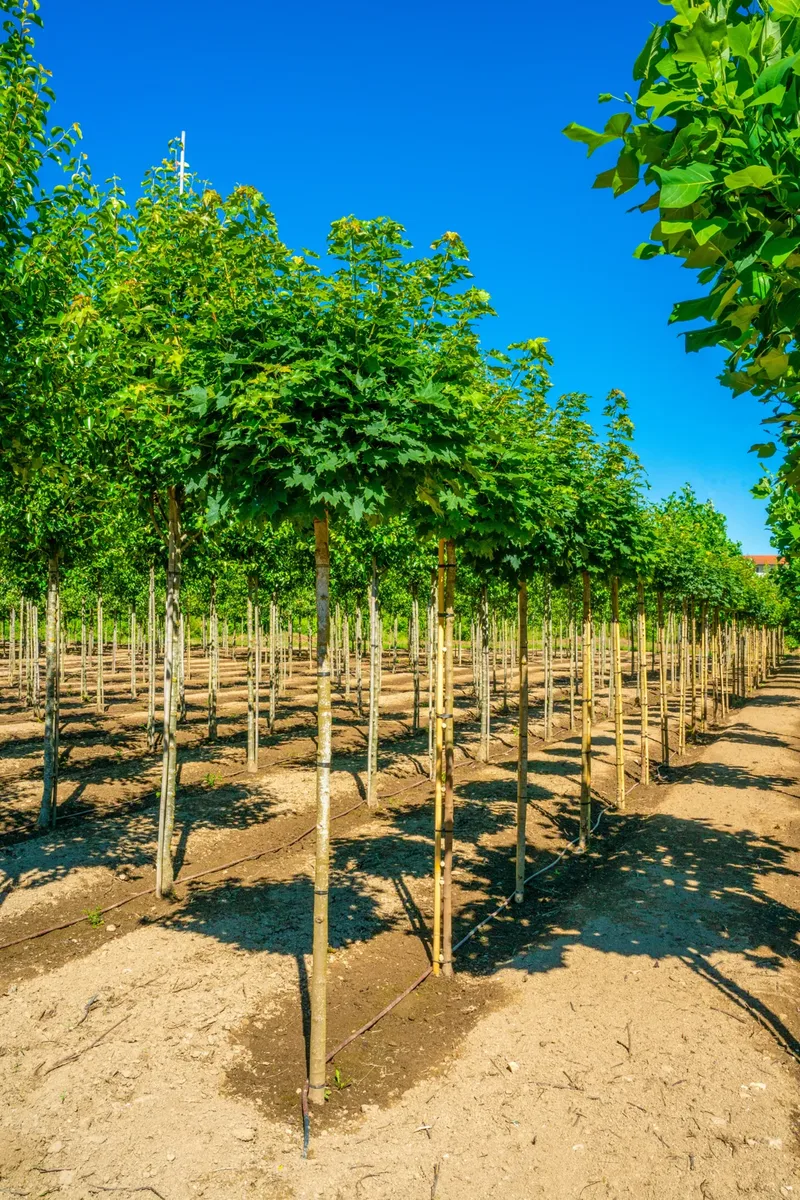
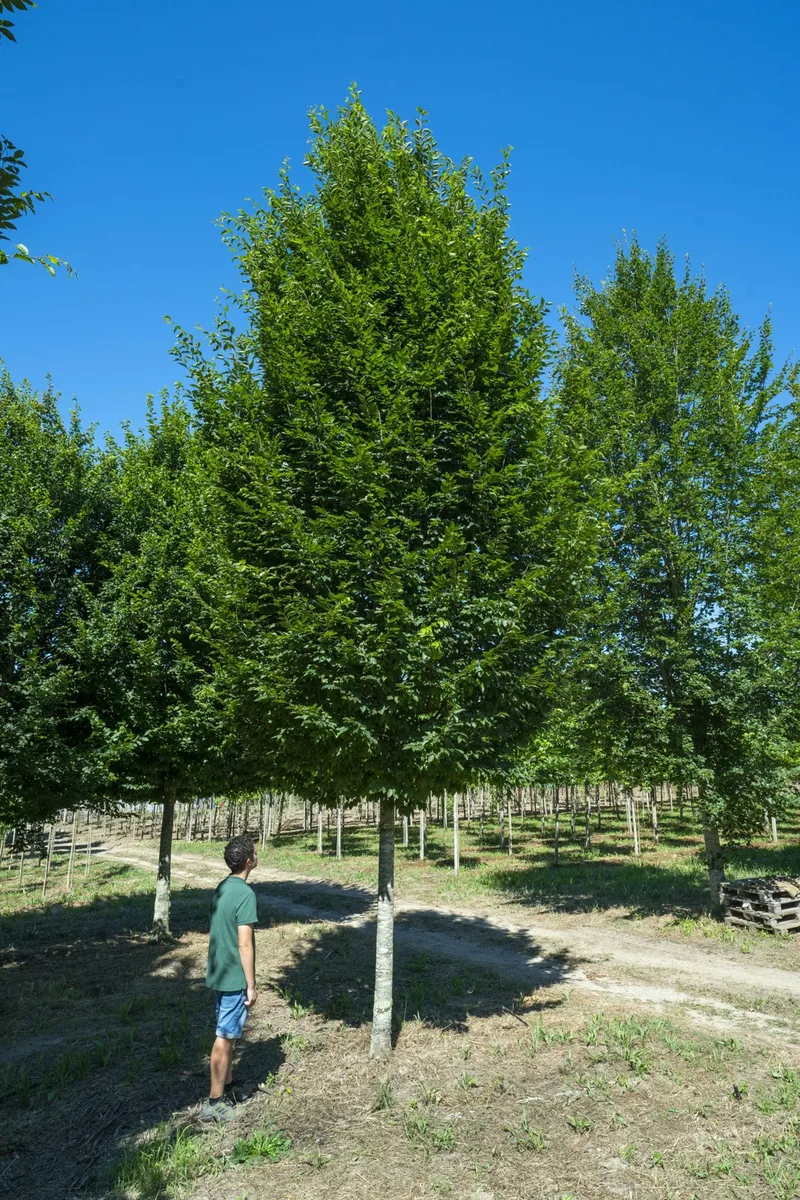
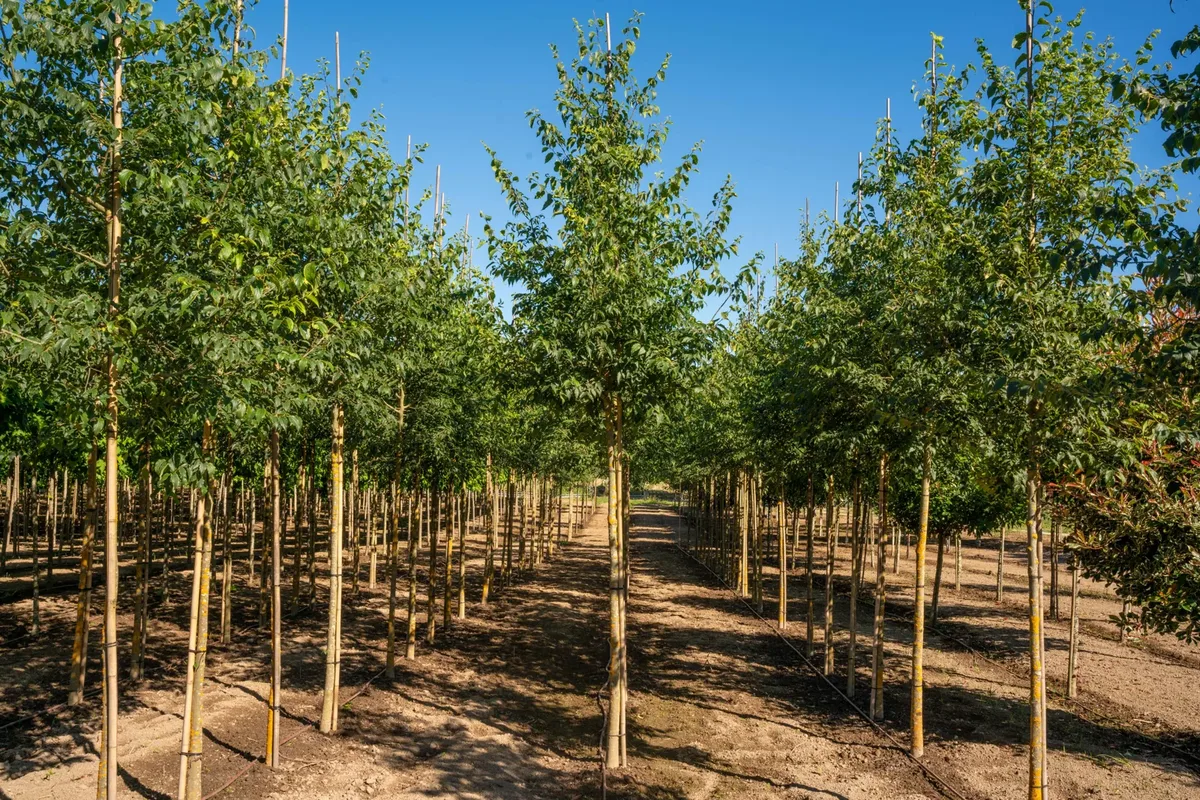
Transplanting in the nursery helps to concentrate roots in the area of the future rootball. We explain how the process is carried out and why it varies between species.
We transplant trees within the nursery to prepare the root system before the final lifting. When we move a tree to another plot, we cut some of the roots that have already grown away from the trunk and give it time to form new roots closer in. Those are the roots that should travel with the rootball when the specimen leaves the field.
At Diaplant, two transplants are the minimum. In the most mature batches, the process can generally run to five transplants, often over 15 to 20 years of production. The number and the interval vary a good deal. A Quercus, a Betula and a Liquidambar do not develop roots in the same way or recover at the same pace.
Not the final transplant to the garden
When people talk about transplanting a tree, they often think of moving it from one garden to another. In the nursery, the operation has a different purpose.
The tree is lifted from one plot and replanted in the field, where it stays in production. It is not yet being prepared for a client or for a particular site. It is completing one more stage of its formative cycle.
After the operation, it stays in the nursery for as long as it takes to recover, grow again and develop new roots. Only later will it be assessed for another transplant or for sale.
This difference matters because the final lifting should not be the first time a mature tree loses a significant part of the roots it has developed in the soil.
What happens to the roots
A field-grown tree extends its roots in search of water, oxygen and nutrients. Over the years, some of those roots travel a long way from the trunk and end up outside the volume of soil that can go with the tree in transport.
During transplanting, the machine cuts the roots at the edge of the working rootball and lifts the specimen. When the tree is planted again, the roots that were kept resume growth and branch anew close to the cuts.
By repeating this process over the years, we aim to keep more root within an area close to the trunk. The intention is not to confine the root system permanently, but to prepare a functional part of the roots to be included in the future rootball.
Fine roots play a particularly important part in taking up water and nutrients. The better they are distributed within the zone that will be transported, the greater the continuity between the work done in the nursery and the establishment phase at the destination.
The process is not immediate. After each transplant, the tree needs time to recover and re-establish. A further operation carried out too soon can interrupt that recovery; carried out too late, it can allow a large share of the roots to grow away again.
What the research tells us
The principle of root pruning has been known and studied for several decades.
In a trial published in 1987, carried out on Picea pungens of about two metres, trees whose roots had been pruned in the nursery five years before lifting had more root surface area inside the rootball than trees that had not received that operation. The study helps to explain the aim of the technique: to increase the proportion of root that goes with the tree.
The results should not, however, be applied directly to every species. Later studies show that the effect depends on the production system, the timing of pruning, the initial root architecture and the species used.
A study on Quercus virginiana, for example, found that root pruning influenced some root characteristics and reduced the percentage of root systems classed as inadequate, but did not change all the parameters assessed in the same way. Nor did the timing of the operation have a relevant effect on every result.
This is the variability we see in the field. The technique has a clear aim, but its execution cannot be reduced to a fixed frequency or to one measure that is the same for every tree.
The pace varies with the species
Some trees need shorter cycles because they develop long roots quickly or because they react more sensitively to cutting.
In Quercus, the tendency towards more tap-rooted systems calls for attention to the stage at which the root is interrupted. Leaving it too long can make the operation more demanding and reduce the amount of functional root that will stay inside the rootball.
Liquidambar and Platanus have more fibrous systems and, in our experience, generally allow longer intervals between transplants, with less stress induced by the operation.
Betula grow naturally in environments where more water is available, extend their roots quickly and can lose a lot of moisture during transplanting. For that reason, the interval, the season and the care after the move need to be well controlled.
With magnolias, root cutting should be done with caution. They are trees that are sensitive to this operation, and the roots that are kept need to remain in proportion to a crown that can carry quite dense foliage.
These examples help to explain the method, but they are no substitute for assessing each specimen. Within the same genus there can be differences between species, cultivars, ages and production methods.
How we decide when to transplant
The decision starts with observing the tree and knowing its previous cycle.
The team assesses vigour, growth pattern, crown structure and how settled the tree is in the plot. Very strong growth can indicate that the tree is already too well established in that spot and that the roots have once again occupied a very wide area.
We also need to anticipate the size we are aiming for. A tree that will stay in production for more years needs to go on being prepared for the rootball volume that can go with that size in the future.
The species, the current size, the time of year and the soil conditions all influence the decision. If the tree has not yet recovered well from the previous operation, the cycle is extended. If the roots are spreading quickly or the specimen is too settled, the move may need to be brought forward.
For that reason, we do not work to a single schedule. The minimum of two transplants applies across the mature range. From there, the path is adjusted to the behaviour of the tree and can extend to five cycles in the most mature batches.
How the operation is carried out
Before transplanting, we define the root volume to be kept, the right machine and the place where the tree will be replanted.
For most specimens, we use a rootballing machine. The blade is chosen to suit the size of the tree and the root volume the species needs. The machine cuts the soil and the roots around the specimen, forms the rootball and allows the tree to be lifted with greater control.
On large trees, especially when the rootball exceeds about 120 cm in diameter, it may be necessary to use an excavator to carry out the operation. In these cases, the process is slower and calls for more hand work to define and stabilise the volume of soil that will go with the roots.
The tree is then planted in a new prepared position within the nursery. The soil is worked in around the rootball, a deep watering is given and the specimen is stabilised. From that moment a new period of recovery and growth begins.
The quality of the operation is not judged on the day. It is in the following months and years that we observe the return of vigour, the development of the crown and the way the tree re-establishes in the field.
Why the number of transplants does not tell the whole story
Two trees with the same number of transplants can have very different roots, vigour and preparation.
One transplant done at the right time, with a suitable volume and followed by good recovery, can be worth more than several badly timed operations. The species, the soil, the availability of water and the initial state of the roots all change the result.
The top growth counts too. A very dense crown loses more water and needs roots able to keep up. A tree that is unbalanced or low in vigour may need more time before it is worked again.
That is why we do not regard transplanting as an administrative task that is done simply because it appears in the batch history. What interests us is the tree’s response and the quality of the roots that will be available at the next lifting.
The relationship with the final rootball
When a tree is sold rootballed, the mass of soil that goes with it did not simply come about on the day of lifting.
Its quality depends on the earlier cycles. Transplanting helps to keep roots closer to the trunk and to prepare the zone that will be lifted in the future. At dispatch, we look for a cohesive rootball, of a size in keeping with the species and the size of the tree, and with roots distributed through it.
The final rootball is formed and protected only when the tree leaves the field for its destination, but the root preparation began several years earlier.
This work is particularly important in mature trees because the specimen has a larger crown, more weight and a greater need for water than a young plant. The larger the tree, the more important the relationship becomes between the root volume transported, the preparation of the site and the aftercare following planting.
What transplanting does not solve
Root preparation improves the condition in which the tree leaves the nursery, but it does not remove the stress caused by the move.
Nor does it correct compacted soil, poor drainage or insufficient watering. A well-prepared tree can fail if it is planted too deep, if the rootball stays dry or if water is held around the roots with no oxygen.
Transplanting in the nursery should be understood as one part of the process. The choice of species, the quality of the specimen, the lifting season, transport, planting and care in the first years continue to have a direct influence on how the tree adapts.
Before sale
Once it has completed the planned cycles, the tree is assessed again.
We look at the growth pattern, the vigour, the crown structure and the relationship between the size of the tree and the prepared root system. Some trees are ready; others stay longer in the field or are transplanted again.
The aim is to avoid a specimen leaving simply because it has reached a given height or girth size. The tree should meet the quality criteria set and be prepared for the next operation.
The batch of Liquidambar styraciflua that we will document over the coming cycles will allow us to show this process with the same tree or group of trees at different points in production.
See the process at the nursery
Transplanting is carried out at specific times of year and depends on how the fields are planned. During a technical visit, you can see different stages of production and understand how roots, trunk and crown are monitored over the years.
Discover the nursery Book a visit
Related content
- How a mature tree is formed
- What a rootball is and why it matters in a mature tree
- Field-grown or container-grown: what changes?
- Planting mature trees: from rootball to adaptation
Sources and supporting references
- Watson, G. W.; Sydnor, T. D. (1987). “The Effect of Root Pruning on the Root System of Nursery Trees”. Journal of Arboriculture, 13(5), 126–130. DOI: 10.48044/jauf.1987.027.
- Gilman, E. F.; Paz, M.; Harchick, C. (2016). “Effect of Liner Container Size, Root Ball Slicing, and Season of Root Pruning in a Field Nursery on Quercus virginiana Mill. Growth and Anchorage After Transplanting”. Arboriculture & Urban Forestry, 42(4), 234–245. DOI: 10.48044/jauf.2016.022.
- Gilman, E. F. (2001). “Effect of Nursery Production Method, Irrigation, and Inoculation with Mycorrhizae-Forming Fungi on Establishment of Quercus virginiana”. Journal of Arboriculture, 27(1). DOI: 10.48044/jauf.2001.005.
- European Arboricultural Standards. European Tree Planting Standard, 2025 revision.
Tags