Open ground and container influence the roots, the size, the season and the planting. Compare the two systems without assuming that one is always better.
A field-grown tree grows directly in the soil and is lifted with a rootball when the time comes for dispatch. A container-grown tree develops its roots within a limited volume of growing medium and leaves the nursery with that root mass.
The two systems influence the shape of the roots, the size that can be produced, the planting season, the weight and the logistics. Neither is automatically better. Quality depends on the species, on the time spent in the system, on how the roots are prepared and on how the tree is planted and looked after.
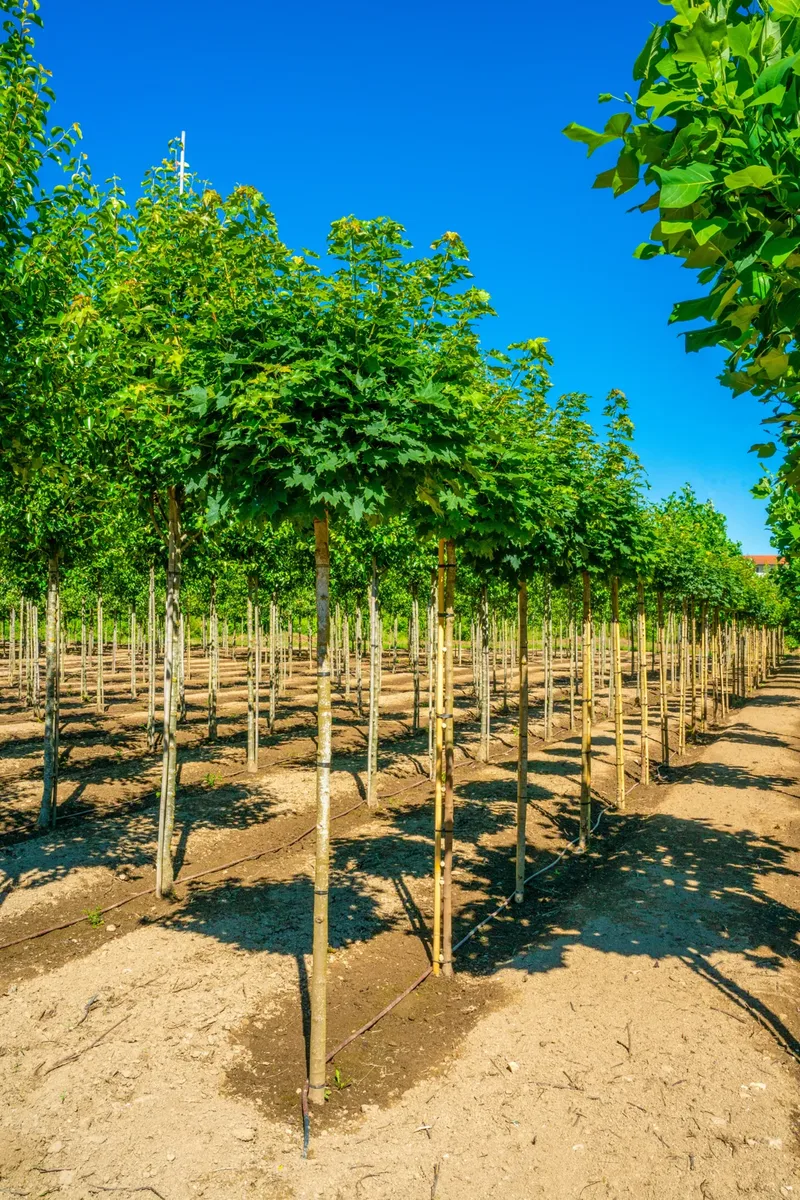
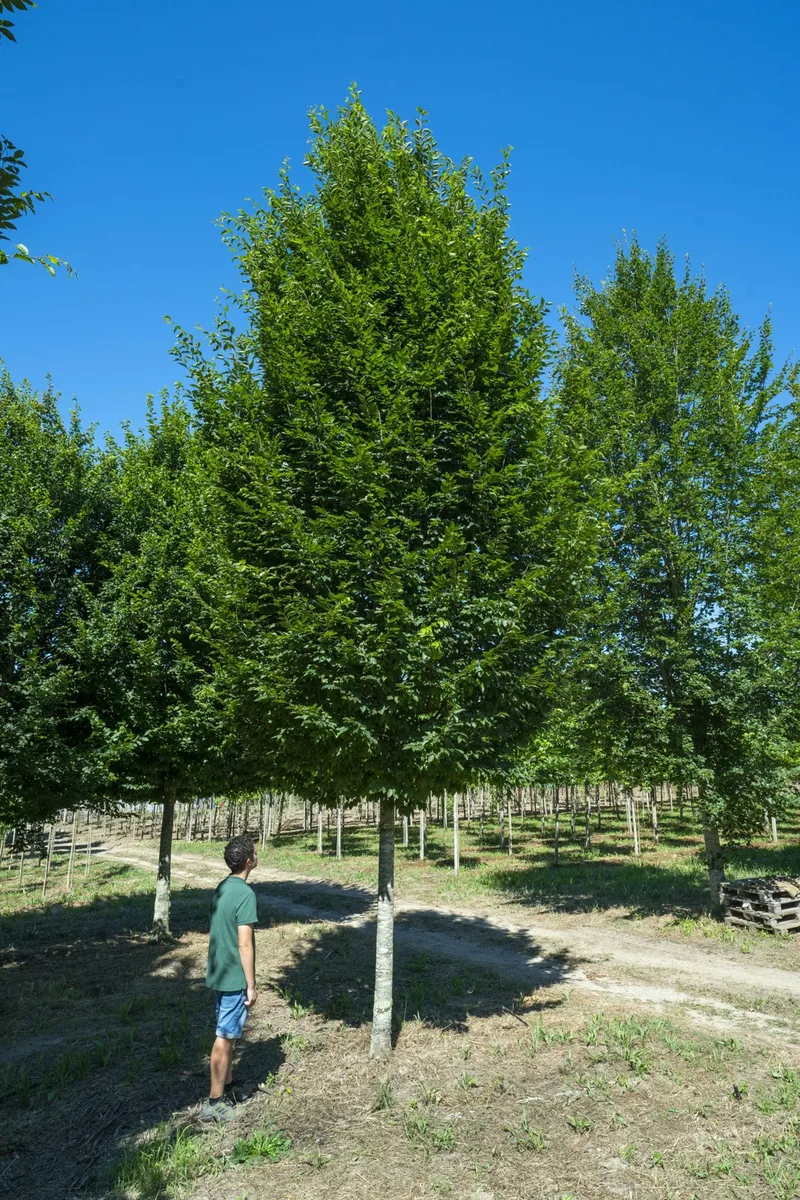
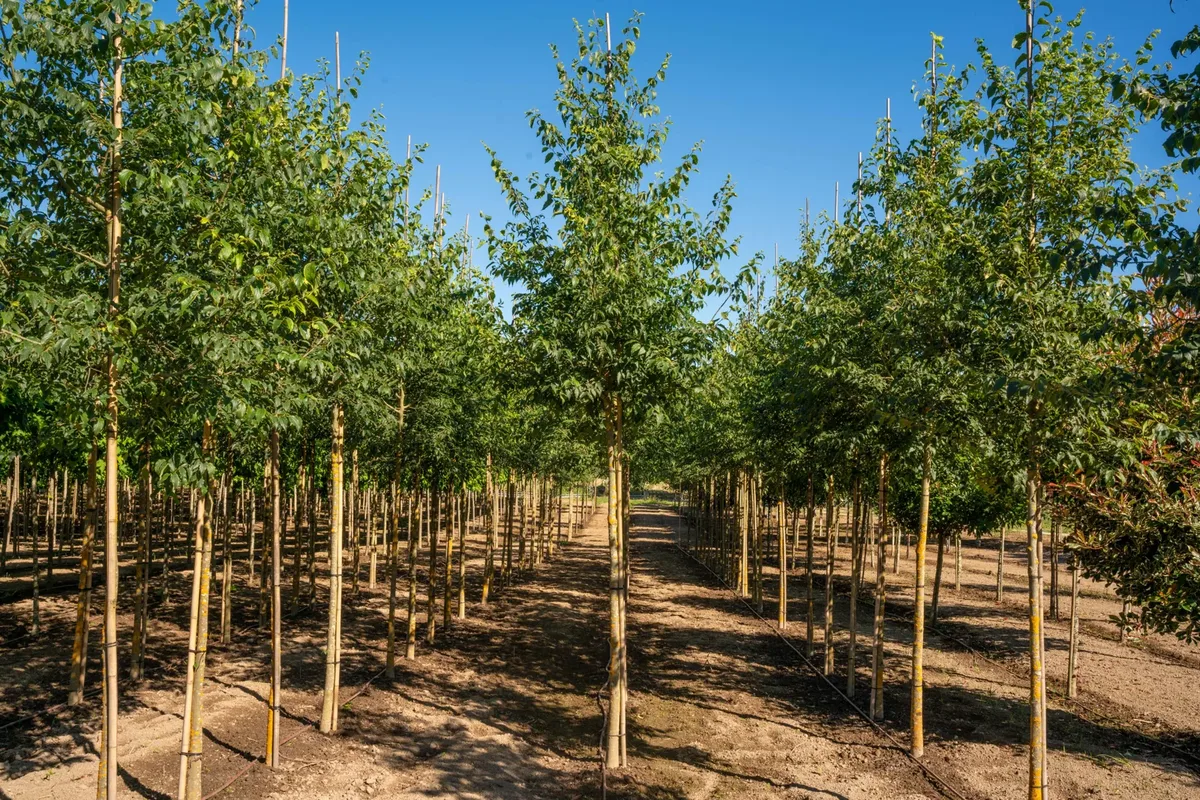
Diaplant grows mostly in open ground. Containers are used only marginally, as a transition stage or when they are the most suitable solution for a particular plant.
Before comparing, it helps to distinguish the terms
A field tree is grown directly in the ground. During the production cycle, it may be transplanted within the nursery to concentrate roots close to the trunk. At final lifting, it leaves with a rootball protected by hessian and wire mesh.
A container-grown tree develops its roots in a limited volume of growing medium. In principle, the root mass stays whole when the plant is taken out, but that does not mean all the roots are well formed.
There are also plants that were grown in the field and put into a container shortly before sale. They are not equivalent to plants that have completed a phase of growth and rooting inside the container. The difference shows when you check whether the roots have filled the growing medium and whether the mass holds together with no signs of recent potting.
Bare-root is another system, used mainly for smaller sizes and for certain species. It is not the focus of this article.
How the roots grow in the field
In open ground, the roots explore a volume of soil far greater than the future rootball. They develop according to the texture, the water, the compaction and other obstacles present in the ground.
So that the tree can be lifted later, the root system is prepared through successive transplantings. Some of the roots that have moved away from the trunk are cut, and the tree has time to form new branching close to the zone that will be transported.
At final lifting, part of the root that has grown back out beyond the rootball is inevitably lost. The quality of the specimen therefore depends on the earlier preparation and on the amount of functional root present in the volume that is kept.
This system makes it possible to produce mature trees and large sizes over long cycles. It also allows each tree to be worked individually, following the crown, the trunk and the roots over the years.
How the roots grow in a container
In a container, the roots meet a physical limit.
When they reach the wall of the container, they may deflect, branch or carry on growing in a circle, depending on the species, the growing medium and the design of the container. There are containers with perforated walls, ribs or air-pruning systems that aim to reduce deformities, but quality always has to be confirmed.
A tree kept too long in the same container can develop circling roots, kinks and an excessive concentration at the edge. Some defects remain after planting and can affect future spread or stability.
On the other hand, when production is well managed, the container keeps a large part of the root mass and allows the plant to be transported without cutting roots when it leaves.
Inspection is therefore essential. It is not enough to confirm that the plant is in a container.
Practical differences
| Criterion | Open ground and rootball | Container |
|---|---|---|
| Size | Suited to producing mature trees and large sizes | More common in small and intermediate sizes |
| Roots on leaving | Part of the system goes with the rootball | The contained mass goes with the plant |
| Season | More dependent on dormancy and soil conditions | Generally more flexible |
| Weight | High, especially in large rootballs | Variable, often lower for the same size |
| Main risk | Root loss, drying out or a broken rootball | Circling or deformed roots, or a buried root collar |
| Planting | Requires lifting equipment and protection of the rootball | May require root correction and opening up the system |
| Assessment | Transplanting history, cohesion and roots in the rootball | Time in the container, distribution and shape of the roots |
This comparison is only a starting point. A badly prepared field tree may have too little root. A well-grown container plant may have a good-quality root system. The reverse also happens.
What the research shows
The scientific literature does not identify one winning system for all trees and sites.
A review published in Urban Forestry & Urban Greening concluded that the production method influences root architecture, planting and the tree’s response once planted. The results vary, however, between species and are conditioned by the soil, the watering and the technique used on site.
In field trees, root pruning can increase the amount of root included in the rootball, although the response depends on the timing and the species. In containers, several studies show the importance of controlling circling roots and of avoiding excessive time in the same volume.
Water after planting can matter more than the difference between systems taken in isolation. A tree with good roots will struggle to establish in a dry, compacted or waterlogged soil.
The comparison should therefore be made between real specimens and not just between production labels.
Why we grow mostly in the field
Open-ground production is tied to the kind of trees Diaplant develops.
We work mainly with medium and large specimens, long cycles and forms that need space to develop. The field lets us follow the maturity of the trunk, the architecture of the crown and the root preparation over several years.
Successive transplantings are part of this method. The tree grows, is lifted, moves to another plot, recovers and goes on forming. It is a demanding process, but one suited to the scale and the type of product that define the nursery.
The container still has its uses. It can serve as an intermediate stage, allow certain plants to be stabilised temporarily or meet specific production and sales needs. We do not present it as an inferior system; it is simply not the centre of our production of mature trees.
The planting season
Rootballed trees are preferably lifted and planted during dormancy. At Diaplant, the main season runs from November to April.
The container offers, in principle, more flexibility because the roots are not cut at the time of dispatch. That does not mean it can be planted at any time without risk. Intense heat, wind, lack of water or a deformed root system can make adaptation considerably harder.
For both systems, the ability to water and look after the plant is decisive. Planting outside the most favourable window calls for closer control and is not always technically advisable, especially with large trees.
What should be checked before choosing
With a field specimen, it is worth knowing the production history, the root preparation, the size of the rootball and its cohesion. The weight and the access available on site also need to be confirmed.
With a container specimen, look at the root collar, the stability of the mass of growing medium and the shape of the roots. Roots that circle against the wall, cross the trunk or form a very compact block need to be assessed before planting.
In both cases, the crown and the trunk still count. The production system does not make up for a poor structure, a lack of vigour or a species unsuited to the site.
Choosing according to the project
The choice depends first on the result you want.
When the project calls for immediate scale, mature trees or batches prepared over several years, open ground is often the solution available. When the size is smaller, the timing of the works is more flexible or the logistics are constrained, the container can bring advantages.
The species should also be considered. Some respond well to both systems; others need specific care. Access, drainage, the availability of water and the capacity for maintenance complete the decision.
The right question is not simply ‘rootball or container?’. It is: which of these specimens has the better roots, a suitable form and real conditions to establish in this project?
Ask for advice
Diaplant can help you select the system, species, form and size best suited to the project and to the planting season.
Talk to the team Discover the nursery
Related content
- How a mature tree is formed
- What a tree’s rootball is
- How to assess the quality of a mature tree
- The best time to plant rootballed trees
Sources and supporting references
- Allen, K. S. et al. (2017). “A review of nursery production systems and their influence on urban tree survival”. Urban Forestry & Urban Greening, 21, 183–191. DOI: 10.1016/j.ufug.2016.12.002.
- Gilman, E. F.; Paz, M.; Harchick, C. (2016). “Effect of Liner Container Size, Root Ball Slicing, and Season of Root Pruning in a Field Nursery on Quercus virginiana Growth and Anchorage After Transplanting”. Arboriculture & Urban Forestry, 42(4), 234–245. DOI: 10.48044/jauf.2016.022.
- Watson, G. W.; Sydnor, T. D. (1987). “The Effect of Root Pruning on the Root System of Nursery Trees”. Journal of Arboriculture, 13(5), 126–130. DOI: 10.48044/jauf.1987.027.
- European Arboricultural Standards. European Tree Planting Standard, 2025 revision.
Tags