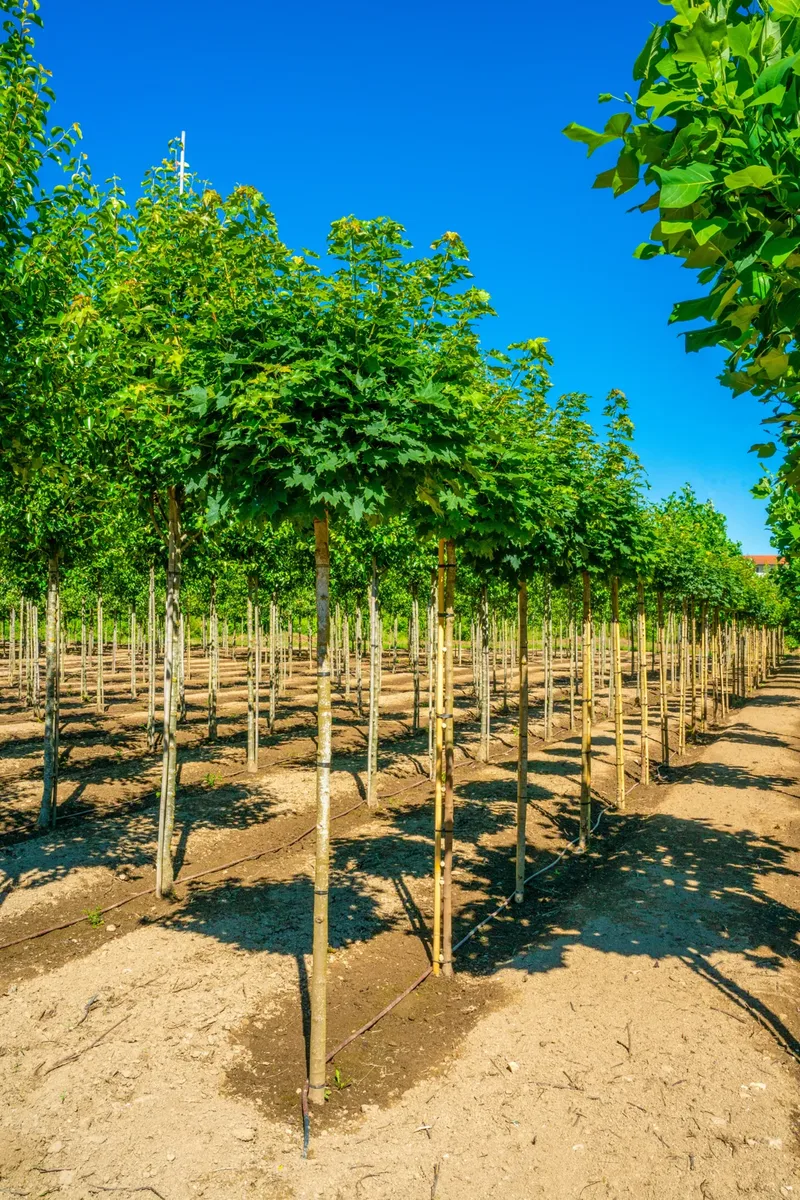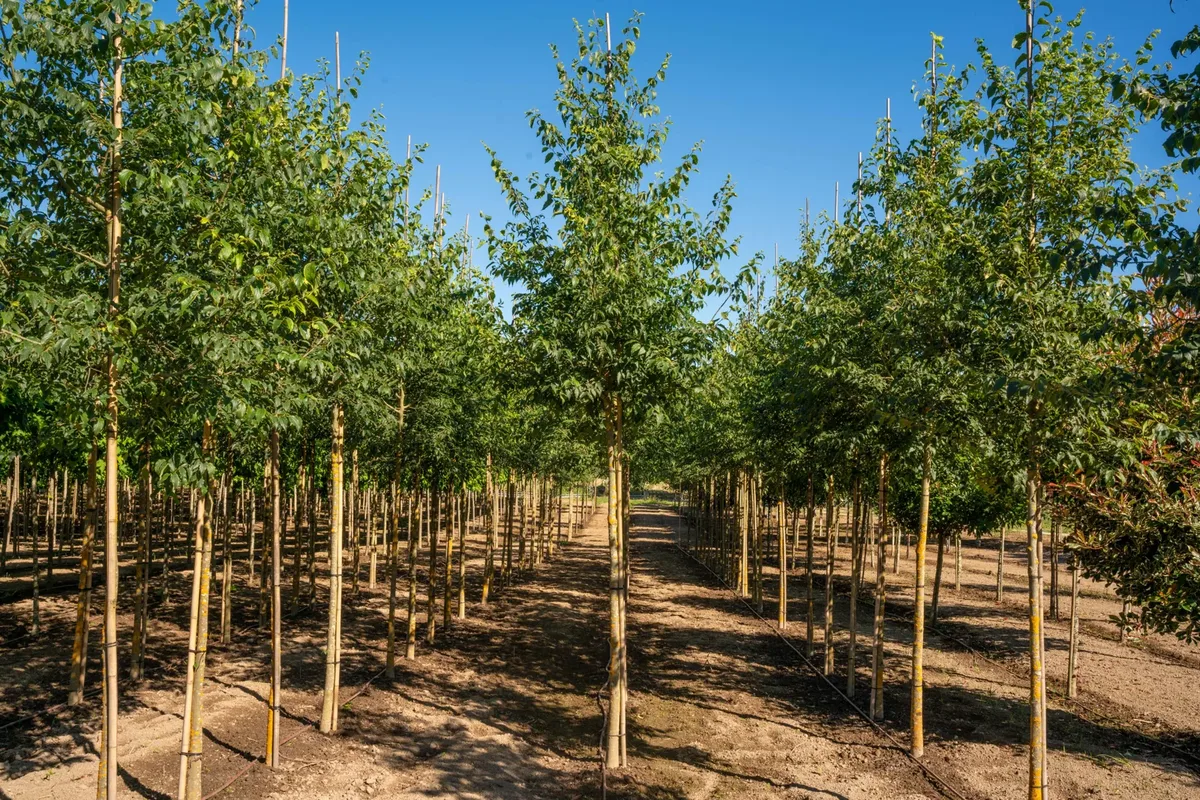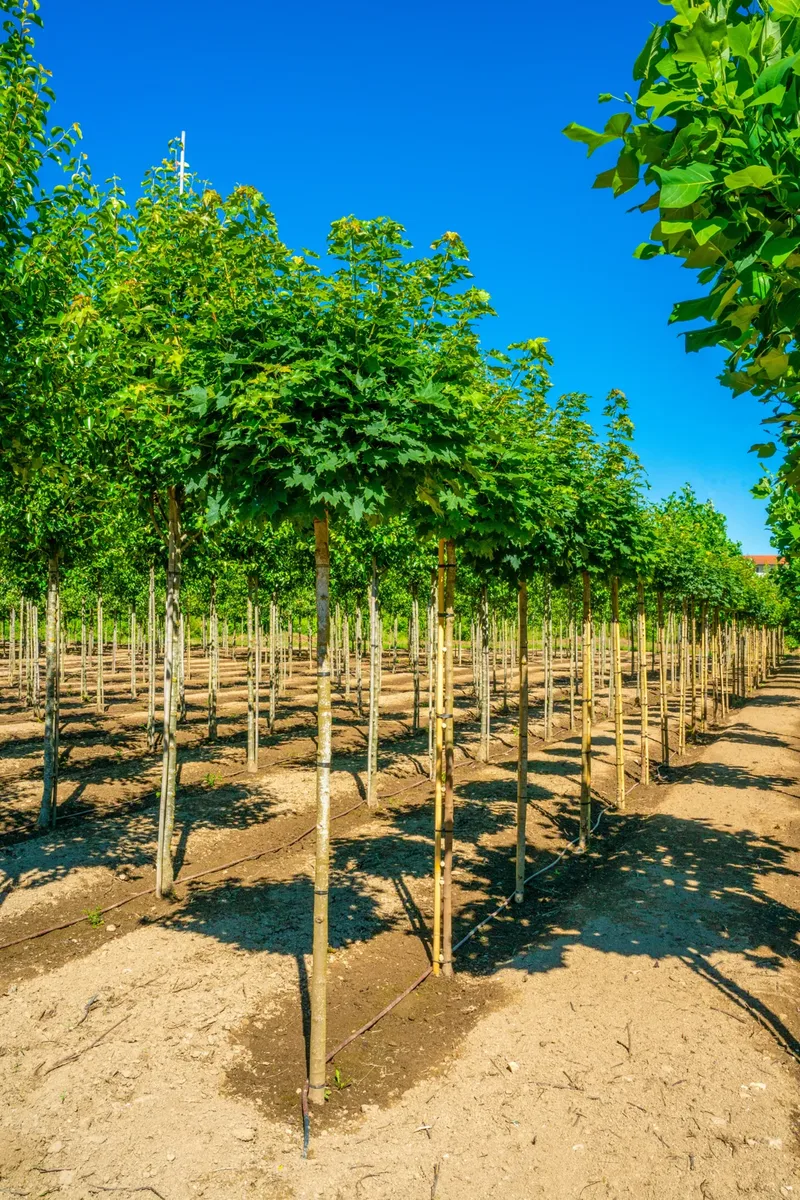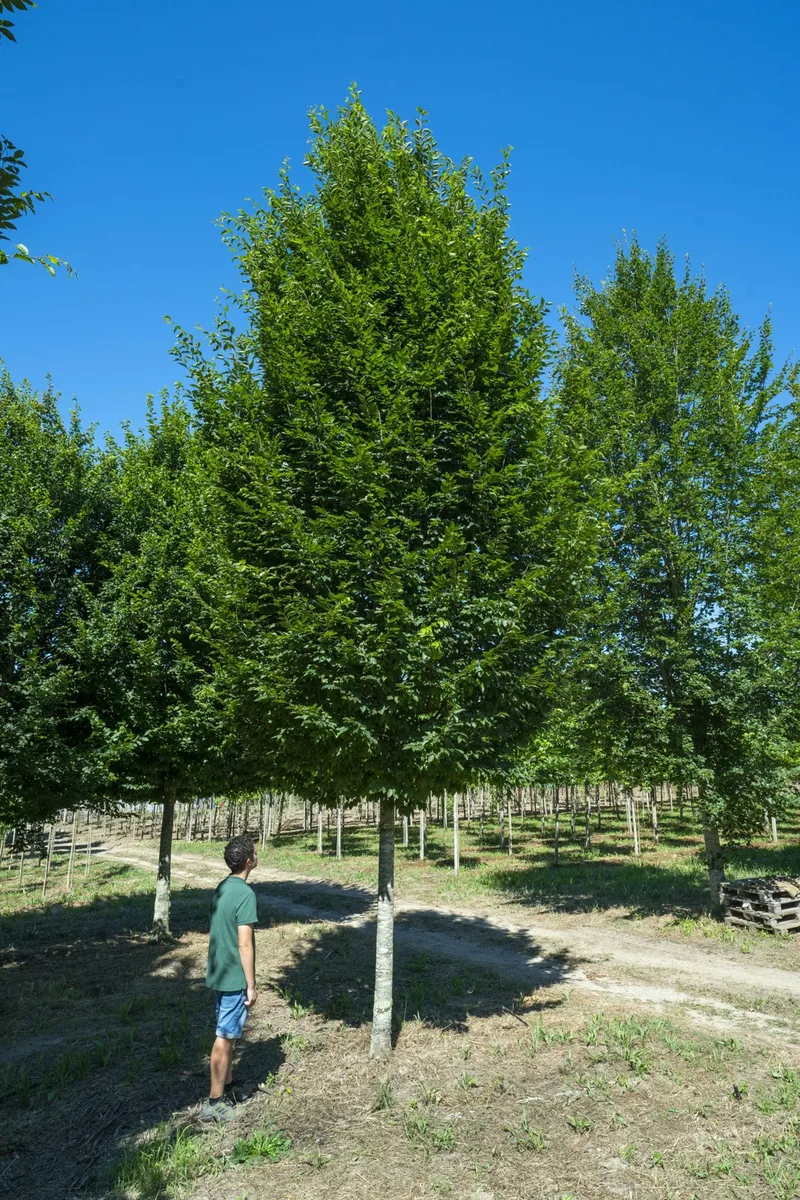
Carpinus betulus 'Fastigiata', Diaplant nursery.
A tree’s crown is monitored from a young age. We explain how formative pruning guides the structure without erasing the natural form of the species.
The crown of a mature tree is the result of the growth characteristic of the species and of the work carried out throughout production. It is not formed in a single pruning, nor should it be corrected only when the tree reaches sale size.
In the nursery, the team monitors the distribution of the branches, the continuity of the leader, crossing branches, imbalances and the relationship between the crown and the trunk. Decisions begin when the branches are still small and can be corrected without large cuts.
The aim depends on the form intended. A tree for avenue planting, a parkland specimen and a multi-stem do not follow the same path.
The species sets the starting point
Each species has its own architecture.
Some trees develop a well-marked central leader. Others divide early into several main branches, form wide crowns or grow more irregularly. There are also differences in vigour, flexibility, ability to reshoot and response to cutting.
Formation should start from that behaviour. Trying to impose an identical crown on every tree creates unnecessary interventions and can remove characteristics that give the species its value.
In a Liquidambar, for example, it is common to work towards a structure with a defined leader and a regular distribution of branches. In an Acer palmatum, the interest lies in preserving a more delicate branching and the natural reading of the crown. A magnolia or a dogwood may need far less structural intervention than a tree prepared for street planting.
Knowledge of the species helps to decide what to correct and, above all, what to leave to grow.
The future function also influences the form
The same species can be produced with different aims.
A tree intended for avenue planting generally needs a clear stem, a compatible crown height and a structure that is relatively uniform with the others. In a garden, a lower, more open and irregular crown may be wanted. In parks or on large estates, a tree of natural form may be selected precisely for its individuality.
With multi-stems, the work concentrates on the relationship between the several stems. The spread at the base, the distribution of weight and the way the crowns cross are assessed. The aim is not to make all the stems equal, but to avoid a weak structural concentration or an unbalanced composition.
There are also trained forms, such as roof-trained trees, globe crowns, balls, pyramids, espaliers and macro-bonsai. In these cases, keeping the form calls for regular interventions and starts early.
Why we intervene while the branches are young
A small branch can be removed with a small wound. The same branch, several years later, leaves a larger cut and changes the distribution of the crown more abruptly.
Formative pruning seeks to anticipate problems. Crossing branches, competing leaders or unfavourable branch unions are assessed before they gain too much weight. In many cases, the branch does not need to be removed completely; its vigour can be reduced and its development followed in the years that follow.
This approach avoids severe pruning and allows the work to be spread over several cycles.
The February 2025 version of the European Tree Pruning Standard frames formative pruning as an intervention directed at the future architecture of the tree. The principle is compatible with nursery work: set objectives, intervene with proportionate cuts and respect the response of the species.
The main leader
In trees produced as standards with a central leader, the continuity of the trunk is watched from early on.
Two branches of similar vigour may appear, competing for dominance. If both are left to grow, the crown may divide at a point with a less favourable union. The correction is simpler while the leaders are young.
It is not always necessary to choose a single branch straight away and remove the other. The team can reduce the competing branch, direct the growth and reassess in the next cycle. This gradual intervention keeps more leaf and avoids a sudden gap in the crown.
There are species and forms in which division of the leader is natural and desirable. The decision depends on the model of tree being produced.
Crown height and temporary branches
To form a clear stem, the lower branches are removed progressively.
The removal should not be done all at once. The low branches contribute to the trunk’s growth in diameter and help to maintain a good taper. If they are removed too early, the tree may gain height without developing the same structural stability.
For some time, some of these branches are kept as temporary branches. Their vigour can be controlled so that they do not become dominant. As the trunk develops and the crown height is set, they are removed in successive stages.
The final height depends on the use. A tree for pedestrian areas, car parks or street planting may need a higher crown. In a garden, this clearance may not be necessary.
Distribution and balance
The crown is looked at in three dimensions.
What matters is the distribution of the branches around the trunk, but also the space between them and the proportion between the different sides. A specimen can look balanced in a photograph taken from the front and have a very empty crown when seen from another angle.
Wind, exposure in the field and the proximity of other trees influence growth. One side may develop more, or the branches may reach for light outside the planting row.
Pruning corrects some of these differences, but it does not always set out to cancel them. In garden trees, a moderate asymmetry can give the specimen character. In batches for avenue planting, uniformity carries more weight.
The assessment should be made according to the destination and not through a single idea of symmetry.
Natural forms and trained forms
A natural crown is also monitored.
Letting the tree express the form characteristic of the species does not mean abandoning formation. We continue to watch for damaged branches, crossing branches, competition and the distribution of weight. The difference lies in the degree of intervention and in the result intended.
With trained forms, the relationship with future maintenance has to be accepted from the outset. A roof-trained tree or an espalier does not keep that geometry without regular cuts. The client and the designer should know about this requirement before choosing the form.
The same applies to globe crowns obtained by grafting or by training. The initial measurement of the crown does not represent the future volume, and behaviour varies between cultivars.
The tree’s vigour changes the rhythm of pruning
Fast-growing trees need to be checked more often. A competing branch can gain size in a single cycle and make the correction more demanding.
In species that are slow or sensitive to cutting, the interventions are more restrained. The general condition of the tree is also taken into account. A specimen that is recovering from transplanting, with the root cutting it involves, may not be pruned as hard as a fully established tree.
The timing depends on the species, the aim and the type of cut. There is no universal date for the whole of production.
The history helps in deciding. Before intervening, it is important to know what was removed in previous years and how the tree responded.
When the crown is not yet ready
A tree may have the intended girth size and stay in production because the crown has not reached the expected level of quality.
There may be a gap in the branching, a marked imbalance or a need to consolidate the crown height. Instead of trying to correct everything shortly before dispatch, the tree stays in the field and is worked on for another cycle.
This decision avoids sending to the project a specimen that has the right measurement but not yet the right structure.
Not all irregularities are defects. A singular tree may be chosen precisely for its form. What matters is understanding whether that form is stable, compatible with the species and suited to the place.
Assessing the crown in the nursery
The choice should be made from several angles and with the future orientation in mind.
In a project, the crown may need to open towards a view, keep away from a façade or cast shade in a particular direction. Turning the tree at the moment of planting changes the reading of the specimen considerably.
In the nursery, it is possible to compare trees of the same species and see differences that a catalogue measurement does not show. Height, girth size and spread are important, but the distribution of the branches and the overall form are just as relevant.
In uniform batches, the assessment includes the relationship between the various trees. In a free-standing specimen, a more individual presence may be sought.
Discover the production
The architecture of the crown can be seen at different stages in Diaplant’s fields, from trees in formation to mature specimens.
Book a visit to the nursery Discover the production
Related content
- How a mature tree is formed
- When is a tree ready to leave the field?
- Tree or multi-stem: how to choose the form
- Natural, globe, columnar and pleached crowns
Sources and supporting references
- European Arboricultural Standards. European Tree Pruning Standard, February 2025 version.
- European Arboricultural Standards. “Pruning Young Trees: A Fact Sheet on Formative Pruning”.
- European Arboricultural Standards. “Introduction to Tree Architecture”.
Tags