Diaplant
Tree, multi-stem and shrub occupy space in different ways. Learn about the structure, the use and the criteria for choosing.
The form of a plant changes the way it occupies the garden, even when the species is the same. A single-stem tree frees up the lower level; a multi-stem brings the structure closer to eye level; a shrub forms a mass that branches from the base.
The choice should start from the space and the function. What matters is knowing where the crown begins, how much ground will be taken up, which views should stay open and how the plant will be maintained over the years.
Single-stem tree
A tree has a clearly defined main axis linking the base to the crown. During production, the lower branches may be kept for a time to help the trunk develop and then removed gradually up to the intended height.
This form is suitable when you want to walk, park, sit or see through the space beneath the crown. The clear stem height has to match the use: a tree beside a street or a thoroughfare has different requirements from a specimen set in a wide lawn.
At the nursery, the points to look at are the continuity of the trunk, its taper, the height of the crown, the distribution of the branches and the relationship between the upper volume and the size of the specimen.
Multi-stem
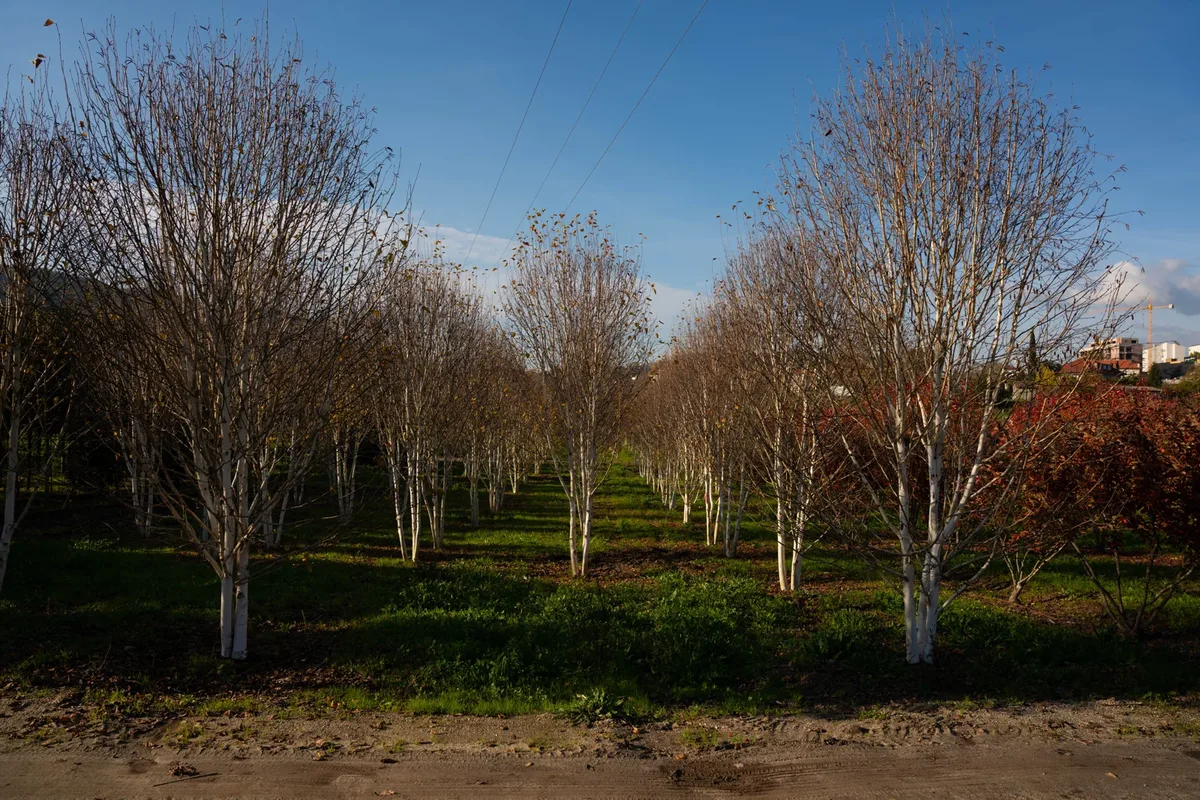
In a multi-stem, several trunks or main axes rise from the ground or from a very low point. The plant still reads as a tree: the axes are clearly identifiable, gain height and carry a shared crown or several crowns that relate to one another.
The trunks do not need to be exactly the same diameter. A moderate difference can give naturalness and movement. What matters is how they are distributed, the space between them, the unions and the direction of the weight.
A multi-stem takes up width from early on and creates a strong presence at ground level. It works well as a free-standing specimen, in the transition between architecture and planting, beside water or as a visual filter. On narrow paths, it can become too dominant if its future spread has not been allowed for.
Shrub or shrub form
In a shrub, branching starts at the base and forms a denser mass, with no clear separation between trunk and crown. There may be a set of main branches, but it reads differently from a multi-stem: there is more low branching and less hierarchy between the axes.
The shrub form is useful for creating volume, shelter, continuity in a bed or a transition between layers. It also makes it possible to work with species that, in natural conditions, do not form a dominant trunk.
Some species can be produced as a tree, a multi-stem or a shrub. The botanical name alone does not explain the form that will arrive on site. The form has to be stated in the specification and should be confirmed on the specimen.
Circulation and ground occupied
When the space beneath the crown has to be used, the single-stem tree is usually the most direct solution. The clear stem leaves the lower level free and concentrates the shade higher up.
The multi-stem takes up part of that area with its several axes. The shrub takes up even more of the lower level and tends to create a continuous mass.
This difference should be measured at mature size. A plant that looks narrow at the nursery can open out considerably after planting. Placing it beside doors, paths or walls without enough margin creates a dependence on pruning that could have been avoided.
Privacy and views
A standard tree lets you see through the garden and frame the landscape. The crown screens mainly in a higher band.
The multi-stem filters from a lower level. The trunks, the gaps and the foliage create depth without necessarily forming an opaque barrier.
The shrub is the better choice when you want to close off the lower level. Density, whether the foliage is evergreen and future height determine the degree of screening.
In mature specimens, orientation is decisive. A multi-stem may have one open side and another that is denser; a shrub may have its mass leaning because of the way it grew in the field. Turning the plant on site changes the result.
Shade and scale
The amount of shade depends mainly on the species, the density and the size of the crown. The form defines how that shade relates to the use.
A standard tree creates a leafy ceiling and keeps usable area beneath it. A multi-stem brings the crown closer and makes the space more enclosing. A shrub creates volume and boundary, but it is no substitute for a shade tree when height matters.
On larger properties, combining the three forms makes it possible to build a richer structure: trees for scale and shade, multi-stems as transitional specimens and shrubs to tie the lower level together.
Structure and quality
In a tree, you look for a trunk consistent with the species and with the intended form. In a multi-stem, you assess the unions, the crossings and the distribution of the axes. In a shrub, you look at the density, the base, the renewal of the branches and the ability to hold its volume without excessive cutting.
Not all asymmetry is a defect. A lean or a difference in girth can give character. The problem arises when the distribution creates contact, weakness or weight incompatible with the site.
Quality should be read as a whole: root, base, trunks, branching, crown and state of growth.
Future maintenance
Single-stem trees may need progressive formative pruning of the crown and the removal of temporary branches. The work should be done early, avoiding large cuts.
Multi-stems call for an eye on the unions, the inner branches and any basal shoots. The aim is not to turn all the axes into a symmetrical form; it is to keep a balanced structure.
In shrubs, maintenance depends on habit. Some species benefit from selective renewal from the base; others hold their shape with little intervention. Cutting every shrub into a ball removes the form that justified the choice.
Choosing the actual specimen
A catalogue photograph shows a tendency, not the plant that will be supplied. With mature trees, multi-stems and large shrubs, seeing them in the nursery lets you relate each side to the project.
It is worth bringing the plan, the measurements, photographs of the site and information about access. The team can then assess width, orientation, weight and means of unloading.
The right form is the one that does the job, fits the space and can go on developing without depending on yearly corrections.
Related content
Sources and supporting references
- European Arboricultural Standards. European Tree Pruning Standard, February 2025 version.
- European Arboricultural Standards. European Tree Planting Standard, 2025 revision.
- Criteria for training and selecting specimens used by Diaplant.
Tags