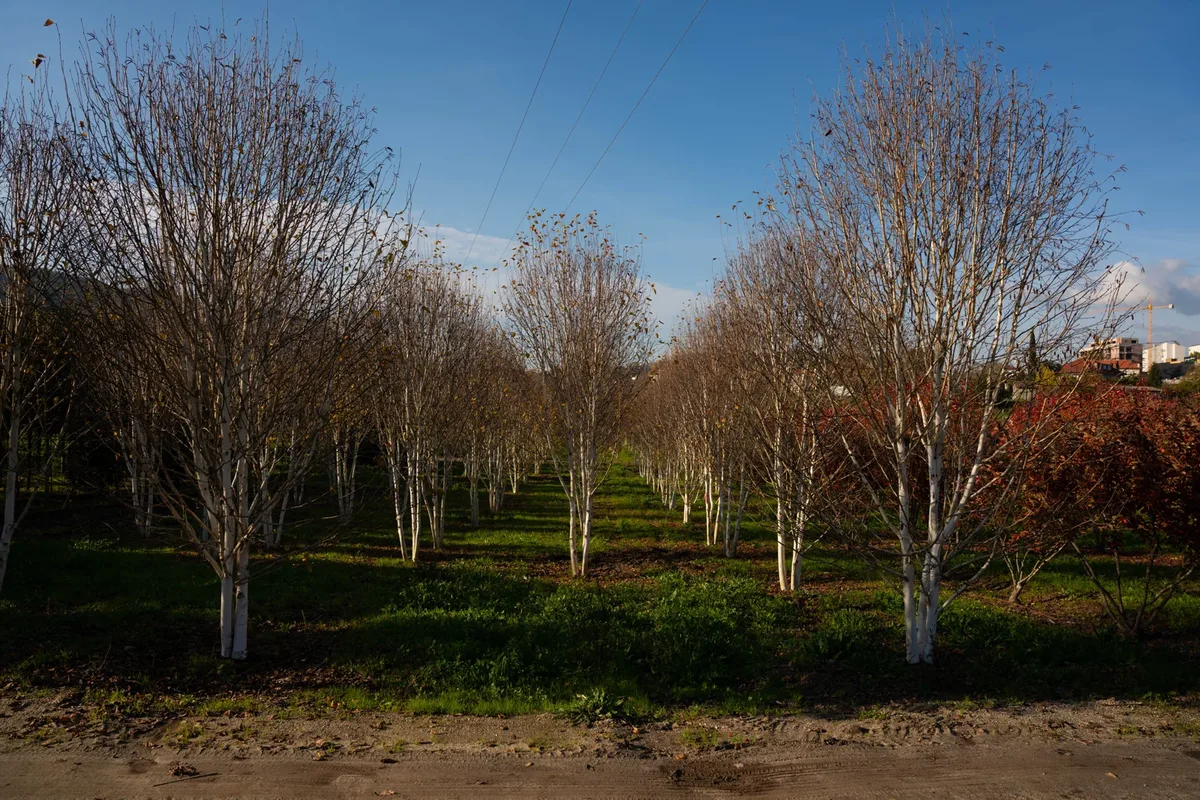
Betula utilis 'Jacquemontii' — the white bark, Diaplant nursery.
The Himalayan birch stands out for its white bark, but it needs moist soil and regular watering. Find out the conditions it needs and the ways it can be used.
Betula utilis subsp. jacquemontii is chosen above all for its white bark, visible all year round and particularly strong in winter. In the trade it still often appears as Betula utilis var. jacquemontii or simply Betula jacquemontii, but Plants of the World Online currently accepts the name at subspecies rank.
The tree has a light crown, deciduous leaves and fairly fast growth when it finds moist soil. This combination makes it interesting in groups, in contemporary gardens and in compositions where the trunks carry an important part of the design. The bark, though, should not hide the main requirement: birch needs available water and reacts badly to dry planting conditions or intense reflected heat.
The white bark develops with time
Young specimens do not necessarily show the intense white associated with mature trees. The bark starts out in brown or cream tones and lightens gradually.
There is also variation between specimens. In a group, the trunks may not reach exactly the same shade or peel at the same rate. This difference is part of working with living material and should be borne in mind when a very formal composition is wanted.
The bark comes away in thin sheets and reveals new surfaces. It should not be brushed or peeled to speed up the effect. Machinery, staking wires and knocks near the trunk can leave marks that last far longer than on other, thick-barked species.
Crown, leaf and scale
The crown tends to be open and fairly transparent. The green leaf turns yellow in autumn and falls, leaving the trunks and the fine branching visible.
As a standard tree, the birch frees up the lower level and can line a path or form part of an informal row. As a multi-stem, the effect of the bark starts at the base and the specimen gains a more sculptural presence.
Groups of three or more trees are common because they reinforce the repetition of the trunks and create depth. Spacing should not be set by the initial effect alone. The crowns go on opening and need enough light not to become unbalanced.
Soil and drainage
Birch adapts to different textures where there is regular moisture and drainage. The soil should neither stay dry for long periods nor be constantly saturated.
On clay, the point is to confirm that water drains away and that compaction is not shutting out oxygen. In sandy soils, water disappears quickly and an organic mulch becomes especially useful.
The root system spreads widely and fairly close to the surface when conditions dictate. The area around the tree should be kept free of compaction, excavation and excessive paving.
Aspect in Portugal
The species tolerates sun, but the expression ‘full sun’ needs to be interpreted in the Portuguese context. An open position in the north, with moist soil, is different from a hard-surfaced courtyard facing west inland.
Reflected heat, dry wind and lack of water can cause scorched leaf margins, early leaf fall and weakening. In hot sites, some protection during the most intense hours and a mulched soil help to maintain quality.
It is not a tree for an area where watering is uncertain during the first years.
Sensitivity during transplanting
Birches extend roots quickly and can lose a lot of water when they are moved. In the nursery, root preparation needs suitable cycles so that a functional quantity of root goes with the rootball.
Lifting is done during the favourable season and the crown must be kept protected from drying out in transit. After planting, the first watering needs to go right through the rootball.
Wilting and leaf drop do not automatically mean a lack of water. Waterlogged ground also limits uptake. Moisture should be checked at depth before the programme is changed.
Use in the garden
The Himalayan birch works particularly well where the trunks can be seen from a distance or against a dark background. Evergreens, stone walls, façades and masses of shrubs can heighten the contrast.
Beside lakes or in cool settings, the species fits in naturally, provided the roots are not permanently submerged.
In contemporary gardens, a group with simple underplanting can produce a very clear result. In more naturalistic compositions, it associates well with grasses, ferns and shrubs for partial shade.
The fall of small twigs, catkins and leaves is part of the cycle. Beside swimming pools or surfaces that demand constant cleaning, this characteristic should be accepted before the choice is made.
Planting and the first years
The soil should be prepared over a wide area and tied in to the surrounding ground. The root collar sits at surface level, and the rootball must not dry out while the roots have not yet grown out into the new soil.
Deep watering is adjusted to the drainage. A layer of organic mulch reduces evaporation and swings in temperature, but it should be kept clear of the trunk.
Staking is determined by size and by wind. The ties need to be inspected because the bark can be damaged by rubbing.
Pruning
Pruning should be moderate. Damaged branches, crossing branches and structural problems are removed while the cuts are small.
The light, irregular crown is part of the species. Hard reductions to make it compact cause regrowth, wounds and loss of the natural habit.
A well-placed Betula utilis subsp. jacquemontii needs above all space, water and protection of the soil. The quality of the bark comes later, as the consequence of a healthy, mature tree.
Related content
Sources and supporting references
- Plants of the World Online, Royal Botanic Gardens, Kew — Betula utilis subsp. jacquemontii.
- Royal Horticultural Society — growing information on the Himalayan birch.
- Ashburner, K.; McAllister, H. A. The Genus Betula: A Taxonomic Revision of Birches.
- Diaplant’s experience of producing and transplanting birches.
Tags