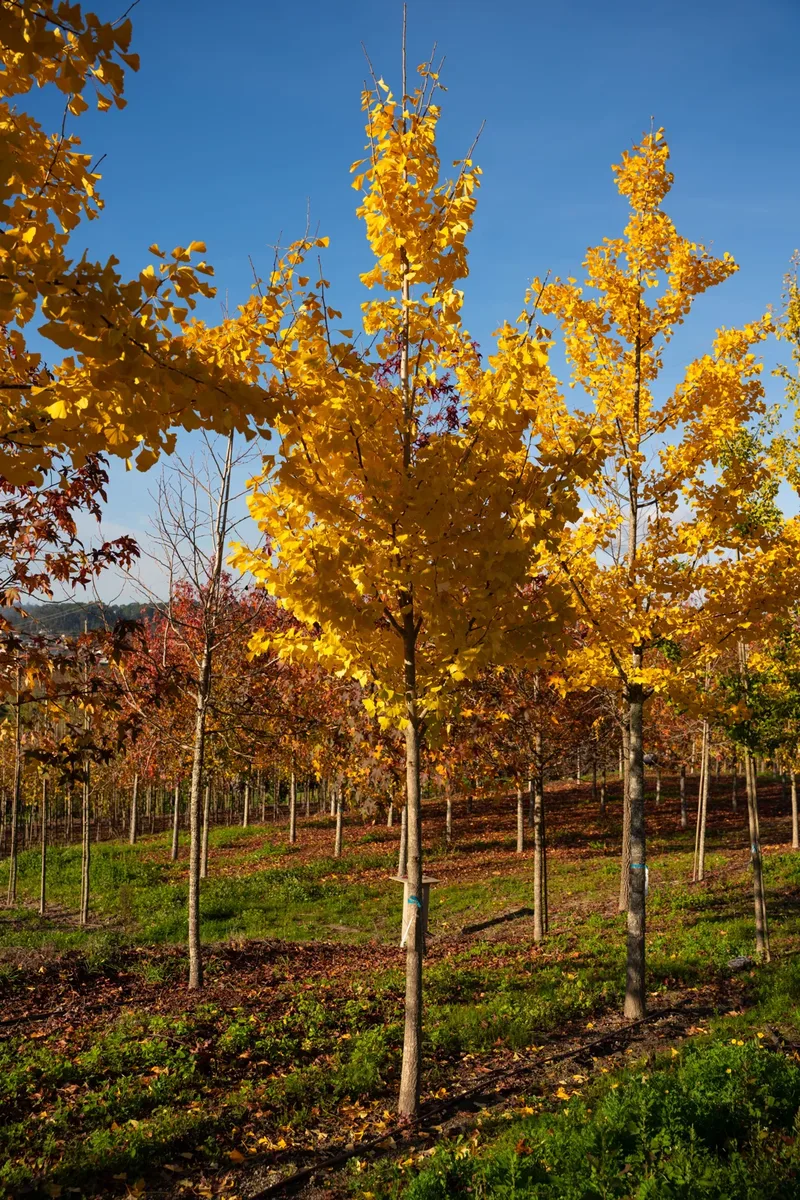
Ginkgo biloba in autumn, Diaplant nursery.
Ginkgo biloba is a large tree with fan-shaped leaves and yellow autumn colour. Find out why male clones are chosen for streets.
Ginkgo biloba is a very long-lived deciduous tree, with fan-shaped leaves and a highly recognisable yellow colour in autumn. Young trees often grow with a narrow, irregular crown; maturity brings greater width and presence.
The species tolerates urban conditions better than many trees, but this toughness does not remove the need for soil, water and space. The mature form can reach a large size and should be planned for from the design stage.
Leaf and autumn colour
The leaves have veins that fan out and may have a more or less marked central split.
In autumn they turn yellow. Leaf fall can happen over a relatively short period, leaving the ground covered in leaves almost all at once.
The intensity and the timing depend on the conditions of the year. A tree under water stress may drop its leaves early.
The colour works well in avenue planting and in contrast with evergreens, but it should not be the only reason for choosing a tree whose eventual size is large.
Form and growth
Early growth is generally slow to moderate. Young trees may have rather irregular branches and a crown that looks open.
With age, the structure becomes broader. The straight species can far exceed the scale of a small garden.
There are columnar, compact, globe and weeping cultivars. The name should be confirmed, because the form cannot be deduced from Ginkgo biloba alone.
Formative pruning helps to guide the leader and branches, but the tree does not need containing when it has enough space.
Male and female trees
Ginkgo is dioecious: there are male trees and female trees.
Female trees form seeds wrapped in a fleshy layer. When it falls and breaks down, this layer gives off a strong smell and can make paving slippery.
For that reason, streets, entrances and circulation areas often use male clones. Identification should be guaranteed by the cultivar and by the propagation method.
A young plant with no confirmed clonal origin can take many years to reveal its sex. The absence of seeds in the nursery is no proof that it will be male.
Soil
The species adapts to a range of well-drained soils and tolerates urban conditions, pollution and heat.
Growth improves in deep soil with regular water. Tolerance should not be used to justify small tree pits, compaction or a lack of watering.
Prolonged waterlogging is unfavourable. On construction-site ground, the structure should be confirmed below the surface layer.
Aspect and climate
Sun favours a balanced crown and autumn colour. The species has good cold hardiness and adapts to various European regions.
In coastal or very exposed areas, wind and salt should be assessed in the local context. The leaf may cope, but large crowns need stability and water.
Urban use
Ginkgo works in avenues, parks and wide streets. Its tolerance of the urban environment and its distinctive structure justify its use.
Choosing male clones reduces the problem of seeds on paving. It is also important to select cultivars whose form fits the cross-section of the street.
A columnar tree reduces conflict overhead, but still needs root space. The straight species should be kept for places where the crown can spread.
Use in the garden
In a large garden, ginkgo can work as a free-standing specimen and as a legacy tree, whose presence grows over decades.
In smaller spaces, compact cultivars may be suitable, provided the identity is confirmed and the eventual size is known.
The foliage casts relatively light shade. In winter, the structure is on view and may look irregular for many years before it gains maturity.
Planting and adaptation
A slow start after planting does not necessarily mean failure. The tree may invest in its roots first.
The rootball should be kept moist and the soil prepared over a wide area. The root collar stays at the surface.
Deep watering continues through the first few years. Excessive fertilising does not make up for compaction or lack of water and can lead to unbalanced growth.
Pruning
Formative pruning is done while the branches are small. Structural problems are removed, without trying to build a perfectly symmetrical crown.
Hard cuts on mature trees alter the form and lead to slow recovery.
Ginkgo biloba demands patience. The tree that looks narrow and rather irregular at first can become a specimen of great presence, provided the place was chosen for that scale.
Related content
Sources and supporting references
- Royal Horticultural Society — plant profile for Ginkgo biloba.
- Plants of the World Online, Royal Botanic Gardens, Kew.
- Trees and Shrubs Online, International Dendrology Society.
Tags