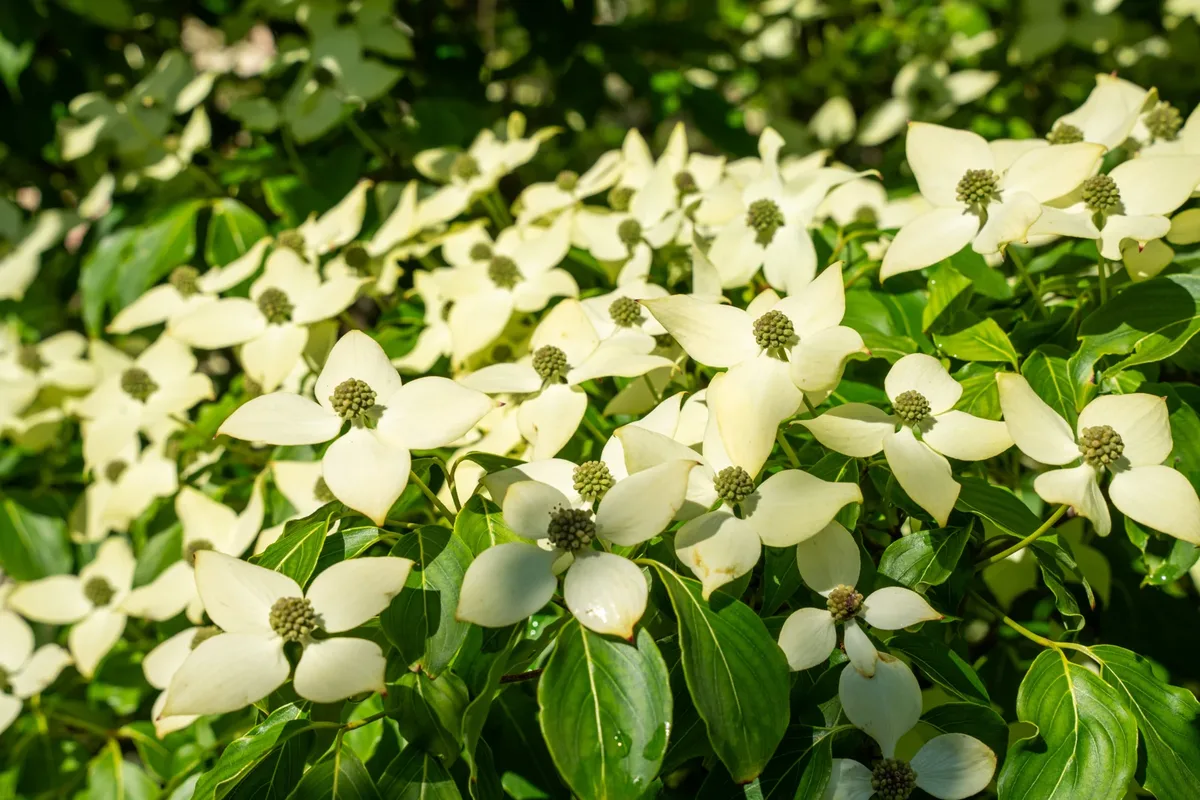
Cornus kousa 'Chinensis' — the white bracts, Diaplant nursery.
Cornus kousa offers pale bracts, fruit and autumn colour. Find out which soil, aspect and space suit this small tree.
Cornus kousa is a small tree or large shrub valued for the pale bracts that surround the flowers, for its fruit and for its autumn colour. The crown tends to form tiers of branching and gains in quality when it has room to develop without frequent pruning.
The species accepts sun or partial shade, but it prefers fertile, well-drained soil with regular moisture. In Portugal, the greatest risk often lies in the combination of heat, dry soil and reflected exposure, and not in any lack of hardiness.
What looks like a flower
The small flowers are gathered at the centre. The ornamental effect comes from the four bracts that surround them, which may be white, cream or pink depending on the form and the cultivar.
The display generally comes later than the flowering of the American dogwoods. The date and duration vary with the climate and with the plant.
On a young specimen, the number of bracts may be small. The tree gains presence as the crown matures.
Fruit and autumn
After flowering, rounded red fruits may form, of interest both as ornament and for wildlife.
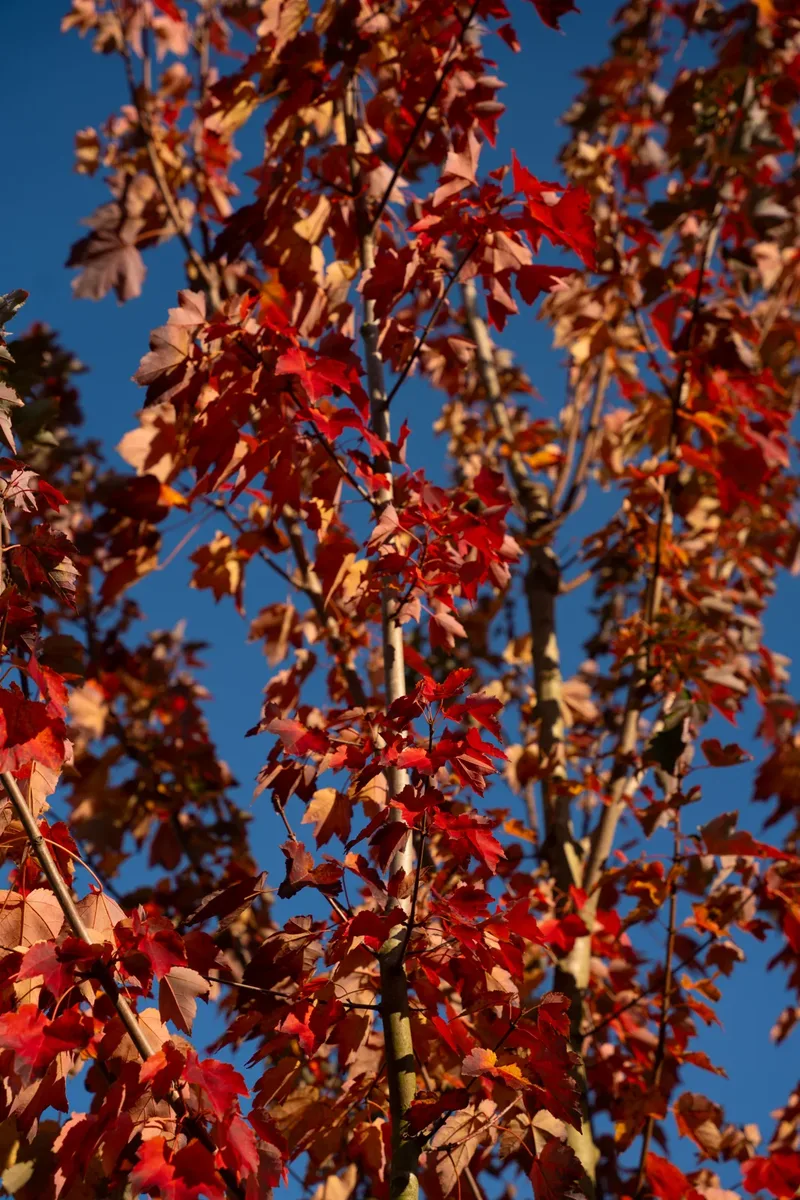
In autumn, the leaves often take on red and purple tones. The intensity depends on aspect, water and temperature.
A tree under stress in summer can lose quality before autumn arrives. Watering during establishment therefore influences an effect that occurs months later.
Crown architecture
The branches tend to create horizontal tiers. This structure does not appear in full on young trees and should not be forced through hard cuts.
As a multi-stem, branching starts closer to the ground and the tree works as a specimen to be seen at close range. As a standard, the crown is raised, but the stem should not be cleared excessively to create headroom.
The natural form can be asymmetrical. When the specimen is chosen at the nursery, its orientation should take account of views, buildings and the space available.
Soil
The RHS recommends fertile, humus-rich, well-drained soil. The species grows in different textures, but the profile should not stay saturated.
In compacted soils, the roots struggle to leave the prepared zone. In sandy soils, moisture disappears quickly and should be conserved with organic matter and mulch.
pH can influence the availability of nutrients. Chlorotic leaves should not be treated with fertiliser alone without checking soil and water.
Aspect
Sun favours flowering and colour, provided the roots have moisture. In very hot sites, protection in the afternoon hours can improve leaf quality.
Partial shade is suitable when there is enough light and little root competition. Under large trees, the soil can seem moist and yet be dry because of uptake by the existing crowns.
Hot, dry wind scorches leaves, especially during the first years.
Use
Cornus kousa works well in gardens where it can be seen at close range. The bracts, the fruits and the branching have the scale of detail and are lost when the tree is too far away.
It fits into Japanese-inspired gardens, large courtyards, tree borders and compositions with ferns, azaleas or shrubs for partial shade.
It is not the best choice for areas of heavy use, trodden soil or spaces where the crown will have to be raised continually.
Cultivars
There are numerous cultivars, differing in bract colour, fruit size, habit and overall size.
A photograph cannot confirm all of them. The name should be validated by the label and the production history.
When the project depends on a specific colour or size, the cultivar should appear in the specification. Stating only Cornus kousa leaves room for different results.
Planting
A wide area is prepared, avoiding a mix that is very different from the existing soil. The root collar stays at the surface.
The first watering should wet the rootball and the adjacent ground. In the following months, moisture is checked at depth.
An organic mulch keeps the roots cool and reduces competition, but it should not touch the trunk.
Pruning and maintenance
Pruning is minimal. Damaged branches, crossing branches and structural problems are removed while the cuts are still small.
A tiered crown loses quality when it is clipped like a hedge. The space should accept the future width.
The tree needs its water monitored in the first and second summers. Once established, it becomes more self-sufficient, but it still responds better in a moist, sheltered soil.
Related content
Sources and supporting references
- Royal Horticultural Society — Cornus kousa plant profile.
- Plants of the World Online, Royal Botanic Gardens, Kew.
- Trees and Shrubs Online, International Dendrology Society.
Tags