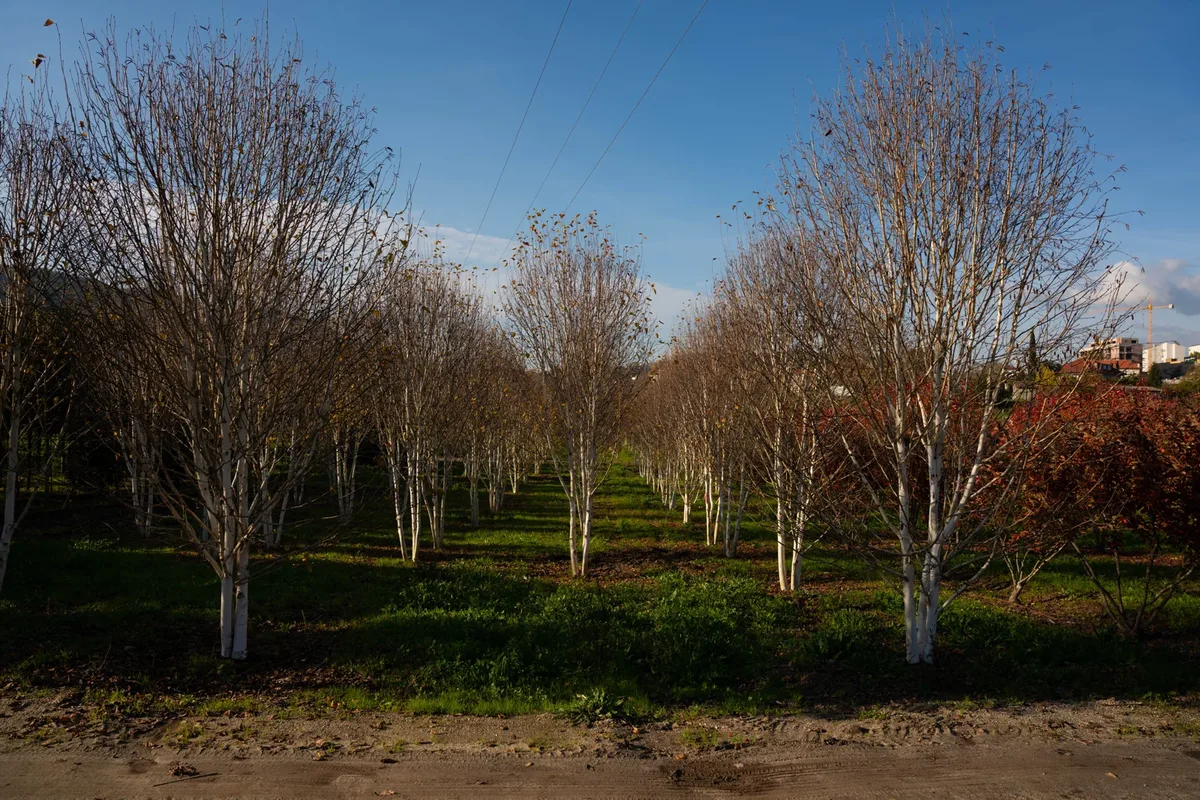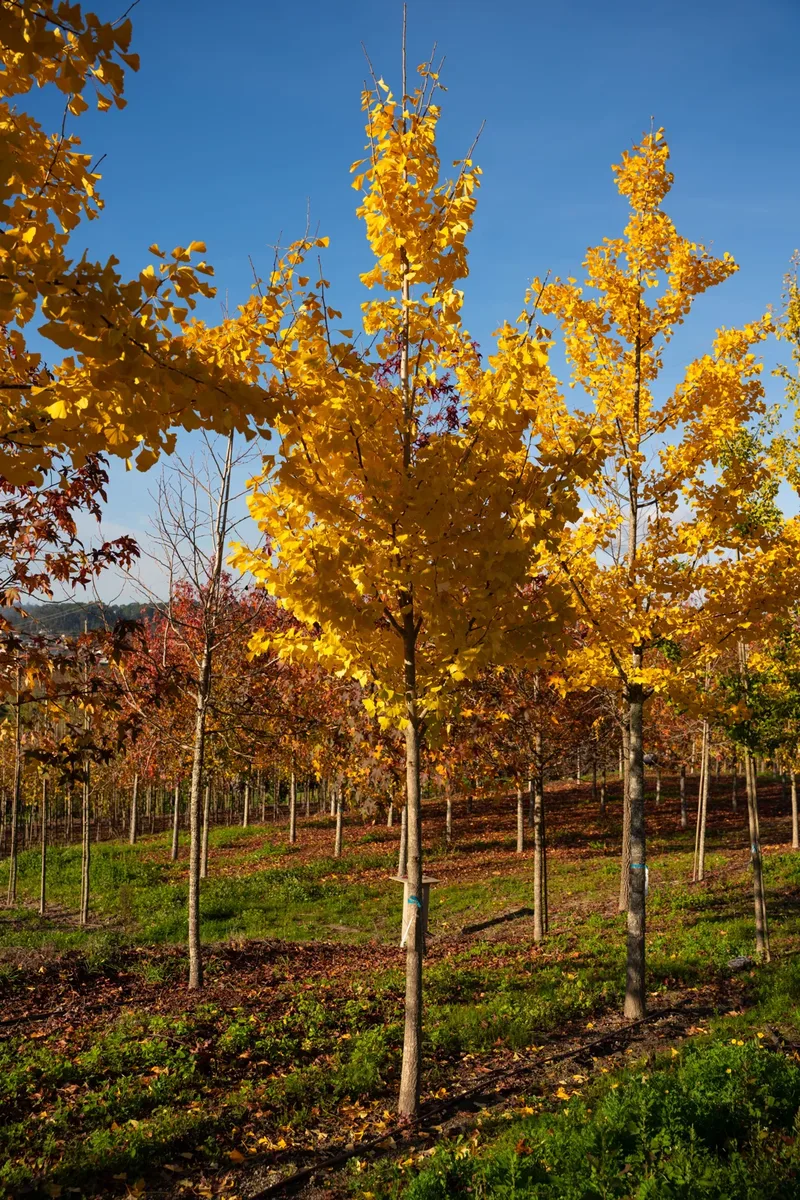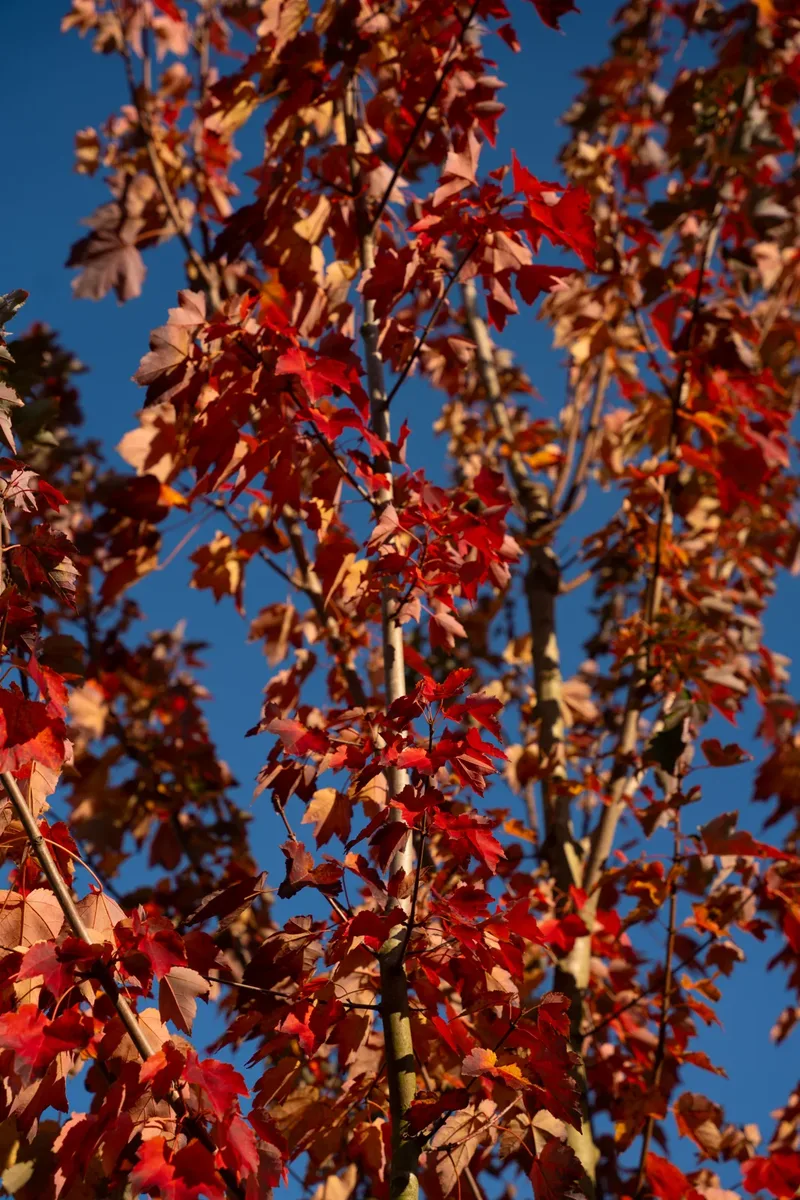
Acer rubrum in autumn colour, Diaplant nursery.
Acer rubrum ‘October Glory’ is a large tree with intense autumn colour. Find out what soil, water and space it needs.
Acer rubrum ‘October Glory’ is a selection of red maple known for its autumn colour. The leaf stays green through the season and can turn intense shades of crimson, usually relatively late.
The cultivar makes a large tree. The RHS gives a height of more than twelve metres and a potential spread of over eight metres. It should not be treated as a small ornamental tree, nor planted next to buildings in the expectation that pruning will contain it.
Habit and structure
The main branches grow upright at first, forming an oval or upright crown. With maturity, the volume increases and the tree gains width.
This form makes it suitable for parks, avenues, large gardens and streets with space above and below ground.
On young specimens, the crown can look narrow. The design should work with the mature size and not just with the nursery form.
Early formative pruning follows the leader, the branch unions and the crown height. After that, maintenance should be kept to a minimum.
Autumn colour
The change to red is the main ornamental feature, but it does not happen with the same intensity every year.
Temperature, night length, aspect, water and the condition of the leaf all influence the result. A tree under stress can yellow, scorch or drop its leaves before it develops any red.
The name ‘October Glory’ does not mean that the colour always appears in October in Portugal. The timing varies with the region and the year.
Soil
The RHS recommends moist but well-drained soil, acid or neutral. The cultivar can grow in different textures, but its reaction to alkaline soils should be taken into account.
On chalky ground or with high-pH water, chlorosis and difficulty absorbing micronutrients can appear. Any correction should start from an analysis and from the real possibility of maintaining suitable conditions.
Compacted soil restricts the roots and growth. A small tree pit does not allow a tree of this size to develop its crown.
Water
In its native range, the red maple is associated with environments where water is available, although it grows in varied conditions.
During establishment, the rootball needs regular moisture. Shallow watering is not enough for a mature tree.
The soil should not stay saturated and without oxygen. Drainage is as important as the volume applied.
In hot summers, the water available has a direct influence on whether the leaf lasts until autumn.
Aspect
Sun favours colour and a balanced crown. Partial shade is possible, but a position dominated by larger trees can reduce density and bring root competition.
Wind increases water loss and should be considered with large specimens. Staking stabilises the rootball at the start, but the choice of site needs to protect the structure in the long term.
Use
‘October Glory’ works as a structural and shade tree, and not just as a point of colour.
In parks and on estates, it can be used on its own or in groups. In avenues, the selection of batches should take account of crown height, girth size and form.
Combining it with trees that turn yellow in autumn or with evergreens creates a longer sequence. A monoculture, however, increases vulnerability to pests and weather conditions.
Planting
The soil is prepared in a volume compatible with the rootball and with future expansion. In an urban setting, there should be lateral continuity under or between paved areas.
The root collar stays at the surface. The first watering soaks through the rootball and settles the ground.
Staking is chosen according to size and wind. The ties are checked and removed once the roots provide stability.
Grafting and identity
The cultivar is propagated vegetatively, often by grafting, to keep its characteristics. The identification should appear on the label and in the documentation.
A tree sold simply as Acer rubrum does not guarantee the same habit, timing or colour.
The full name is particularly important in batches and projects that depend on a consistent seasonal image.
Pruning and maintenance
Pruning concentrates on formation and safety. Large cuts are avoided once the tree is mature.
A crown that needs reducing every year shows a lack of space. The size should be accepted before planting.
‘October Glory’ can give a strong presence and good autumn colour, but it only achieves that result when it is given soil and water to match a large tree.
Related content
Sources and supporting references
- Royal Horticultural Society — Acer rubrum ‘October Glory’ plant profile.
- Plants of the World Online, Royal Botanic Gardens, Kew — Acer rubrum.
- Urban arboriculture literature on soil volume and establishment.
Tags