Diaplant
A street tree should be chosen for the space it will have when mature, and not for the size it has on the day of planting.
A street tree should be chosen for the space it will have when mature, and not for the size it has on the day of planting.
Crown spread, branching height, soil volume, buried services and maintenance capacity need to be analysed together. When one of these parts is ignored, the tree becomes dependent on frequent pruning or grows in a volume that cannot sustain the intended size.
The street cross-section
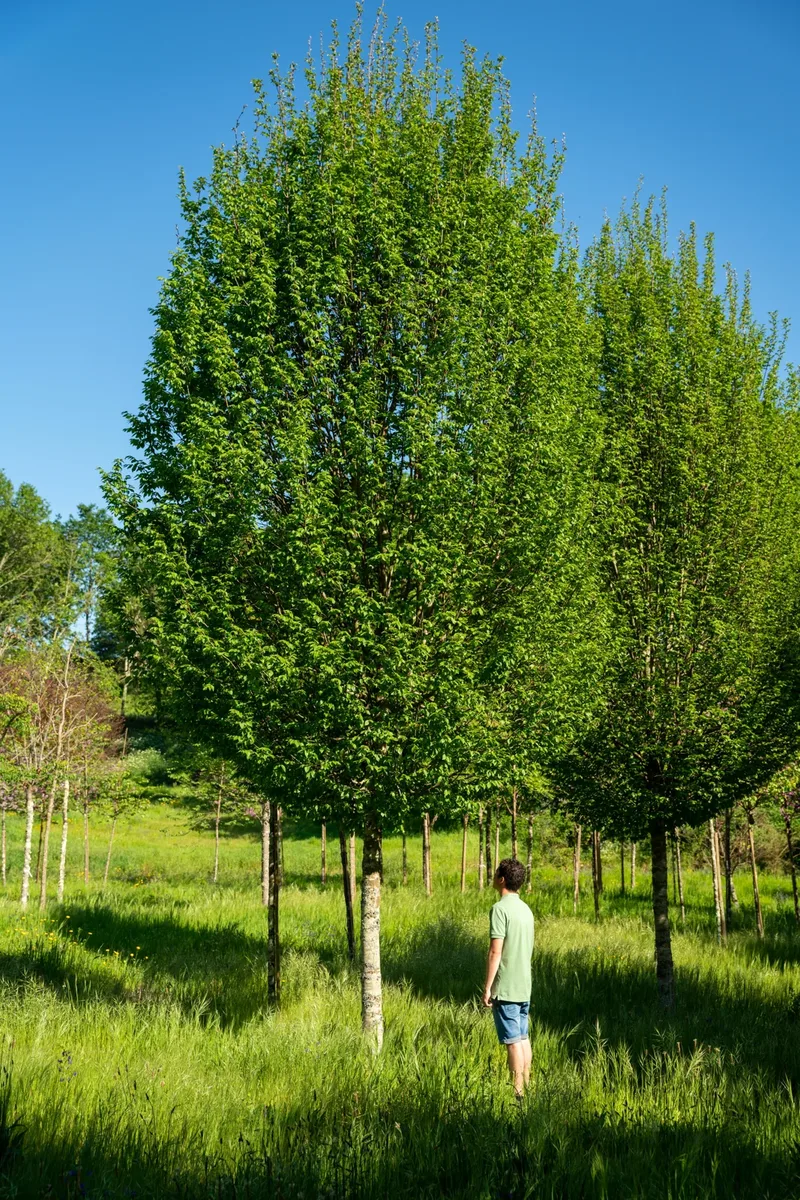
Pavement, carriageway, façades, balconies and cables define the space above ground. In narrow streets, a broad crown can quickly come into conflict. A columnar form reduces width, but it can reach a great height and still have significant root requirements.
The position must also respect visibility at junctions, pedestrian crossings, entrances and signage.
Underground space
Beneath the pavement lie paving sub-bases, foundations, sewers, water, electricity, gas and telecommunications. The tree pit visible at the surface may be no more than an opening over ground that is almost entirely occupied.
The design should confirm the continuous volume that the roots can explore. When there is none, under-pavement soil systems, links between tree pits or a reorganisation of the infrastructure may be needed.
Climate and microclimate
The same city has very different conditions. A street open to the wind, a west-facing façade and a shaded corridor do not take the same tree.
Reflected heat, drought, salt and temporary waterlogging should be considered. A generic statement of tolerance is no substitute for reading the site.
Form and crown height
Trees along circulation routes need a suitable crown height, but that formation is progressive. Removing all the lower branches at the time of planting reduces leaf area and holds back the development of the trunk.
The nursery can supply trees already prepared for a given function. Formative pruning continues after planting, with small, well-distributed cuts.
Fruit, flower and maintenance
Large fruit, thorns, exudates or a concentrated drop of material may be incompatible with some uses. These characteristics do not make the species unsuitable in absolute terms; they constrain where it is placed.
A tree that needs to be cut back every year to fit the street was wrongly sized for the site.
Diversity
Repeating one species creates identity, but it concentrates risk. A pest or a climatic condition can affect the whole street at once.
Diversity can be introduced by stretches, junctions or landscape units, while keeping coherence of form and scale.
Water in the first years
Even drought-tolerant species need watering during establishment. The irrigation system must be able to deliver water at depth and must be inspected.
Without initial maintenance, technical selection loses much of its value.
Choosing with real information
Municipal plans, inventories and observation of existing trees help to compare performance. How a species behaves in a nearby street is useful, provided the soil and the aspect are similar.
The final choice brings together data, experience and the availability of good-quality material.
What the specification should include
The specification should state the botanical name and cultivar, form, size, crown height and production system. When visual selection matters, provision is made for approval of the batch or a visit to the nursery.
The soil volume, planting, watering and initial maintenance are also defined. Choosing the right tree does not end with the name of the species.
Sources and supporting references
- Plano Municipal de Arborização do Porto.
- Trees for Life: Master Plan for Barcelona’s Trees 2017–2037.
- European Arboricultural Standards. European Tree Planting Standard.
Tags