The terms standard, half-standard and low standard indicate where the crown begins. See how they change circulation, privacy and use in the garden.
Standard, half-standard and low standard describe the relationship between the trunk and the start of the crown. The difference matters because it determines the space available beneath the branches, how close the foliage is and the way the tree relates to people, views and buildings.
The exact limits can vary between nurseries and countries. For that reason, the term should be accompanied by the actual height at which the crown begins whenever this is critical to the project.
Standard tree
In a standard tree, the trunk stays clear up to a relatively high point. This form is common in avenue planting, car parks and areas with pedestrian or vehicle traffic.
The crown does not arrive ready-made from a single pruning. During production, some lower branches are kept temporarily to help the trunk thicken and develop taper. They are removed gradually as the upper structure consolidates.
A tree with a stem too tall for its size can have a small crown and poorly balanced proportions. The height should be compatible with the species, the girth and the use.
Half-standard
In a half-standard, branching starts lower down. The crown comes close to eye level, without fully occupying the base.
This form works well in private gardens, parks and areas where there is no need to pass right beside the trunk. It can create lower shade and a closer relationship with the shrub planting.
The half-standard also makes it possible to keep part of the natural architecture of species that do not respond well to a very long, clear stem.
Low standard
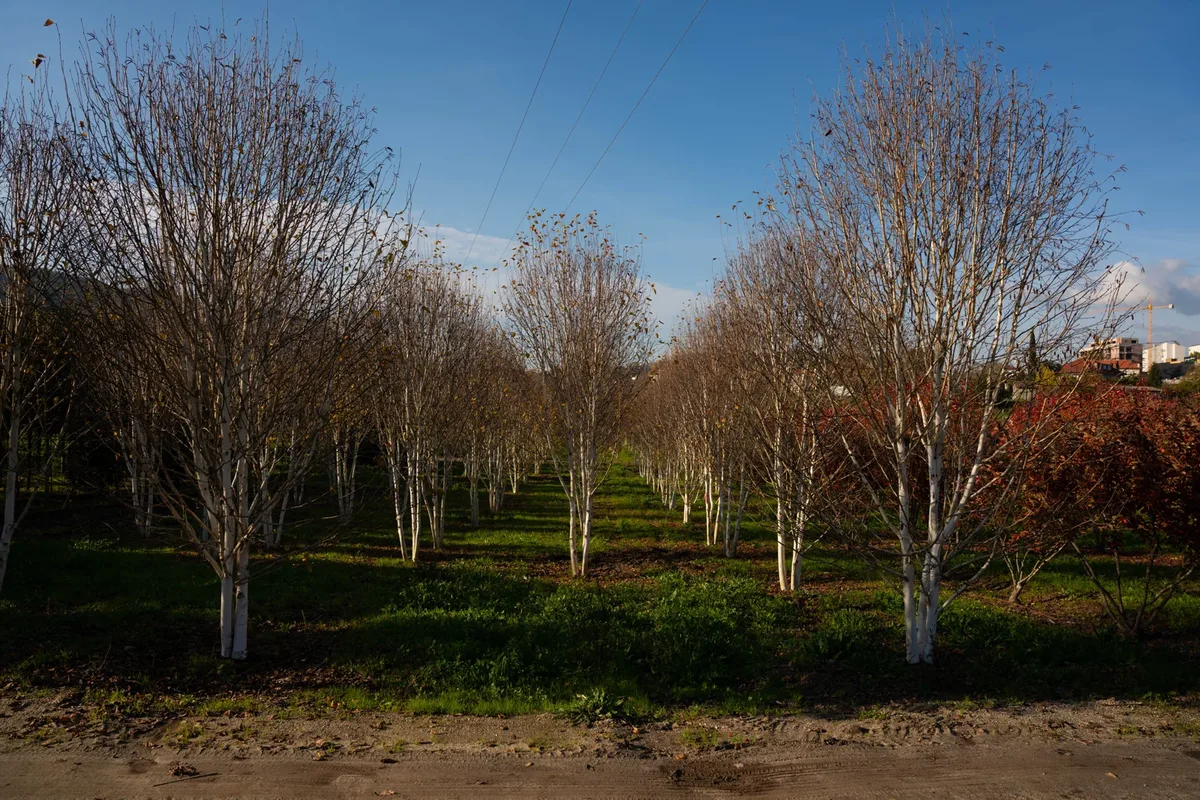
A low standard tree branches at a low level. The crown builds volume from close to the ground and can work as a visual screen, as framing or as a free-standing feature.
It needs room at the sides. Next to narrow paths or through-routes, the branches soon come into conflict.
In evergreen species, it creates a green mass all year round. In deciduous ones, it keeps the branch structure visible in winter.
Not to be confused with multi-stem
A low standard tree still has a main trunk. In a multi-stem, several stems arise from the base or from a very low point.
The two forms can occupy a similar volume, but the structural reading and the maintenance are different. The term should be confirmed by photograph or by looking at the specimen.
The height depends on the function
For pedestrian traffic, parking or visibility, the project may require a minimum clearance. Next to a seating area, a lower crown can offer better scale and shade.
The decision should not be taken on appearance in the nursery alone. You need to project the growth and understand where the branches will be several years from now.
A small tree with a tall stem does not automatically turn into a well-proportioned large tree. The training has to keep pace with the increase in girth and crown.
Species and cultivar
Not all trees adapt in the same way to a long stem. Some have a naturally low architecture or delicate branching. Forcing the removal of branches can take away quality and increase wounds.
Grafted cultivars have a further peculiarity: the height of the graft can fix the base of the crown. A globe form grafted at two metres will not gain a taller trunk through the normal growth of the crown.
How to specify
The specification should state the form and, where relevant, the height at which the crown begins. Generic terms such as ‘standard tree’ can be interpreted differently.
Girth, overall height, spread and a reference photograph help to complete the information.
In the nursery, the tree should be looked at to confirm the proportion between trunk and crown. The right measurement is only useful when the specimen keeps a coherent structure.
Related content
- Tree or multi-stem
- Natural, globe, columnar and pleached crowns
- Girth, girth size, height and pot volume
Sources and supporting references
- European Arboricultural Standards. European Tree Pruning Standard, February 2025 version.
- European practices for the training and grading of ornamental trees.
Tags