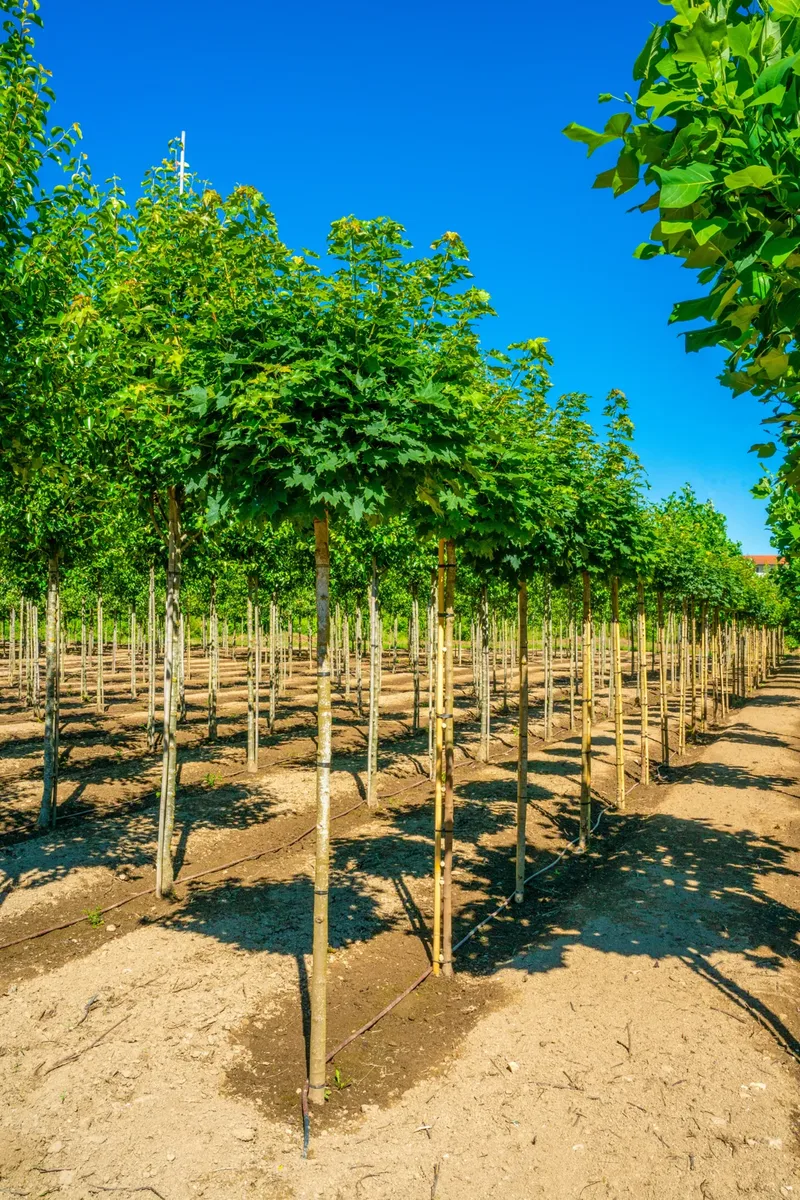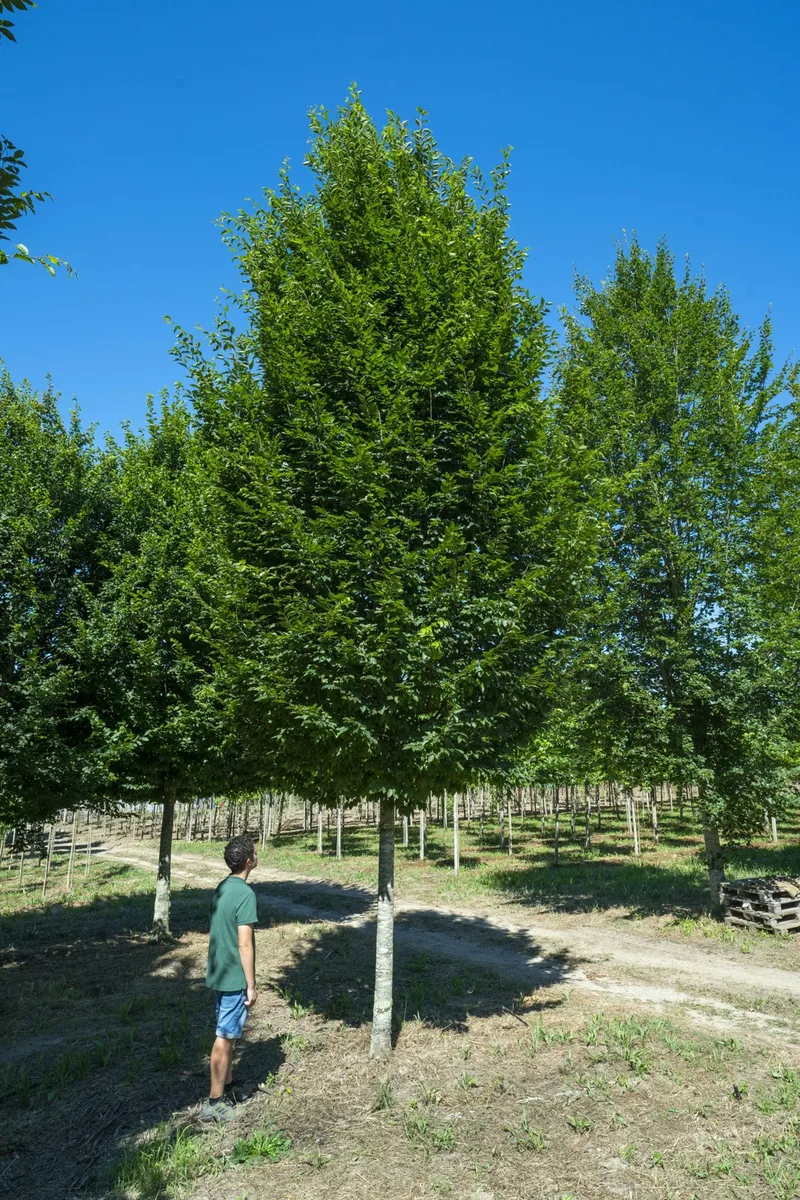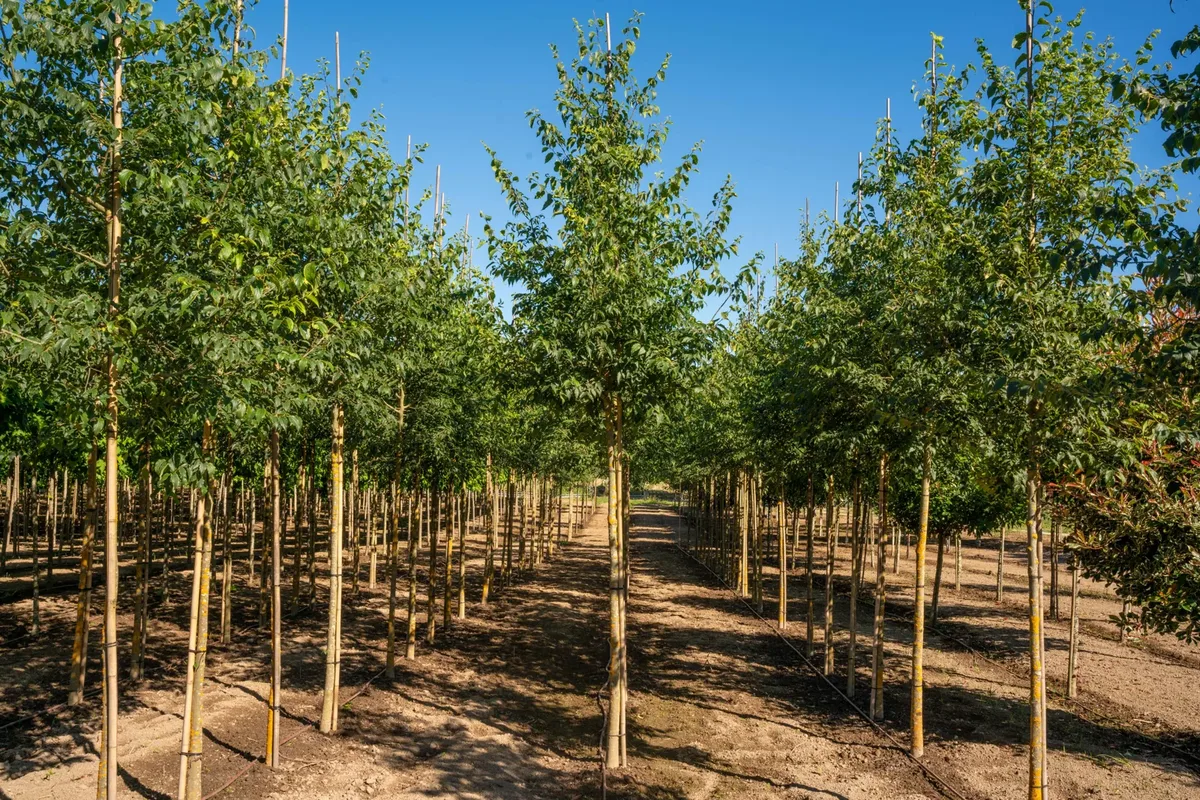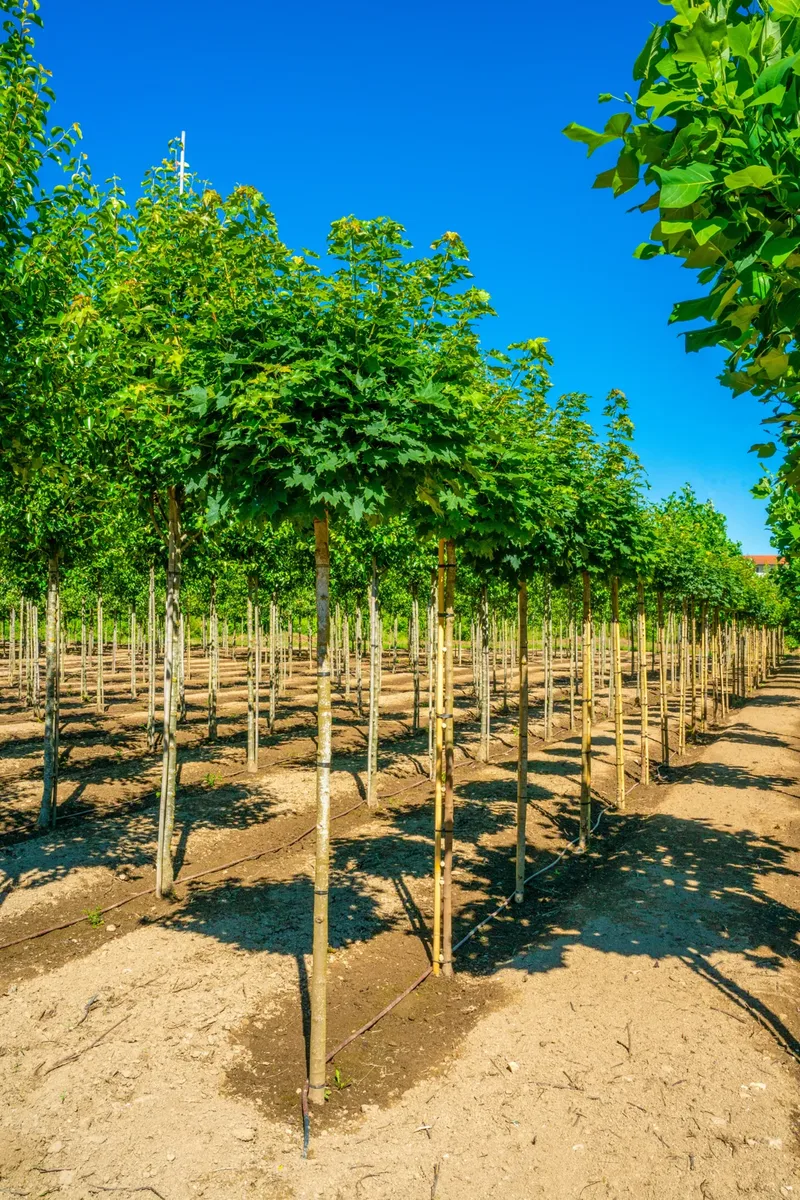
Production plot, Diaplant nursery.
The production of mature trees alternates growth, transplanting, recovery and formation. Find out the technical logic behind these cycles in the nursery.
A mature tree does not stay in the same place, growing until it reaches sale size.
Production alternates periods of growth with operations that interrupt that process. The tree is transplanted to prepare the roots, establishes again, regains its vigour and goes on being shaped. Later, it may change plot once more.
At Diaplant, the trees in the mature range spend at least six years in our fields and are transplanted at least twice. Sales begin, on average, from ten years of age, but the cycles do not last the same time for every species or specimen.
The first period in the field
When a tree goes into a production plot, it first needs to establish.
The roots occupy the soil, the crown resumes growth and the trunk increases in diameter. During this phase, the team monitors watering, formation, vigour and adaptation to the site.
Fast growth is not the only aim. The goal is to develop enough structure for the next phase. A tree with a great deal of crown expansion, but with poorly distributed roots or a trunk that is not yet well consolidated, is not necessarily developing better.
The length of this first period depends on the species, the initial size and the response to the field.
Why growth is interrupted
If the tree always stayed in the same place, the roots would keep moving away from the trunk.
When the time came for lifting, much of the root system would be outside the rootball. Transplanting within the nursery interrupts that expansion and forces the tree to form new roots in a zone closer in.
The operation has a physiological cost. Some of the roots are cut, uptake falls temporarily and the tree has to draw on reserves to recover. That cost is accepted because it prepares the specimen for a much more demanding move in the future.
The timing of the operation is chosen to balance two needs: letting the tree develop and preventing it from becoming too well established.
Transplanting
For most specimens, the tree is lifted with a specialised rootballing machine. The blade is chosen according to the size of the tree and the root volume the species needs.
With very large trees, especially those with rootballs over about 120 cm, an excavator may be needed. The tree is taken out with a volume of soil and roots, moved and planted again elsewhere in the nursery.
During the process, the roots that extend beyond the lifted volume are cut. The crown may also be worked on when there are structural reasons or when the specimen needs balancing, but it is not reduced automatically to compensate for the roots lost.
Transplanting is done preferably in dormancy, within the season suited to the species and to the soil conditions.
Recovery is not measured by the leaf alone
After the move, the tree begins a new period of establishment.
The appearance of leaves and new shoots shows that the top growth has resumed activity, but does not on its own confirm that the roots have recovered. In the first months, the tree may be using reserves built up before the operation.
The team monitors the length of the new growth, the density of the crown, leaf retention and the response to hot spells. It also checks whether the soil holds enough moisture without becoming saturated.
A consistent recovery shows itself over time. The tree grows steadily again and forms new roots beyond the cut zone.
Shaping the crown again
The root cycle does not happen separately from the formation of the top growth.
As the tree recovers, the leader, the distribution of the branches and the intended form continue to be assessed. The intensity of pruning is adjusted to the condition of the specimen.
A recently transplanted tree may not tolerate heavy work on the crown. Instead of concentrating several operations at the same moment, the work is spread over years. Branches are corrected while they are still young, and unnecessary losses of leaf area are avoided.
In trained forms, such as roof-trained trees, globe crowns, espaliers or macro-bonsai, formation continues more regularly. In natural crowns, there is less intervention, but the structure continues to be watched.
When another cycle begins
The decision to transplant again does not come from a single calendar.
The species has a great influence. Trees with more tap-rooted or sensitive root systems may need shorter intervals. More fibrous systems generally allow longer periods. The size of the specimen and the total time planned in production also count.
The team also assesses the growth pattern. Very strong vigour can show that the tree is well established again and that the roots already occupy a wide area. If the specimen is going to stay in the nursery for more years, it may be time to start a new cycle.
The opposite is also possible. A tree that is slow to recover needs more time before it is moved again.
Why cycles vary within the same batch
Trees planted in the same year and in the same plot do not develop in exactly the same way.
Initial differences in roots, position in the field, water availability, exposure to wind and vigour produce different responses. Some reach the intended size and form sooner; others need to stay longer.
The team may work the batch in groups or select only some specimens for the next operation. This difference is not necessarily a problem. It is part of the variability of a living organism.
Production seeks to reduce discrepancies when the aim is to create uniform batches, but it does not eliminate the individuality of the trees.
The soil is also part of the cycle
The same tree can react differently in plots with different characteristics.
Texture, drainage, usable depth and compaction influence root growth. An agricultural soil that has already been cultivated offers different conditions from heavy ground or ground with compacted layers.
Before a tree is replanted, the new position is prepared to receive the rootball and allow expansion. Water should pass through the worked volume and the surrounding ground, without being held for too long.
The cycle does not end when the machine sets the tree down. Establishment depends on the preparation carried out in that plot.
Production time and the age of the tree
At Diaplant, the minimum period of six years refers to the time the trees in the mature range spend in our fields. The total age is greater in many cases, because the plant already had an earlier history before entering that phase.
Sales begin, on average, from ten years of age. Much of the range is made up of trees of around 15 to 20 years, and some batches stay in production for much longer.
These figures do not set an automatic leaving date. The tree may be old enough and still lack the roots, the crown or the maturity intended.
Time allows the cycles to be carried out. It does not replace the operations or the assessment.
The final phase in the nursery
As sale approaches, the team assesses whether the tree needs a new cycle or is ready for final lifting.
The structure of the crown, the trunk, the vigour and the root history are examined. The size of the rootball and the logistics required are also worked out.
If the specimen does not yet meet the criteria, it stays in the field. It may be transplanted once more, given more formative work or simply given more time to consolidate its structure.
When it is ready and there is a suitable destination, lifting is scheduled within the dispatch season.
The cycle continues after planting
The move to the project starts another phase of establishment.
The roots are cut again at lifting and need to occupy the new ground. Watering, drainage, staking and monitoring in the first and second years influence adaptation.
The tree arrives on site with several preparation cycles completed, but it still responds to the conditions of the new soil.
Nursery work narrows the gap between the tree that has grown in the field and the roots able to keep up with it. Final success depends on continuity between production, transport, planting and maintenance.
Seeing the cycles in the field
Trees at different stages stand side by side in Diaplant’s fields: recently transplanted specimens, trees in recovery and batches already prepared for selection.
Book a technical visit to the nursery Discover the production
Related content
- How a mature tree is formed
- Why we transplant trees within the nursery
- What happens to the roots after transplanting
- When is a tree ready to leave the field?
Sources and supporting references
- Watson, G. W.; Sydnor, T. D. (1987). “The Effect of Root Pruning on the Root System of Nursery Trees”. Journal of Arboriculture, 13(5), 126–130. DOI: 10.48044/jauf.1987.027.
- Levinsson, A. (2013). “Post-transplant Shoot Growth of Trees from Five Different Production Methods Is Affected by Site and Species”. Arboriculture & Urban Forestry, 39(5).
- European Arboricultural Standards (2022). European Tree Planting Standard.
- European Arboricultural Standards (2025). European Tree Pruning Standard, February 2025 version.
Tags