Cutting the roots temporarily alters the relationship between root and crown. See how roots regenerate, why the response varies and what determines recovery.
When a tree is transplanted within the nursery, some of the roots that have grown away from the trunk are cut. At that moment the tree loses a portion of the system it used to absorb water and nutrients and to anchor itself in the soil. Recovery begins in the roots that remained and in the areas close to the cuts.
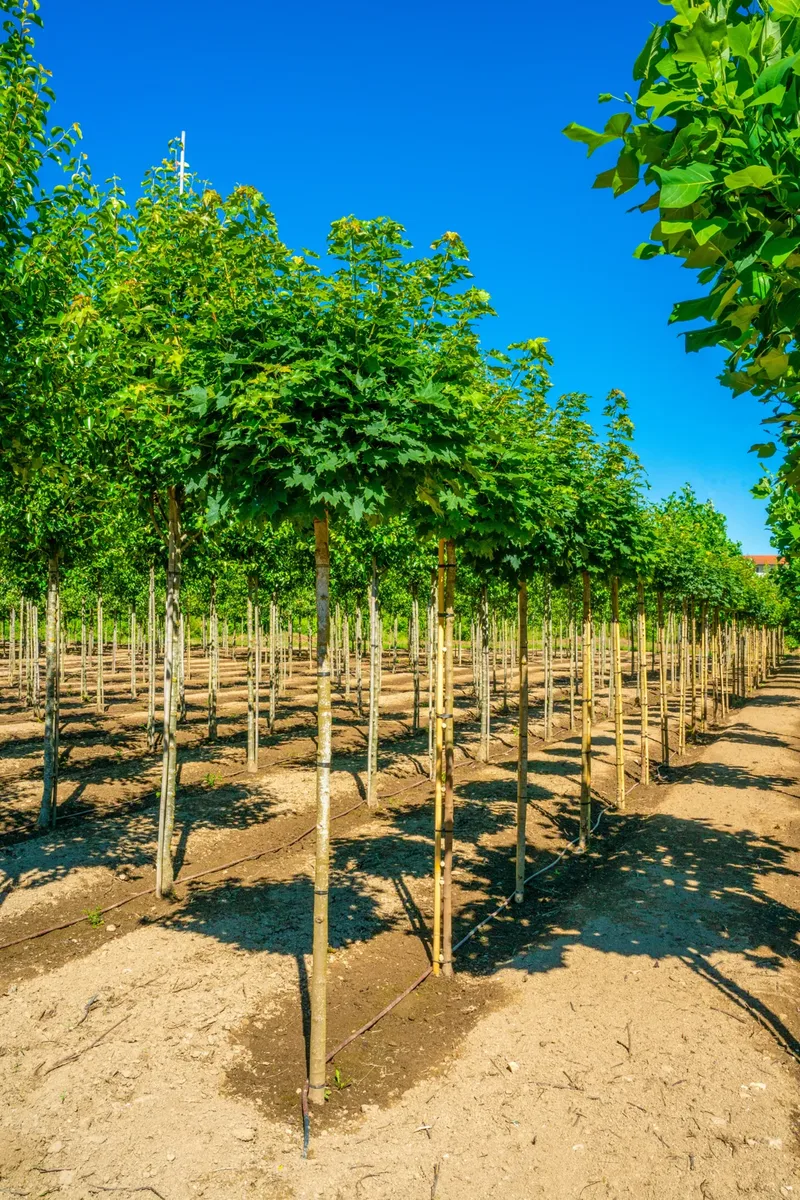
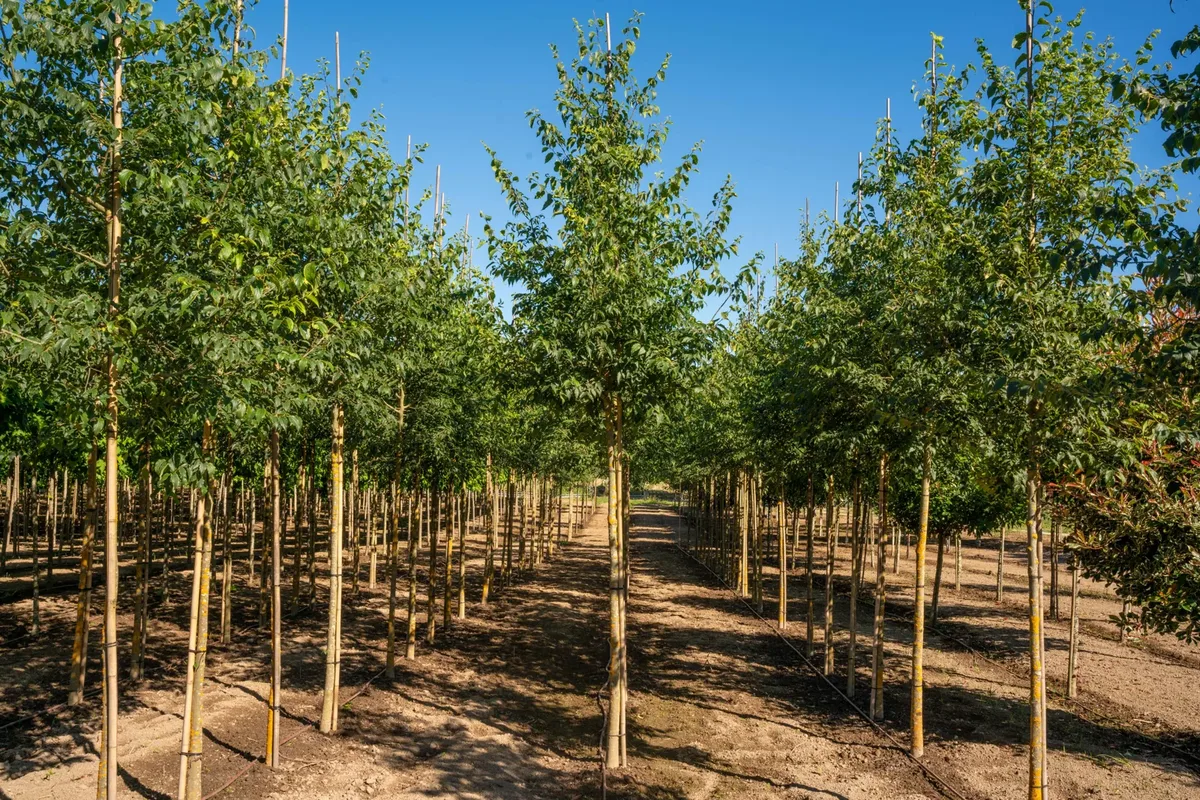
The aim of transplanting in the nursery is to allow that recovery to happen before the final lifting. During the new production cycle, roots form closer to the trunk and it becomes more likely that a functional part of the root system will be included in the future rootball.
This response is not the same in every tree. The species, the age, the vigour, the timing of the operation, the moisture of the soil and the amount of root preserved change the result considerably.
The tree is left with less root available
A field-grown tree can have roots well beyond the outline of the crown. Some are thick and structural; others are finer and play a greater part in absorbing water and nutrients. When the tree is lifted, it is not possible to transport that whole system.
The cut reduces the available root area immediately, while the crown keeps practically the same volume. For some time there is an imbalance: less root to supply the parts above ground.
The tree responds by adjusting its growth. It may reduce the expansion of the crown, partially close its stomata during periods of higher water demand and use reserves stored in its tissues. In parallel, it begins to form new roots.
The intensity of that response depends on the condition of the specimen. A tree with good vigour and reserves, transplanted at the right time of year and planted in a soil with water and oxygen available, is better placed to recover than a tree that is already weakened.
Where the new roots appear
After a root is cut, regeneration tends to occur on existing lateral roots and in areas close to the cut. The exact form varies, but the result sought in the nursery is the appearance of new branching within the area that can be transported later.
New roots start out with small diameters and are more active in exploring the soil. As they grow, some keep an essentially absorbing function and others thicken, playing a greater part in transport and stability.
The classic research by Gary Watson and T. Davis Sydnor showed this effect in Picea pungens. Five years after root pruning, the treated trees had more roots and a much larger root area within the rootball at harvest. The study was carried out on one particular species and production system, so it should not be used as a formula for all trees. It does, however, show the mechanism that is being put to use.
In nursery practice, counting roots matters less than observing the quality of the recovery. We look for a root system that is branched, well distributed and in keeping with the size of the specimen.
The root grows before it is cut again
Transplanting only produces the intended effect if the tree has time to recover.
Once the tree is replanted in the field, the root grows out of the volume originally moved and explores the soil again. The crown resumes its development as the capacity for absorption increases. A further transplanting will be carried out only when the specimen has recovered and the production cycle justifies it.
If the operation is repeated too soon, it can interrupt a recovery that is still incomplete. If it is put off for too long, the roots once again grow far from the zone of the future rootball. That is why the intervals are not the same for every species.
At Diaplant, trees in the mature range receive at least two transplantings. In the most mature batches, the cycle may reach, as a general rule, five, with intervals adjusted to the behaviour of the specimen. The tree’s history matters: when it was transplanted, how it reacted and how long it has stayed in its current plot.
Why some species need more attention
Root systems do not all follow the same architecture.
Several Quercus develop roots that run more vertically at an early stage and can form strong structural roots. In these cases, cutting and transplanting have to be timed so that the tree does not become too dependent on roots that cannot go with the rootball.
In Liquidambar and Platanus, we see more fibrous systems and a response that, as a rule, allows longer intervals. That does not mean an absence of stress; it means that the root pattern and the behaviour after the operation are different.
Betula extend their roots quickly and lose water easily during transplanting. Soil moisture and the timing of the operation become especially important. In magnolias, sensitivity to root cutting makes it necessary to keep a cautious ratio between the available root and the crown, especially in specimens with a lot of leaf.
These observations help in planning production, but they do not replace a reading of each tree. Even within the same species, the soil, the age and the vigour can produce different responses.
The relationship between root and crown
After the roots are cut, the tree temporarily has less capacity to supply water to the crown. That is why the transplanting season and the stage of growth are important.
In deciduous species, working during dormancy reduces the water demand of the parts above ground. When the leaves return, the root has already had some time to begin recovering, although establishment is still far from complete.
Crown pruning should not be used as an automatic response. Removing too much leaf area reduces photosynthetic capacity and removes reserves held in the branches. The decision depends on the species, the root volume preserved, the structure of the tree and the cuts that would already be needed for formative reasons.
The aim is not to make root and crown mathematically equal. It is to avoid an imbalance the tree cannot bear.
Water and oxygen during recovery
New roots need water, but oxygen too.
In dry soil, root growth slows and the tree may not be able to replace the water lost through the crown. In constantly waterlogged soil, the pores fill with water and the availability of oxygen falls. The root can be functionally limited even when there is too much water.
After transplanting in the nursery, watering should wet the volume that was worked and the surrounding soil. The frequency is adjusted to the species, the climate and the drainage. We do not use a single calendar because the same volume of water can be too little on one piece of ground and too much on another.
Soil structure counts too. Compaction, impermeable layers or sharp differences in texture can restrict the spread of roots out of the recently disturbed zone.
What we observe after the operation
The response is not judged only by the appearance of new leaves.
In the months that follow, we monitor vigour, the length of the new growth, the density of the crown and any signs of water loss. Too weak a restart may indicate insufficient recovery; very strong growth, after several years in the same place, may show that the tree has once again become too settled.
Observing the root system is harder because most of it stays in the soil. When a tree is lifted again, the rootball makes it possible to confirm whether fine roots have formed and whether their distribution suits the aim of production.
It is this history of operations and responses that helps to decide whether the tree should stay longer in the field, be transplanted again or be prepared to leave.
What transplanting in the nursery does not guarantee
A well-prepared root improves the starting conditions, but it does not guarantee adaptation at the destination.
At the final lifting, the tree loses roots again. During transport, the rootball has to keep its moisture and cohesion. On site, the soil needs to allow infiltration, drainage and root spread. Watering in the first years remains critical.
The scientific review of nursery production systems shows precisely this interaction. The production method influences root architecture and behaviour after planting, but the results vary between species and are strongly conditioned by the site, the planting technique and the maintenance.
Successive transplanting should therefore be understood as preparation. It gives the tree better conditions for carrying functional root with it, but establishment ends only when the new root system occupies the soil at the destination.
Continue the journey
This article is part of the Academy area and develops the physiological side of the process explained in the guide to transplanting in the nursery.
Why we transplant trees within the nursery What a tree’s rootball is
Sources and supporting references
- Watson, G. W.; Sydnor, T. D. (1987). “The Effect of Root Pruning on the Root System of Nursery Trees”. Journal of Arboriculture, 13(5), 126–130. DOI: 10.48044/jauf.1987.027.
- Gilman, E. F.; Paz, M.; Harchick, C. (2016). “Effect of Liner Container Size, Root Ball Slicing, and Season of Root Pruning in a Field Nursery on Quercus virginiana Growth and Anchorage After Transplanting”. Arboriculture & Urban Forestry, 42(4), 234–245. DOI: 10.48044/jauf.2016.022.
- Allen, K. S. et al. (2017). “A review of nursery production systems and their influence on urban tree survival”. Urban Forestry & Urban Greening, 21, 183–191. DOI: 10.1016/j.ufug.2016.12.002.
- European Arboricultural Standards. European Tree Planting Standard, 2025 revision.
Tags