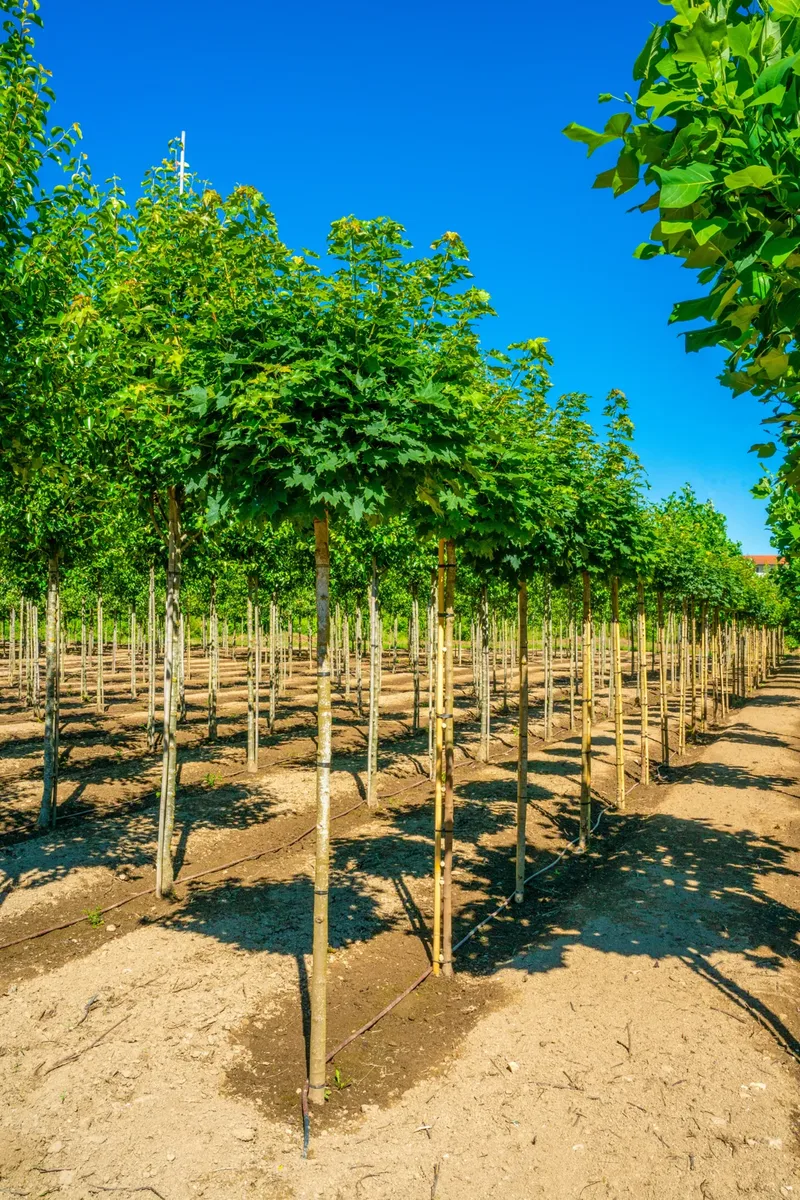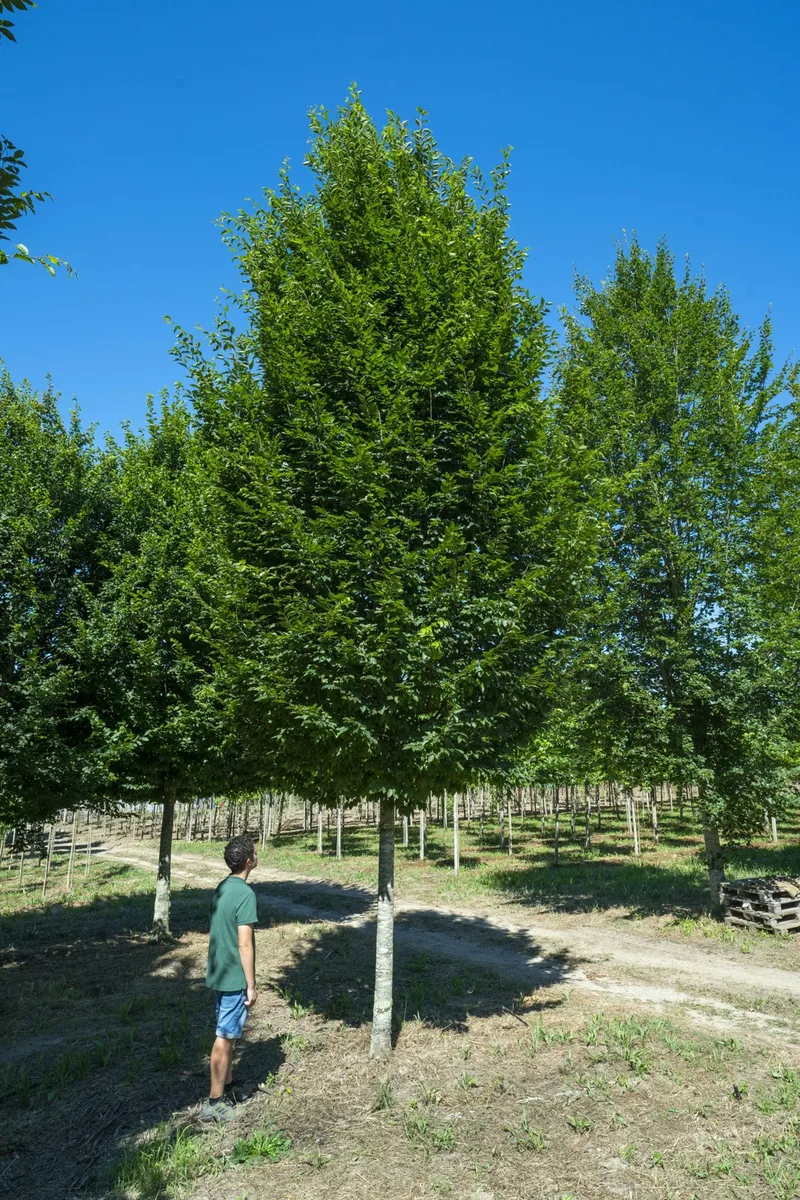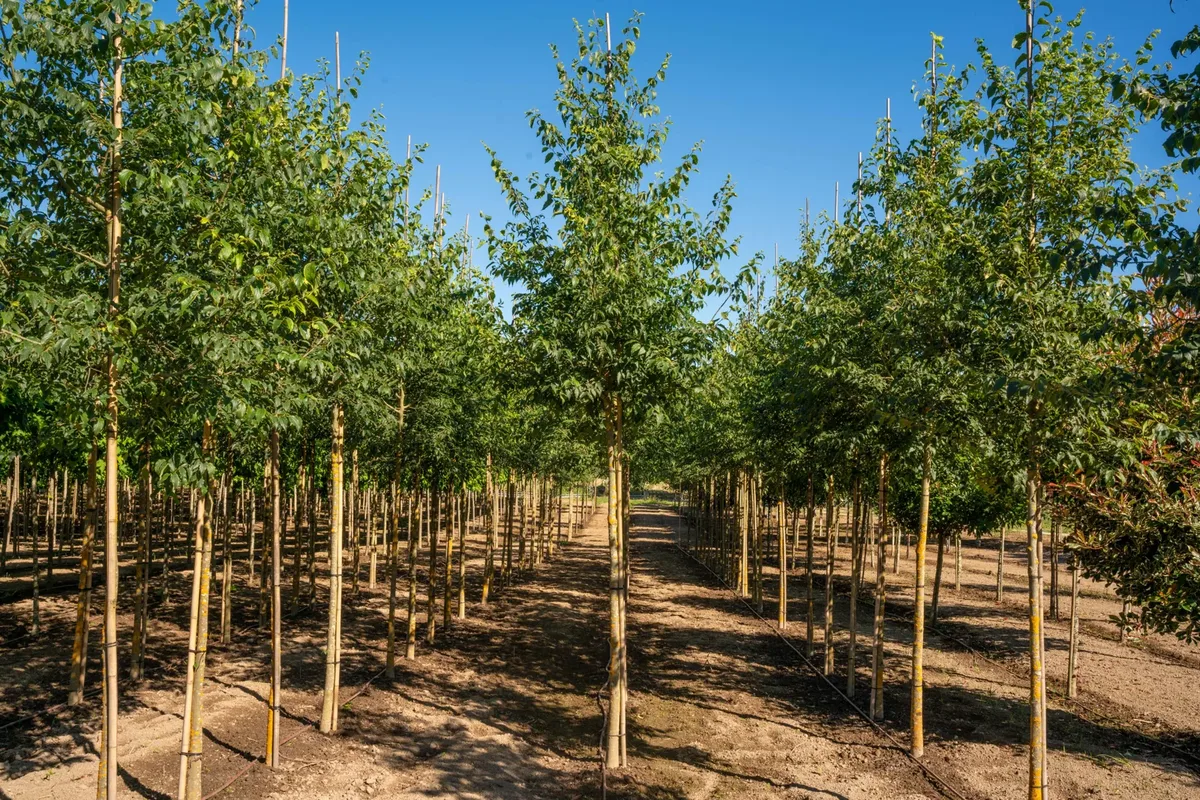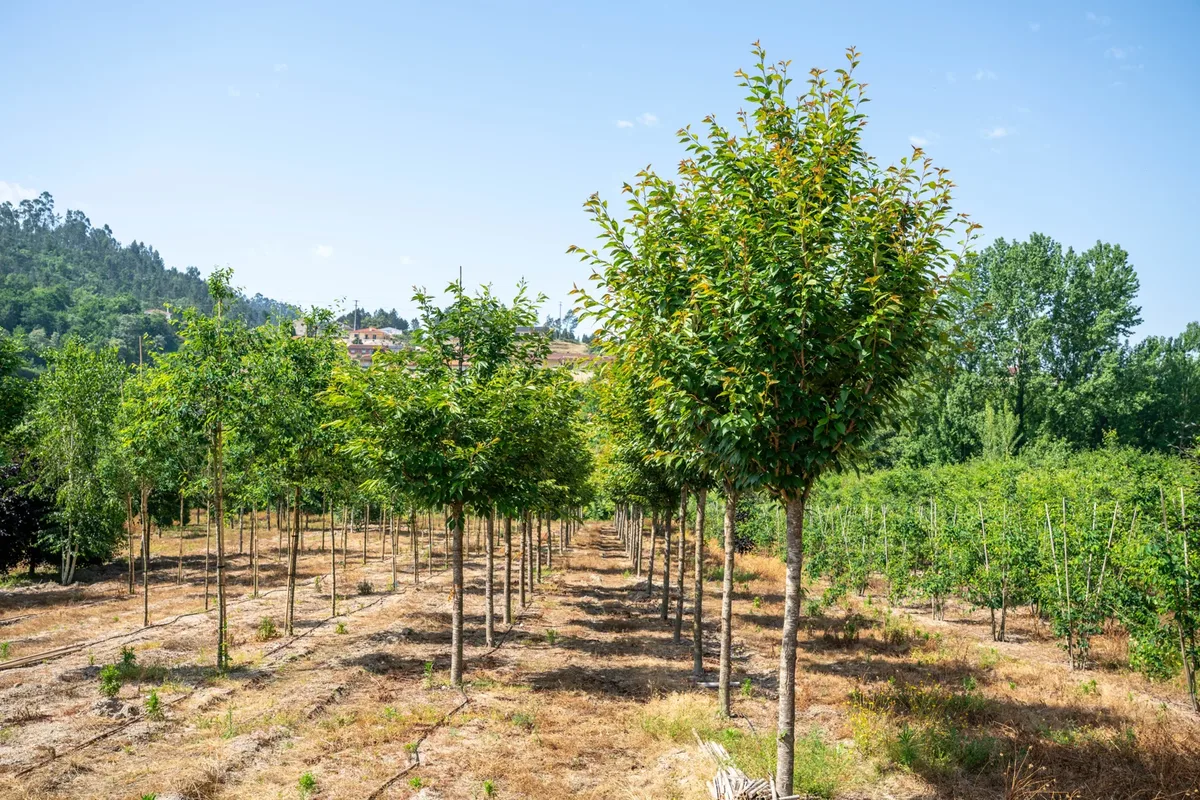
Field plot, Diaplant nursery.
A tree is not ready simply because it has reached a certain height or girth size. See how we assess root, rootball, trunk, crown, vigour and maturity.
A tree is not ready simply because it has reached a certain height, trunk girth or age.
Before it leaves the field, we assess whether the root system has been prepared, whether the crown has a suitable structure, whether the trunk is sturdy and whether the specimen has recovered from earlier operations. We also confirm that the tree can be lifted with a rootball compatible with its size and with the conditions of the project.
At Diaplant, trees in the mature range stay in our fields for at least six years and receive a minimum of two transplantings. Sale begins, on average, from ten years of age, but the final decision is made specimen by specimen.
Measurements are only the start of the assessment
Height and girth are needed to describe and specify a tree. They make it possible to compare sizes, prepare quotes and anticipate part of the logistics.
They do not show, however, the distribution of the roots, the cohesion of the future rootball or the way the crown has developed. Nor do they reveal whether the tree has only just recovered from a transplanting or has been settled in the same plot for too long.
Two trees with the same measurement can be at very different levels of preparation. One may be balanced and ready; the other may need one more cycle in the field.
That is why the technical sheet does not replace observation.
The roots have to be prepared
The first criterion lies below ground.
During production, the tree is transplanted to concentrate roots close to the trunk. Before final lifting, what matters is whether there has been enough time for recovery and whether the volume planned for the rootball can include an adequate quantity of functional root.
The answer varies with the species. Several Quercus need shorter cycles because of their root architecture. Liquidambar and Platanus generally tolerate longer intervals. Magnolias and birches call for particular attention to root cutting and water loss.
The production history helps with the decision. A tree that was transplanted recently may not yet be ready for another move, even if the crown looks vigorous.
The rootball has to be viable
The size of the rootball is set according to the size of the tree, the species, the soil and the earlier preparation.
Before the tree leaves, we assess whether a cohesive volume can be formed and handled without breaking up the roots. The type of soil has a direct influence. Ground that is too dry, saturated or lacking in cohesion may mean postponing the operation.
It is also necessary to confirm that the rootball is compatible with the access and the means of transport. A tree may be biologically ready and still not be suitable for a particular site because its weight or width exceeds what the site allows.
This question should be settled during selection and not on the day of delivery.
The crown should match the destination
The tree is observed from several angles.
We look for a distribution of branches compatible with the form, no significant damage and a balanced relationship between the volume of the crown and the trunk. A tree for avenue planting needs greater uniformity and a crown height consistent with the others. In a garden, a more irregular form may be precisely the best choice.
The criterion is not perfect symmetry. Some species have naturally open, weeping or asymmetrical crowns. What we assess is whether the structure is stable, whether it respects the tree’s habit and whether it serves the project.
When there are still gaps in the branching or imbalances that can be corrected with time, the specimen stays in production.
The trunk and the root collar
The trunk is examined for soundness, taper, wounds and development.
On grafted trees, we also look at the graft union and the relationship between the rootstock and the crown. The root collar should be identifiable and not hidden by a build-up of soil. This check will matter later for setting the correct planting depth.
Marks left by production are not assessed in isolation. What matters is their size, how they are developing and their influence on structural or visual quality. A small wound that is healing over does not mean the same as extensive damage or a weak union between stems.
Vigour has to be read with care
A dense crown and long shoots may seem sufficient signs of quality, but vigour has to be interpreted in the context of the production cycle.
If a tree grows too fast after several years in the same place, it may be too well settled in the plot. The roots have spread again far from the zone of the future rootball, and it may need to be transplanted once more before sale.
The opposite also deserves attention. A tree with reduced growth may be recovering from an operation, suffering from the soil or showing a problem that is not yet evident.
The team compares the current pattern with the behaviour expected of the species and with the history of the specimen.
Age does not determine the leaving date
Trees start to be sold, on average, from ten years of age, and much of the range is between 15 and 20 years old.
These figures help to explain the type of production, but they do not work as a deadline. Some species reach the intended characteristics sooner; others need more time. There are also trees that stay in the field for reasons of form, root or maturity.
The age given in the catalogue is approximate. Within the same batch, trees can differ in development and be ready at different times.
The production process does not end when a tree reaches a birthday or a measurement.
Health and general condition
Before dispatch, we check for symptoms that might argue against lifting.
The observation covers leaves, branches, trunk, root collar and visible signs in the soil. An isolated change does not necessarily mean that the tree cannot leave, but it has to be understood.
The season also counts. On deciduous trees, assessing the crown during dormancy gives a better view of the structure, but it does not show how the foliage behaves. The history of the growing season completes that reading.
When there are doubts, the tree stays in the nursery until a safe decision can be made.
The project can change the selection
Being ready to leave the field does not mean being suitable for every project.
A tree may be of good quality and not fit the future space for its crown. It may require a crane that cannot reach the site, or have an orientation that is not favourable for the intended position. A species that is right for a deep soil may not be the best choice for a restricted tree pit.
Selection relates the tree to the place. We assess the species, form, size, access, wind, drainage and the capacity for aftercare.
In projects with uniform batches, compatibility between specimens also matters. Sometimes a tree that is good individually is left out because it does not match the group.
Preparing the departure
After approval, the lifting period is set, normally within the season from November to April.
The team chooses the machine and the blade size, forms the rootball, wraps it in hessian and wire mesh and prepares the crown for transport. The trunk is given suitable protection and loading is coordinated with the weight, the access and the unloading sequence.
This stage can still reveal limitations. If soil conditions do not allow a secure rootball to be formed, or if the weather increases the risk, the operation is postponed.
The tree is only truly ready when its biological condition and the logistics of the operation are compatible.
Why some trees stay longer
Keeping a tree in the field does not mean there is a serious problem.
It can be a decision about quality. The crown needs one more cycle, the roots have to be prepared again or the tree has not yet reached the intended proportions. In other cases, the longer stay comes from the natural pace of the species.
What matters is not to force the tree out just to meet a measurement or a date. A mature tree represents years of production, and the last decision should protect that work.
Choosing at the nursery
A visit lets you compare specimens of the same species, look at the crown from different angles and confirm the real scale before selecting.
Book a visit to the nursery Discover Diaplant’s production
Related content
- How a mature tree is formed
- Why we transplant trees within the nursery
- How the architecture of the crown is formed
- How to assess the quality of a mature tree
Sources and supporting references
- European Arboricultural Standards. European Tree Planting Standard, 2025 revision.
- European Arboricultural Standards. European Tree Pruning Standard, February 2025 version.
- Watson, G. W.; Sydnor, T. D. (1987). “The Effect of Root Pruning on the Root System of Nursery Trees”. Journal of Arboriculture, 13(5), 126–130. DOI: 10.48044/jauf.1987.027.
- Allen, K. S. et al. (2017). “A review of nursery production systems and their influence on urban tree survival”. Urban Forestry & Urban Greening, 21, 183–191. DOI: 10.1016/j.ufug.2016.12.002.
Tags