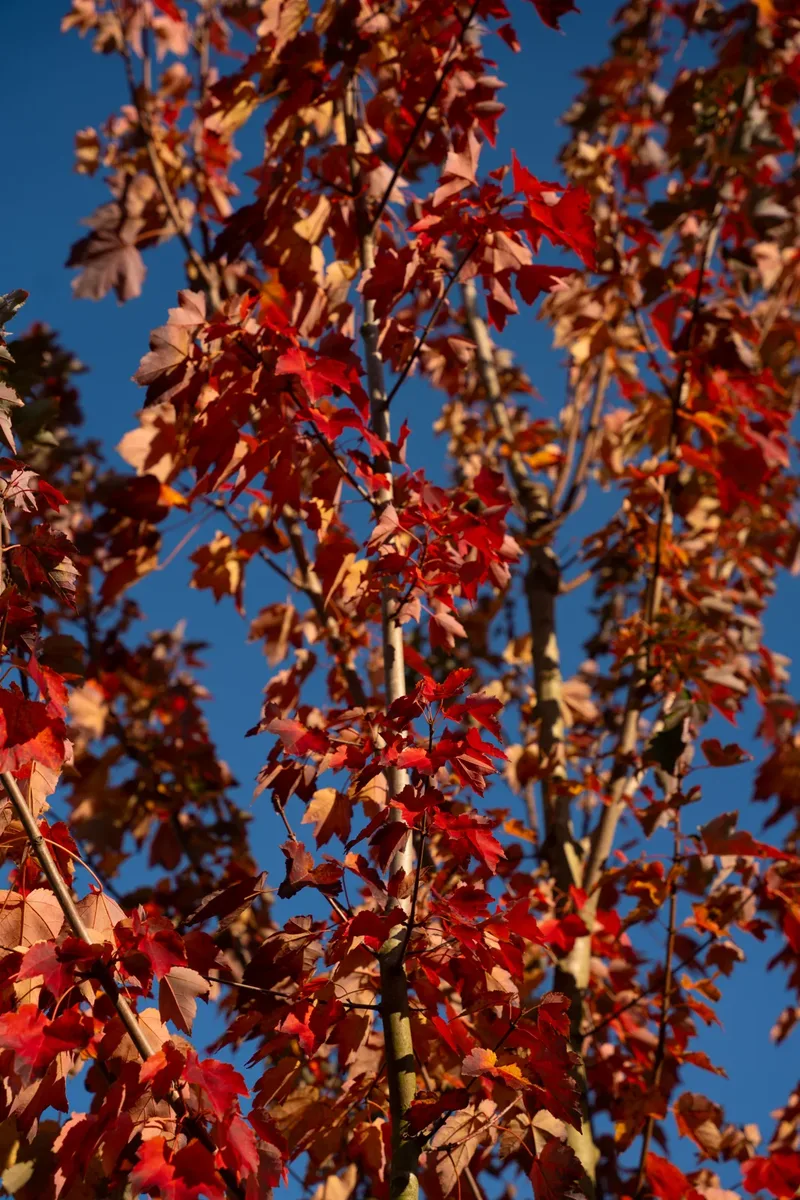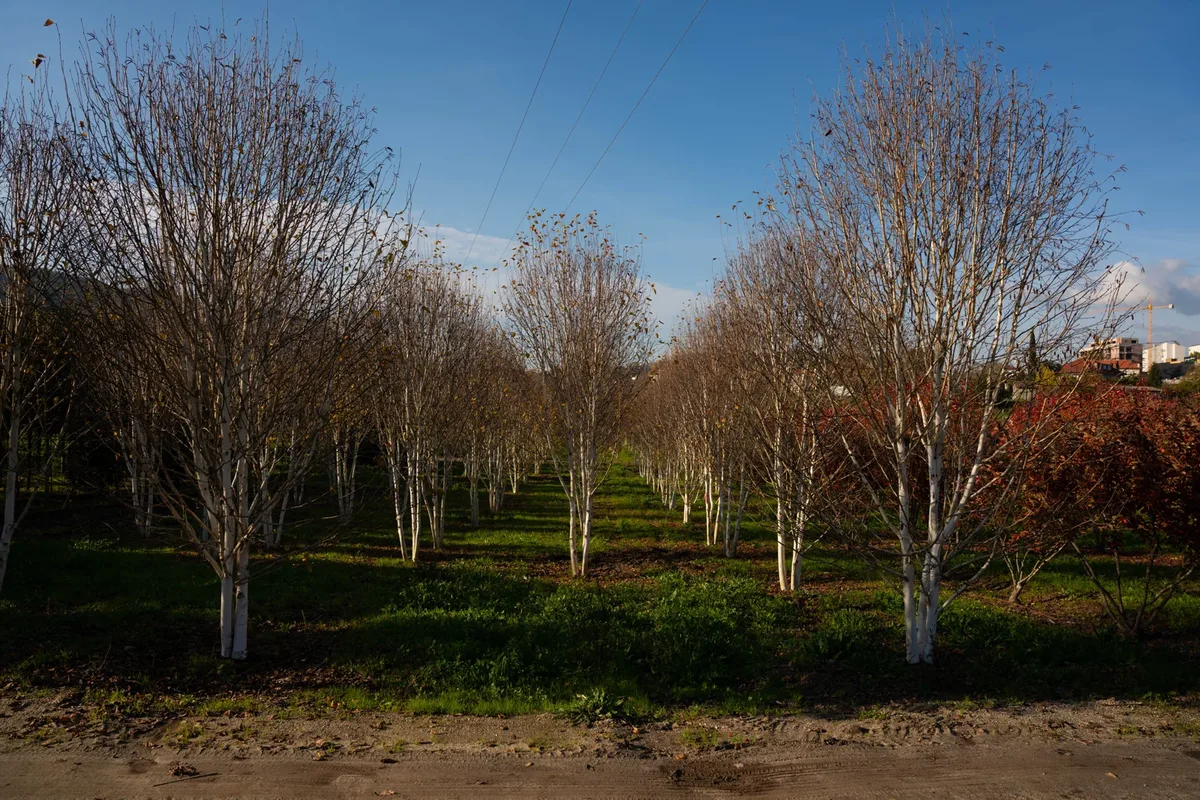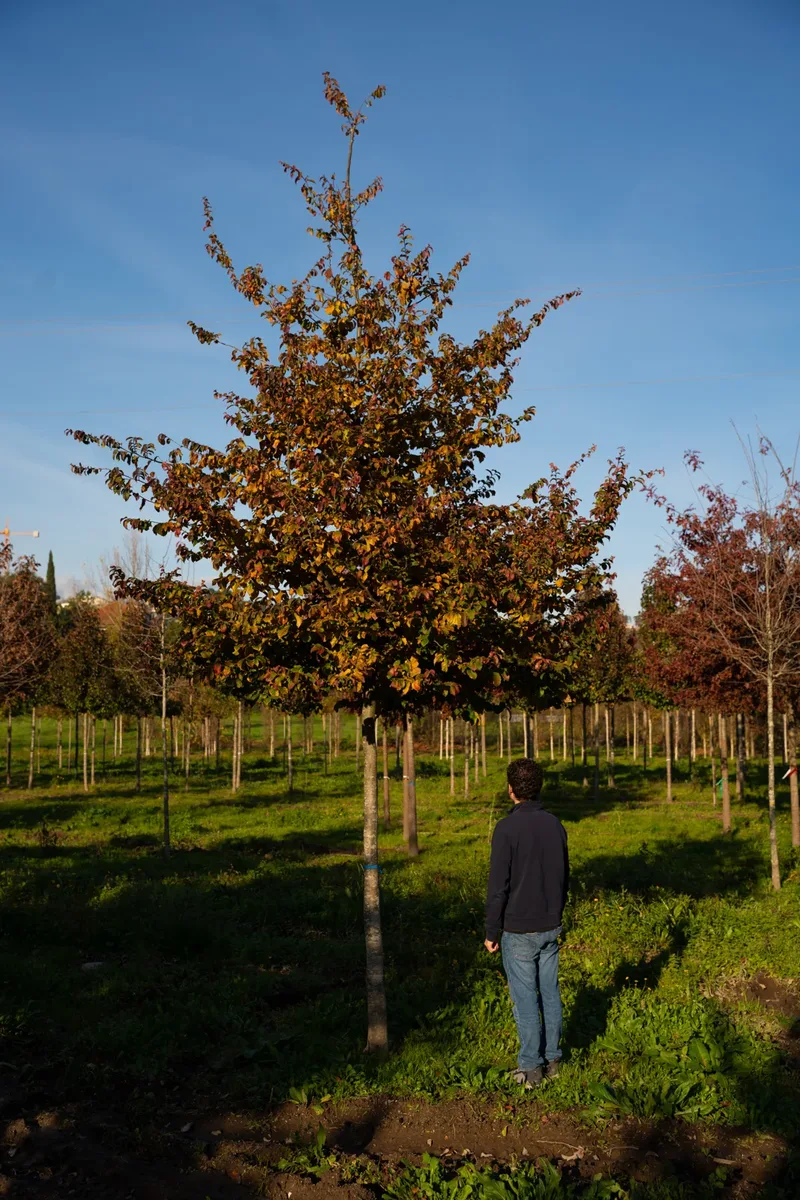
Parrotia persica in autumn colour, Diaplant nursery.
Parrotia persica offers autumn colour, decorative bark and a broad crown. Get to know its forms, conditions and use.
Parrotia persica is a deciduous tree valued for its autumn colour, its bark and a broad crown that gains presence with age. It can be formed as a single-stem tree or a multi-stem, and the choice changes the scale near the ground considerably.
The species grows at a moderate rate and adapts to different well-drained soils. Its image as a small tree should not lead you to underestimate its width: the RHS gives a crown that can exceed eight metres.
Discreet flowering
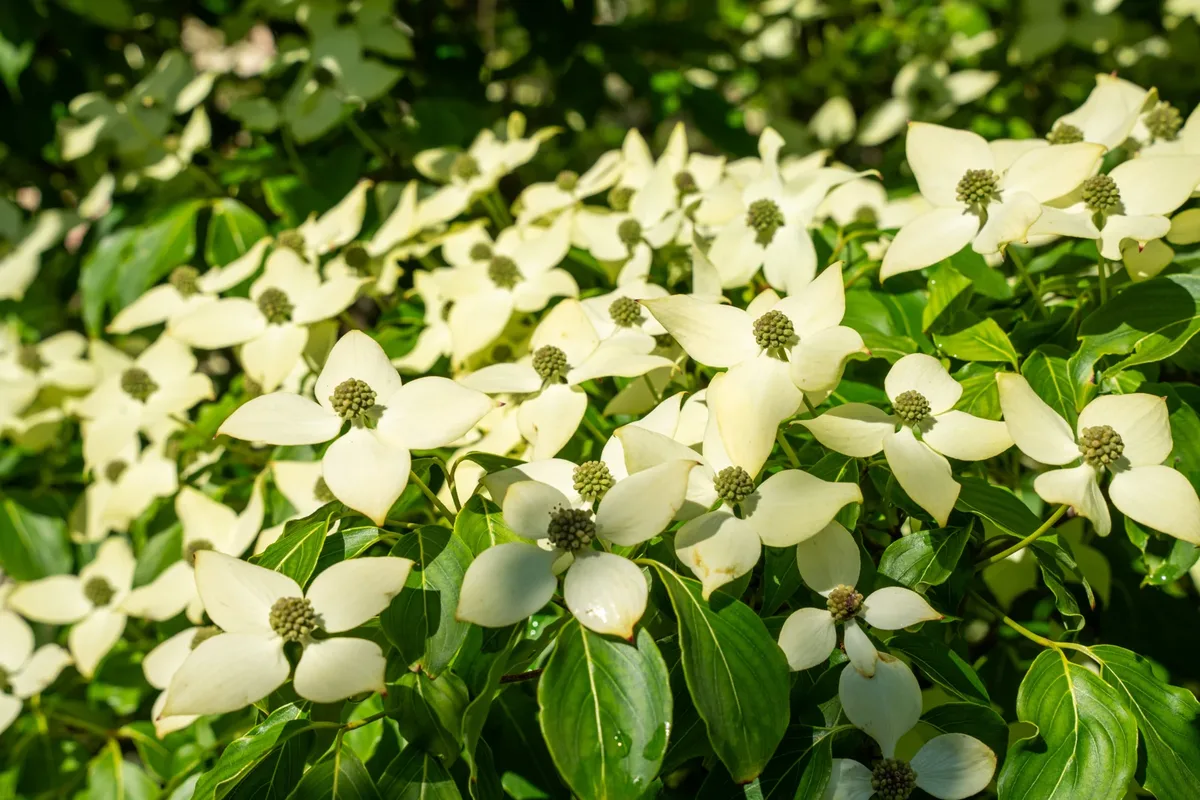
The flowers appear in late winter or early spring, before the leaves. They are small and reddish, with no large petals.
The effect is best seen close up and against the dark branching. It is not the main reason for choosing the species, but it adds interest at a time of little activity.
Afterwards the crown fills with green leaves, sometimes with a bronze tint as they open.
Autumn colour
The same tree can show yellow, orange, red and purple. The leaves do not all change at the same time, creating a long transition.
The intensity depends on temperature, light and water. In years of drought or prolonged heat, the leaves may fall early and reduce the effect.
Autumn should not be described as a guaranteed colour. The quality of the soil and of watering through the summer influences the result.
Bark
On mature specimens, the bark flakes off in plates and reveals cream, grey and brown tones.
The effect is most visible on a multi-stem, where there is more trunk surface at eye level. On a standard tree, the bark follows a more formal axis.
Maturing is slow. A young tree may not yet show the expected pattern and needs time to develop it.
Crown and size
The crown tends to be broad, dense and somewhat irregular. The multi-stem takes up more space from the base and works well as a free-standing specimen or in naturalistic gardens.
The standard tree allows circulation and a clearer reading of the trunk. It needs early formative training to define the leader and the crown height.
The species is not suited to a narrow space simply because it grows slowly. Its final size still calls for width.
Soil
It adapts to clay, loam, sandy and chalky soils where there is drainage. It grows best with depth and regular moisture.
Once established, it tolerates some dryness, but autumn colour and crown density benefit from available water.
Persistent waterlogging is unfavourable. On construction sites, compaction should be checked before planting.
Aspect
Sun and partial shade are both possible. With good exposure to light, autumn colour tends to be more expressive.
In very hot positions, watering and protecting the soil become important. Partial shade should still offer enough light for a balanced crown.
The tree tolerates exposure, but large specimens need suitable staking during establishment.
Use in the project
Parrotia persica works well in parks, contemporary gardens, wide lawns and compositions where winter structure matters.
It can be combined with evergreens that give a backdrop to the colour and the bark. Grasses and perennials make it possible to keep the base open and see the trunks.
In medium-sized courtyards, a form and cultivar of compatible size should be chosen. Narrower or more compact selections exist, but they need a confirmed name.
Planting
The rootball is set with the root collar at the surface and the soil prepared over a wide area. A layer of organic mulch helps to maintain moisture and biological activity.
Watering in the first years should be deep. Keeping the leaves healthy until autumn is part of establishment.
The orientation of a multi-stem can be chosen at the nursery, making the most of the more open side or the best group of bark.
Pruning
Pruning is minimal. The structure gains quality with time and does not benefit from regular cuts to create geometry.
Crossing branches and structural problems are dealt with early. On multi-stems, the relationship between stems is observed without trying to make all the diameters uniform.
Parrotia persica does not give its best effect straight away. It is a tree whose bark, width and colour become more expressive as the garden matures.
Related content
Sources and supporting references
- Royal Horticultural Society — plant profile for Parrotia persica.
- Plants of the World Online, Royal Botanic Gardens, Kew.
- Trees and Shrubs Online, International Dendrology Society.
Tags