A large tree can have size without the same maturity or preparation. We explain what separates size, age, training and nursery quality.
A large tree has significant dimensions. A mature tree brings together size, maturity and nursery preparation.
In practice, the two terms are often used interchangeably. The difference matters when you compare the quality of specimens of the same height or the same girth.
A tree can grow quickly and reach a large size without having had the transplanting, the structural training or the time it needs to consolidate its crown. It can also be many years old and still be relatively small, because the species grows slowly or because it has been trained in a particular way.
What ‘large’ means
‘Large’ mainly describes what can be measured.
It may refer to height, girth, crown spread, volume or weight. It is a useful indication for understanding the immediate scale and for organising transport, planting and the quote.
The term does not explain how the tree was produced. Two large trees can have very different histories. One may have been transplanted several times within the nursery; another may have stood in the same place for years. One may have a balanced crown; another may have grown unevenly in search of light.
Size is one characteristic. It is not a complete assessment.
What ‘mature’ means in nursery production
There is no universal botanical age at which every tree becomes mature.
Species move at very different rates. A Betula and a Quercus do not reach maturity at the same speed. The way a tree is produced also alters its development.
At Diaplant, we use the term for specimens that have already been through a long cycle of training and have the scale, structure and root preparation needed for use in a project.
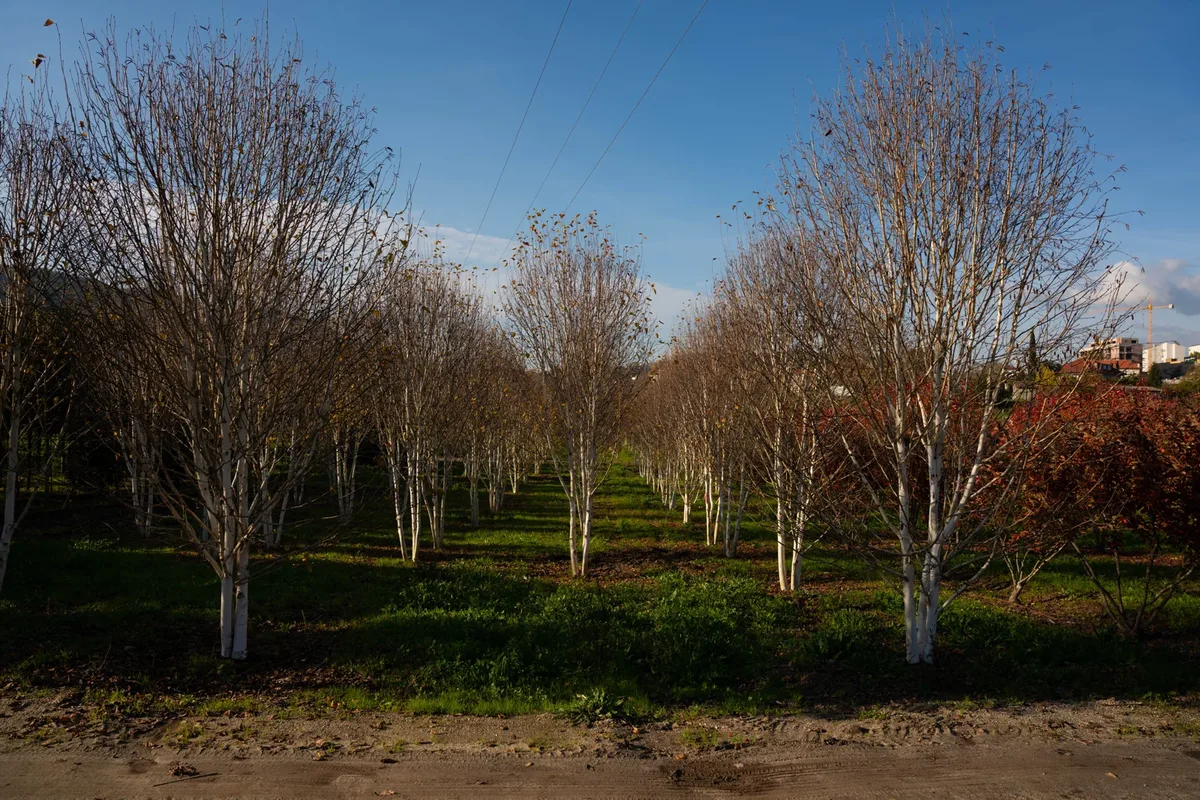
Trees in this range spend at least six years in our fields, are transplanted a minimum of twice and are, on average, first sold from the age of ten. A good proportion are around 15 to 20 years old, although some batches are considerably older.
These figures frame the method, but the decision is still made tree by tree.
The roots are a decisive part of the difference
The visible size grows above ground, while the ability to be transplanted depends on what has happened below it.
A tree that has stood for a long time without being transplanted may have much of its root system far from the trunk. At lifting, the rootball takes in only a fraction of the system that was supplying the crown.
Transplanting in the nursery cuts long roots and stimulates new branching close to the zone that will be moved. Repeating the operation and allowing time for recovery increases the amount of root available inside the future rootball.
A prepared mature tree does not keep all of its roots. That is not possible. It does, however, arrive with a root system that has been worked to cope better with the move.
The structure of the crown
Fast growth can produce size without producing good architecture.
Competing branches, crossing branches or imbalances become harder to correct as they gain diameter. Formative pruning follows the tree from early on and spreads the corrections over several cycles.
On a standard tree, it may be necessary to guide the leader and set the crown height. On a multi-stem, what is assessed is how the stems arise and the relationship between them. On trained forms, the work is more specific still.
A mature tree does not need a perfectly symmetrical crown. It needs a structure that is consistent with the species, the form and the intended use.
Age is not enough either
An old tree may not have the preparation it needs to be transplanted.
Specimens that have grown for decades in a garden or on a plot of land are not equivalent to mature trees produced in a nursery. The roots have spread freely and the crown has adapted to the conditions of that place.
Transplanting an existing tree may be possible, but it calls for study, preparation and specialist equipment. Great age does not automatically turn a specimen into prepared nursery stock.
The same holds in the other direction. A younger tree may be well formed, have been transplanted within the cycle and have the maturity needed for a given use.
The immediate effect on the project
Both a large tree and a mature tree create scale as soon as they are planted. The difference lies in how predictable the process is.
A prepared specimen has a production history, a known form, a correctly sized rootball and planned logistics. You can select it in the field, assess the crown and coordinate planting with the project.
That does not remove the period of adaptation. The tree loses roots at lifting and needs watering and aftercare. Maturity does not mean an absence of stress.
It means that work was done beforehand to improve the conditions in which the tree faces that change.
You do not always need to choose the largest size
A mature tree of moderate size may be more suitable than the largest specimen available.
The future space for the crown, the soil volume, the access and the capacity to water should limit the choice. A very large size increases the weight of the rootball and the demands of the operation. It also tends to lengthen the time the roots need to occupy a volume of soil in proportion to the crown.
In some projects, a smaller tree establishes faster and adapts better to the conditions. In others, the immediate scale justifies a large mature specimen.
The decision depends on the aim and on the real capacity of the site.
How to compare two specimens
The comparison should start with the species and the form required. Then look at the measurements, the production history, the rootball, the trunk and the crown.
At the nursery, it is important to see the tree from several sides. The direction of the branches, the true spread and the relationship with human scale do not come across fully in a photograph.
It also matters whether the specimen will be used on its own or as part of a batch. A singular, expressive tree may suit a garden, while an avenue planting calls for greater regularity between crowns and clear stem heights.
Simply asking ‘which is the biggest?’ rarely leads to the best selection.
The term should be backed by information
In a project and in a quote, the terms should be supplemented by measurements and specifications.
Girth, height, form, crown spread, production type and rootball size help to reduce differing interpretations. For batches, uniformity criteria can also be set.
The term ‘mature tree’ describes the positioning and the history of the specimen, but it does not replace that data.
At Diaplant, selection combines the catalogue information with observation in the field. It is that combination that makes it possible to choose a tree suited to the place and to the result expected.
Choosing at full scale
At the nursery you can compare sizes, maturities and forms before deciding on the specimen for the project.
Book a visit to the nursery Discover the mature trees
Related content
- How a mature tree is formed
- How to assess the quality of a mature tree
- Girth, girth size, height and pot volume
- How to choose the right tree for each place
Sources and supporting references
- European Arboricultural Standards (2022). European Tree Planting Standard.
- Watson, G. W.; Sydnor, T. D. (1987). “The Effect of Root Pruning on the Root System of Nursery Trees”. Journal of Arboriculture, 13(5), 126–130. DOI: 10.48044/jauf.1987.027.
- Allen, K. S. et al. (2017). “A Review of Nursery Production Systems and Their Influence on Urban Tree Survival”. Urban Forestry & Urban Greening, 21, 183–191. DOI: 10.1016/j.ufug.2016.12.002.
Tags