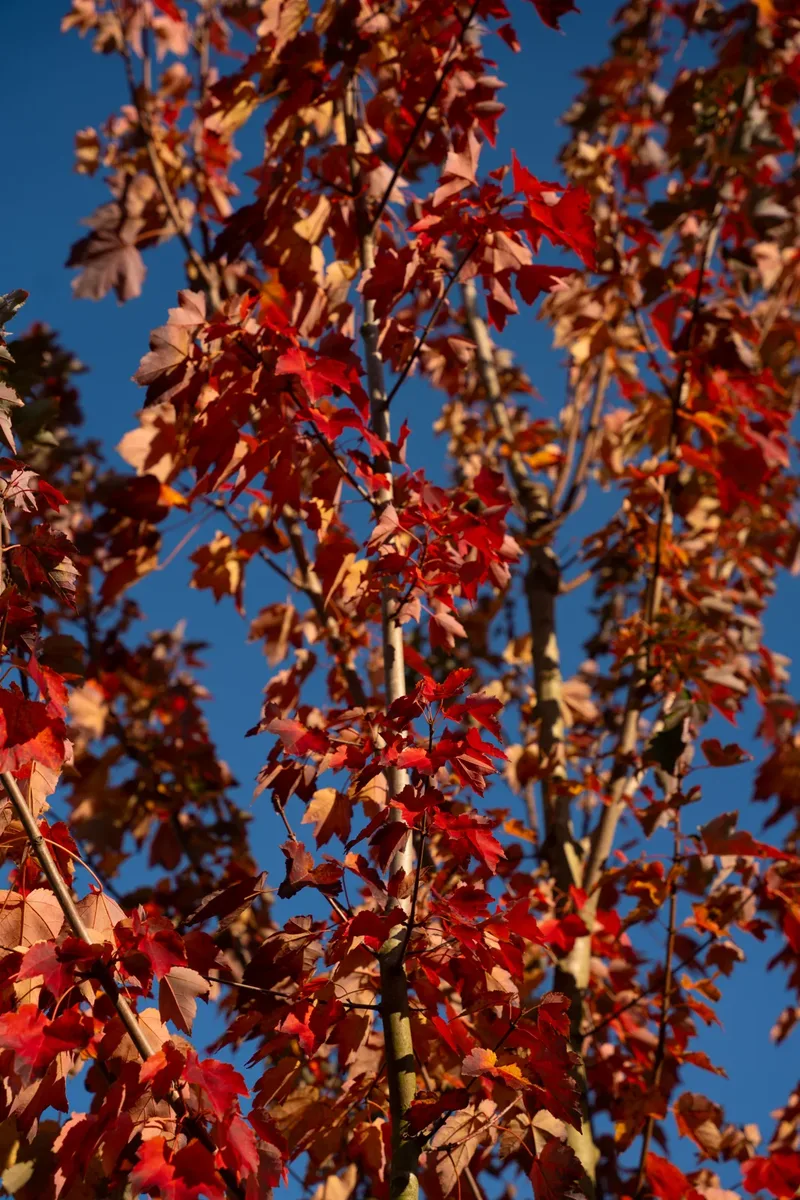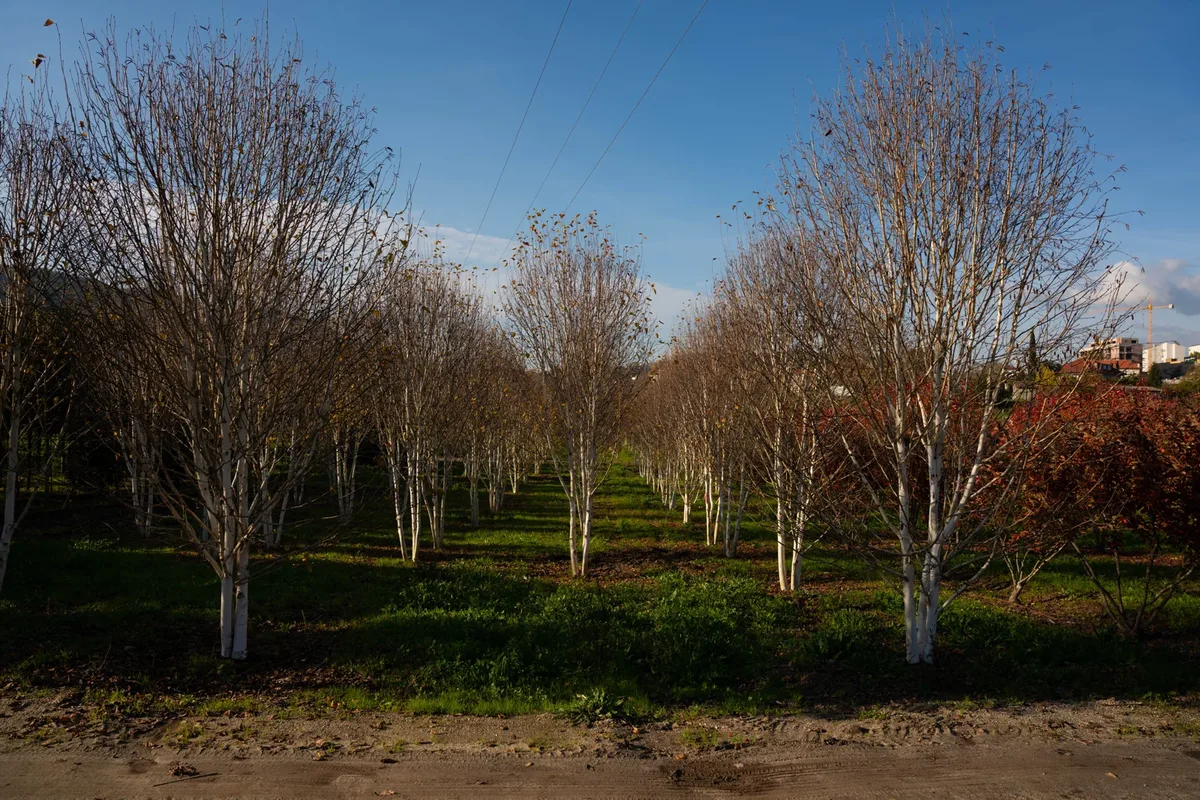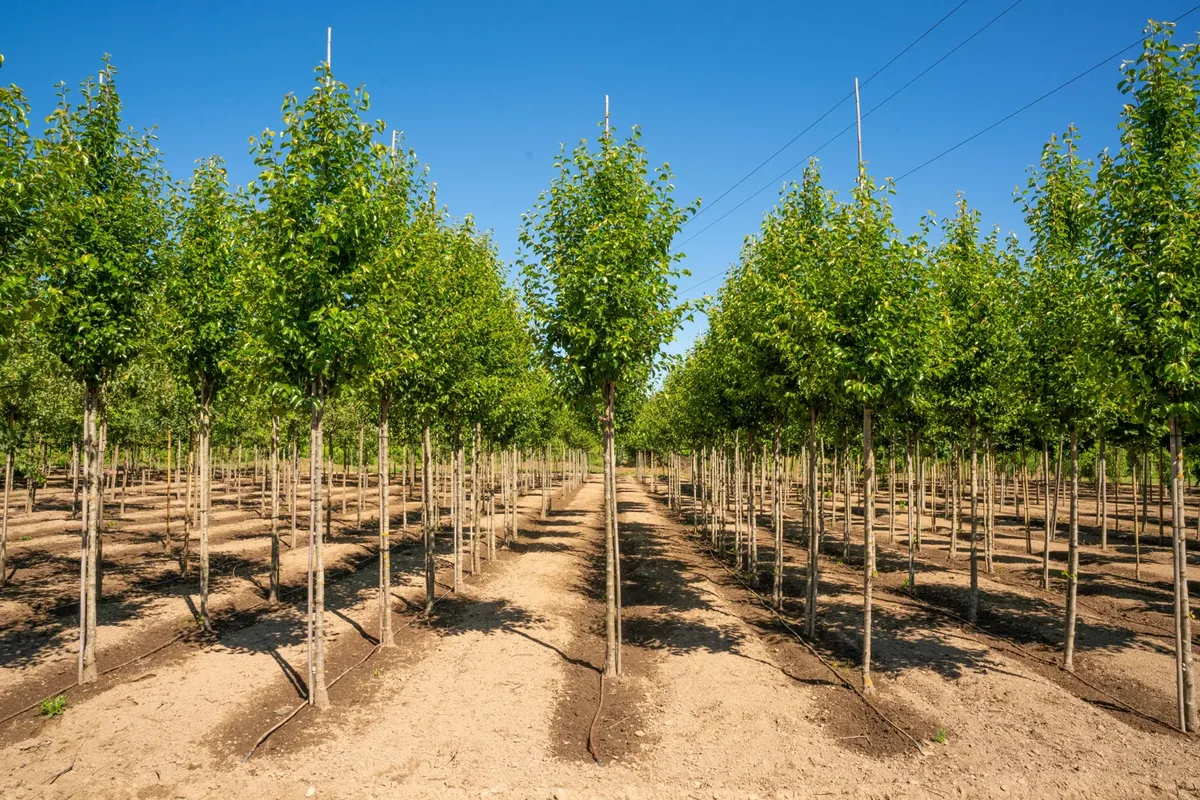
Uniform plot, Diaplant nursery.
Avenue planting and formal compositions call for trees that match in girth size, crown and vigour. Find out when to select and which tolerances are realistic.
A uniform batch brings together trees that are close enough in size, form and stage of development to work as a group. It does not mean producing identical specimens. Natural variation remains, but it should not break the rhythm intended in the design.
This selection is particularly important in avenue planting, entrances, car parks and geometric compositions. In an informal garden, the difference between trees can be a quality rather than a problem.
Where uniformity has the greatest impact
When trees are planted at regular intervals, the observer compares them automatically. Differences in crown height, spread or lean become more visible than in a loose group.
In avenues and streets, the continuity of the crown influences shade and the reading of the space. In a formal square, a specimen that is much smaller or branches low can alter the composition.
Next to architecture, crowns may also need to be coordinated with windows, façades and axes. In these cases, selection should begin before delivery and not be made solely on the basis of a list of measurements.
What should be compared
Girth and height are only the start. The team looks at crown height, spread, leader, distribution of branches, vigour and degree of maturity.
Two trees with a girth of 30–35 cm can differ significantly in volume. If they are planted side by side, the crown may weigh more in the reading than the small variation in the trunk.
Orientation also counts. A tree with more volume on one side can be compatible with the batch if that side is turned to an equivalent position in the row.
Uniform does not mean identical
Trees are living organisms. Even when they belong to the same batch, they have responded differently to the soil, the aspect and the production operations.
Demanding total sameness leads to rejections that serve little purpose and does not guarantee that the trees will stay the same after planting. Small differences may grow with time or shrink as the crowns adapt to the new site.
The design should state the essential attributes and the acceptable tolerances. In a pedestrian avenue, crown height may be critical; in a formal woodland, overall volume may matter more.
Selecting and reserving early
The larger the number of trees and the more demanding the standard, the earlier the batch should be sought.
Reserving early makes it possible to follow the specimens, confirm availability, prepare additional transplantings and, in some cases, adjust the training of the crown. It also gives time to find alternatives if the number required cannot be gathered from a single source.
In phased projects, the difficulty increases. The trees planted first go on growing while the rest stay in the nursery. It may be necessary to reserve the whole set or accept that the phases will show temporary differences.
One species or several
Uniformity does not mean using a single species throughout the project. Diversity reduces vulnerability and can be introduced in an organised way.
A street can work with different sequences for each stretch, keeping forms and crown heights compatible. In a park, different species can repeat a rhythm or a scale.
Mixing at random does not produce planned diversity. The change should have a legible logic and consider the future behaviour of each tree.
Visual batch and production batch
Trees that look alike may have different production histories. For a demanding project, it is worth knowing the root preparation, the transplanting season and the ability to form compatible rootballs.
A batch that is visually uniform but has very different roots or vigour may respond unevenly after planting.
The assessment should therefore combine appearance and history. Immediate uniformity is not the only aim; a reasonably consistent adaptation is sought too.
Tolerances in the specification
A useful specification sets ranges for girth, overall height, crown height, form and quality. It should state when selection in person is required and how substitutions will be approved.
Criteria that are too narrow can exclude good-quality material without improving the result. Vague criteria leave room for trees that meet only the easiest measurement.
Reference photographs help, but they should not create an expectation of an exact copy.
Planting the group
On site, the trees should be laid out before they are fixed in place for good. The team compares volumes and orientations, placing the most closely matched specimens in the positions where they will be most directly compared.
The planting level, the staking and the watering should keep to the same technical standard. Differences in installation can produce an uneven batch even when the selection was correct.
What happens over time
The trees go on becoming individuals. The availability of water, the light and the proximity of buildings affect each position.
Maintenance should aim for continuity without forcing every crown into an artificial geometry. Formative pruning corrects structural problems; it should not be used to turn living trees into permanent copies.
A uniform batch is a foundation for the project. The design, the planting and the management determine whether that reading holds.
Related content
- How to choose a specimen at full scale in the nursery
- How to assess the quality of a mature tree
- Species diversity in tree planting
Sources and supporting references
- European Arboricultural Standards. European Tree Planting Standard.
- Principles for specifying and selecting plant material for landscape projects.
- Batch selection criteria used by Diaplant.
Tags