Diaplant
Genus, species, cultivar, hybrid and production form mean different things. Learn to read a plant’s name correctly.
A plant’s name can identify the genus, the species, a cultivar, a hybrid and also a production form. Each part adds different information.
Confusing these levels can lead to specifying a plant with a different size, colour or behaviour. An Acer palmatum is not equivalent to every Japanese maple cultivar, and ‘multi-stem’ is not part of the botanical name: it describes the form in which the specimen was grown.
Genus and species
In Acer palmatum, Acer is the genus and palmatum the specific epithet. Together they form the name of the species.
The genus begins with a capital letter and the species with a lower-case one. Both are written in italics. After the first mention, the genus can be abbreviated when there is no risk of confusion: A. palmatum.
The scientific name makes it possible to communicate between countries and reduces the ambiguity of common names. Even so, taxonomy changes with new research and some species keep synonyms in circulation.
Cultivar
A cultivar is a selection maintained in cultivation for recognisable and relatively stable characteristics. It may be distinguished by colour, size, leaf shape, flowering or habit.
The name appears in single quotation marks and is not written in italics: Acer palmatum ‘Bloodgood’.
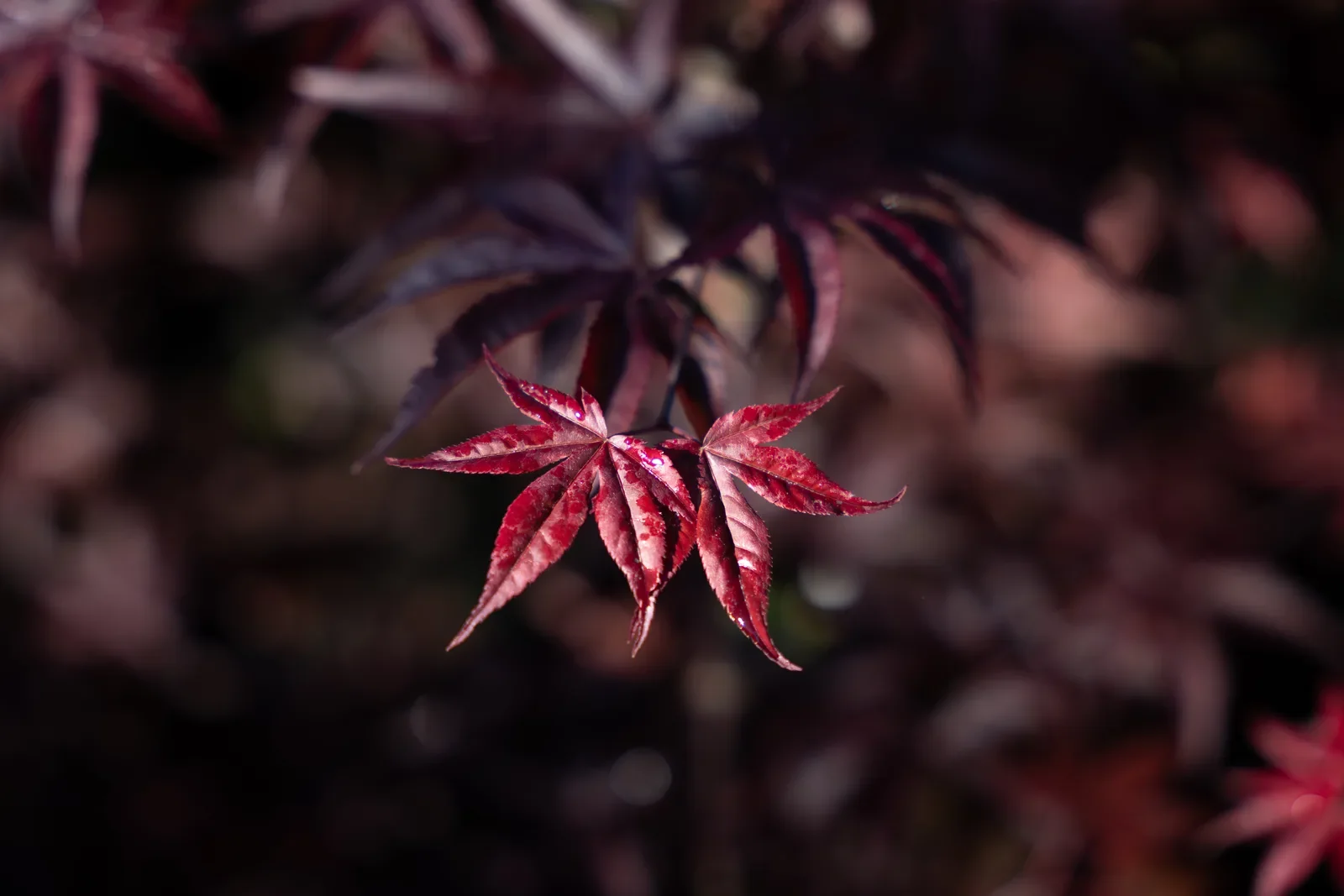
Cultivars of the same species can behave very differently. ‘Bloodgood’ forms a small upright tree; ‘Garnet’ belongs to the cut-leaved group and develops a low, weeping crown.
Stating only Acer palmatum is not enough when the design depends on this difference.
Hybrids
The symbol × indicates hybrid origin. In Magnolia × soulangeana, it appears between the genus and the epithet.
Hybrids can result from natural crosses or from selection in cultivation. They are not lower-quality plants, nor necessarily unstable. The symbol simply gives information about taxonomic origin.
In some cases, the name of a hybrid is followed by a cultivar, adding a level of precision.
Botanical variety and cultivar
A botanical variety is a taxonomic rank found in nature and is written in italics after the abbreviation ‘var.’. A cultivar results from selection and maintenance in cultivation.
The terms should not be used as synonyms. In the ornamental trade, ‘variety’ is often used informally for cultivar, but technical documentation should prefer the correct term.
Trade name and brand
Some plants are marketed under a trade name different from the registered cultivar. DYNAMITE, for example, is a trade name associated with a cultivar of Lagerstroemia.
The brand can make selling easier, but it should not erase the botanical identity. In the specification, it is advisable to record the accepted name and the trade name when both are needed to track down the product.
The same cultivar may also be sold under different trade names in different markets.
Horticultural form and presentation
Standard tree, multi-stem, ball, pyramid, espalier, roof-trained crown or macro-bonsai describe the form in which the plant has been trained.
The same species and cultivar can exist in several forms. A standard Carpinus betulus and an espalier of Carpinus betulus differ greatly in use, size and maintenance, despite sharing the same botanical name.
This information should appear separately from the scientific name.
Grafting
Many cultivars are grafted. The height of the union can govern the form, especially in globe or weeping crowns.
The name does not always indicate the graft height. The specimen’s technical sheet should add clear stem, crown height and presentation.
It is also important to confirm that rootstock shoots are not being mistaken for the cultivar.
Synonyms and taxonomic changes
Different databases may give accepted names and synonyms. The project documentation should choose one main reference and, where necessary, give the old name in brackets.
Spelling mistakes are another problem. One wrong letter may be just a typo or may make a search impossible. Catalogue names should be checked before publication and ordering.
Databases such as Plants of the World Online and World Flora Online help to verify species names. Horticultural registers and cultivar registration authorities complete the validation.
Why a photograph is not enough
Several cultivars can only be told apart clearly at a particular time of year, and some differences are subtle. A single photograph may have altered colour, show a young plant or fail to represent the mature form.
Identification should start from the label and the production history. The image works as support, not as the sole proof.
How to write it in a specification
A line can include botanical name, cultivar, form, size and production system. For example:
Lagerstroemia indica ‘Nivea’ — standard tree, girth 20–25 cm, crown height as per the design, supplied rootballed.
The amount of detail depends on the project, but each element should have a clear function. The aim is to prevent a vague description from being filled by a technically different plant.
Reading the name correctly is not an academic exercise. It is the basis for buying, planting and maintaining the species and the form that the design actually defined.
Related content
Sources and supporting references
- Plants of the World Online, Royal Botanic Gardens, Kew.
- World Flora Online.
- International Code of Nomenclature for Cultivated Plants.
- Royal Horticultural Society — cultivar registers and nomenclature.
Tags