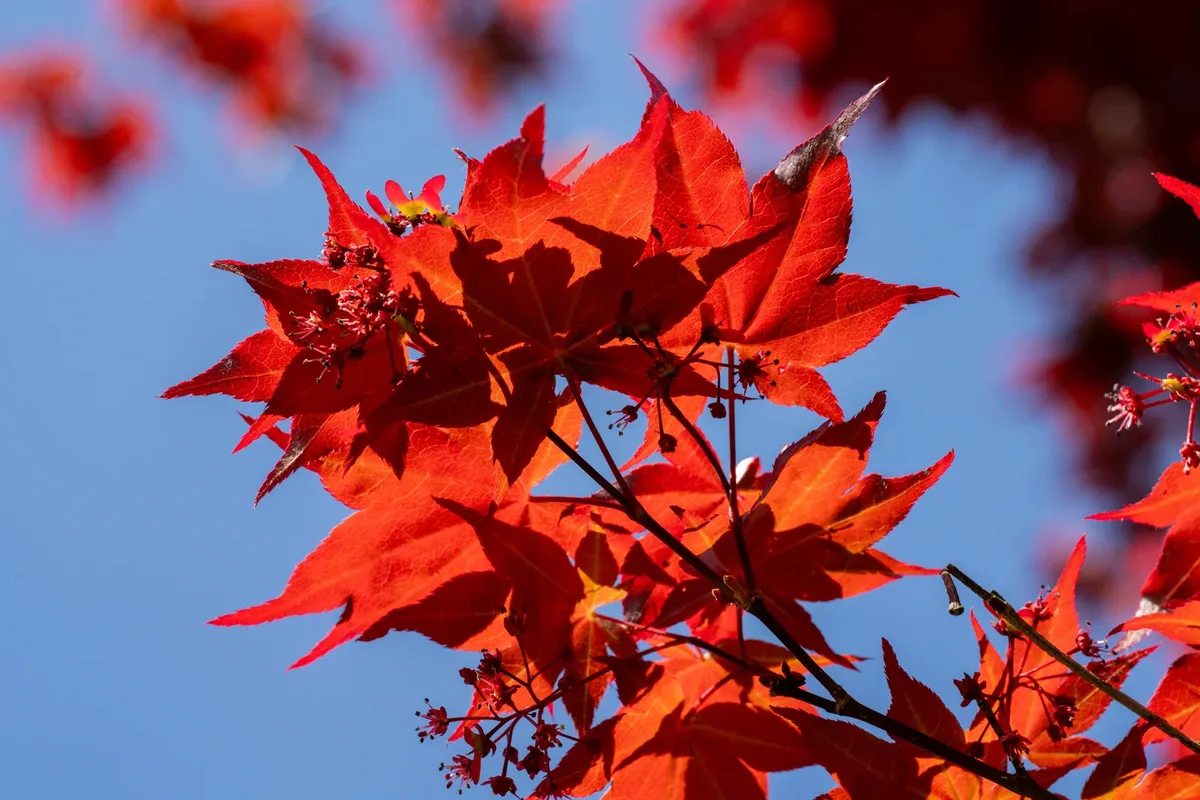
Acer palmatum 'Bloodgood', one of the red-leaved cultivars.
Red Acer palmatum vary in habit, leaf and colour. Compare upright and dissectum cultivars and find out where to plant them.
Red-leaved Acer palmatum are not a uniform group. There are upright cultivars, with the habit of a small tree, and low, weeping forms from the Dissectum group. The colour changes through the year and responds to light, heat, wind and the water available.
Choosing from a spring photograph alone can leave you with a plant of a different scale or behaviour. ‘Bloodgood’, ‘Fireglow’, ‘Trompenburg’ and ‘Garnet’, for example, share reddish tones, but they do not occupy the garden in the same way.
Upright cultivars
‘Bloodgood’ develops an upright habit and can form a small tree with a broad crown as it matures. In suitable conditions the foliage opens purple and holds that colour for much of the season, before changing in autumn.
‘Fireglow’ is also upright in growth and is valued for the luminosity of its leaf. Its habit and density can differ from those of ‘Bloodgood’ and should be confirmed on the specimen itself.
‘Trompenburg’ has a deeply divided leaf, but it does not belong to the same weeping type as ‘Garnet’. The crown grows upright and open.
These cultivars can give structure to an entrance, a courtyard or a mid-scale composition. They need room to spread in the future and should not be treated as compact shrubs.
Dissectum forms
‘Garnet’ has a finely cut leaf and a weeping habit. The crown grows mainly in width and falls from the graft height or from the trained leader.
It suits positions beside water, on gentle banks, in sheltered courtyards or as a specimen to be seen at close quarters. Pruning off the lower branches to create a tall trunk removes the form that sets the cultivar apart.
The fine leaves are more sensitive to drying wind and reflected heat. The position should be more sheltered than for many upright cultivars.
Colour varies
The intensity of the red does not stay constant. New leaves, summer and autumn each bring different tones.
In deep shade, some cultivars turn greener. In very strong sun, especially when the roots are dry, the leaf margins scorch and the leaf loses quality.
A position with enough light and shelter during the hottest period often gives the best balance in Portugal. The aspect should be adjusted to the local climate, because conditions that suit Amarante may not work in the same way in a very hot enclosed courtyard.
Soil
Japanese maples prefer a well-drained, moist soil with organic matter. They do not cope well with compaction, permanent waterlogging or prolonged dryness.
The roots are relatively shallow and benefit from an organic mulch. Competitive lawn, excavation and paving close to the base reduce the conditions available to them.
On chalky soils or with very alkaline water, nutritional problems can arise. Correction should start from an analysis, and not simply from applying iron when chlorosis appears.
Water and heat
The resilience of an established plant does not remove the need for watering. While the plant is establishing, the rootball needs to stay moist without becoming saturated.
Wind and heat increase water loss through the leaf. A dissectum may show damage before a cultivar with a thicker leaf.
Shallow watering keeps only the top layer wet. It is better to water deeply and to check the moisture next to the rootball.
Production method
Many cultivars are grafted. The graft union and its height influence the architecture.
On a ‘Garnet’, a high graft produces a taller cascade. A specimen trained from low down creates a crown closer to the ground. On upright cultivars the graft may be less obvious, but it still needs to be inspected.
Shoots arising below the union belong to the rootstock and should be removed.
Use in the garden
A red Acer palmatum works better as a contrast than as a mass repeated to excess. Green foliage, stone, water and evergreen backdrops help the colour to stand out.
Upright cultivars can create vertical structure and light shade. Weeping forms work as focal points and need clear space around them.
Next to façades, reflected heat should be allowed for. In pots, the roots heat up and dry out faster, which calls for a large pot, drainage and careful watering.
Planting
The planting hole should connect with the existing soil and keep the root collar at the surface. An organic mulch reduces swings in temperature.
The orientation of the specimen can be chosen at the nursery, especially for mature trees with a clearly directional crown.
In the first few years, watching the leaf helps to adjust exposure and watering, but a scorched leaf does not recover that season. Prevention is more effective than correcting afterwards.
Pruning
Pruning should preserve the delicate structure. Dead and crossing branches are removed and small corrections made.
Hard cuts provoke regrowth and produce a less refined crown. The best maintenance starts with choosing the right cultivar and the right space.
Speaking of a ‘red acer’ is not enough for a project. The full name, the form and the production height determine the plant that will actually arrive in the garden.
Related content
Sources and supporting references
- Royal Horticultural Society — plant profiles for Acer palmatum ‘Bloodgood’ and ‘Garnet’.
- Plants of the World Online, Royal Botanic Gardens, Kew — Acer palmatum.
- Maple Society — horticultural information on groups and cultivars.
- Experience of producing and selecting Acer palmatum at Diaplant.
Tags