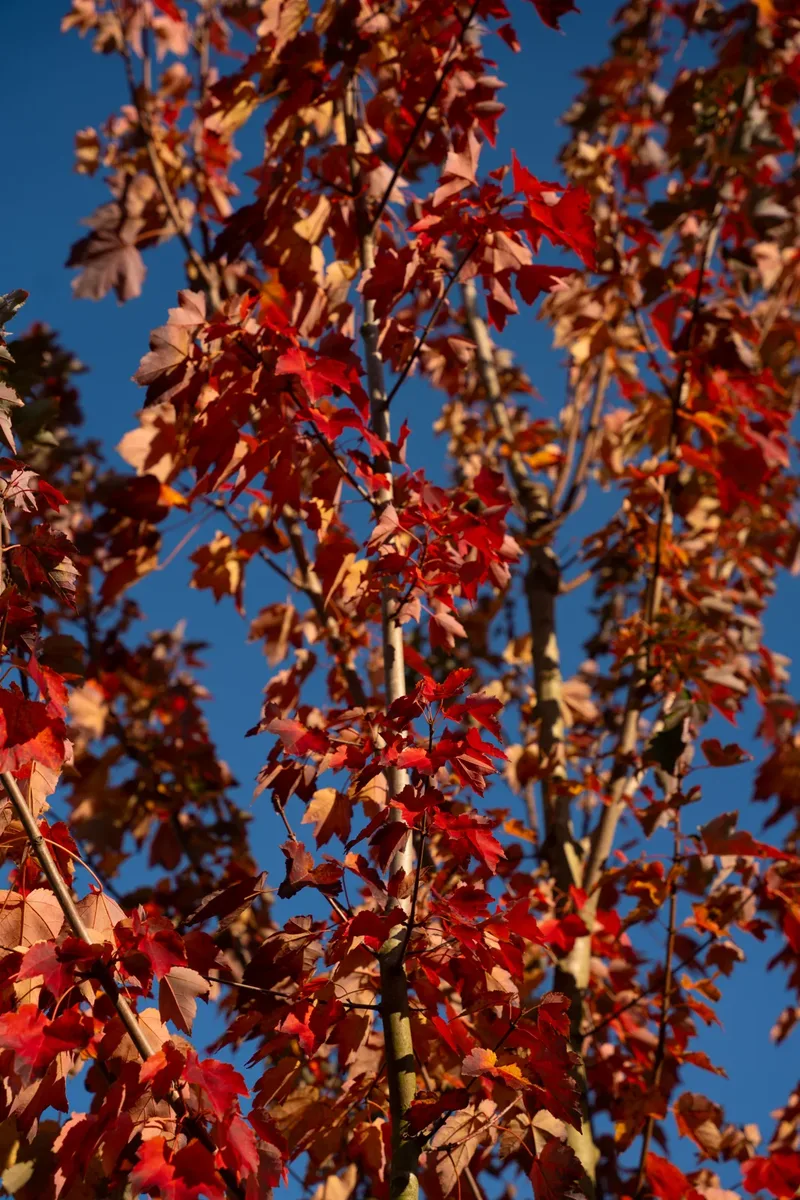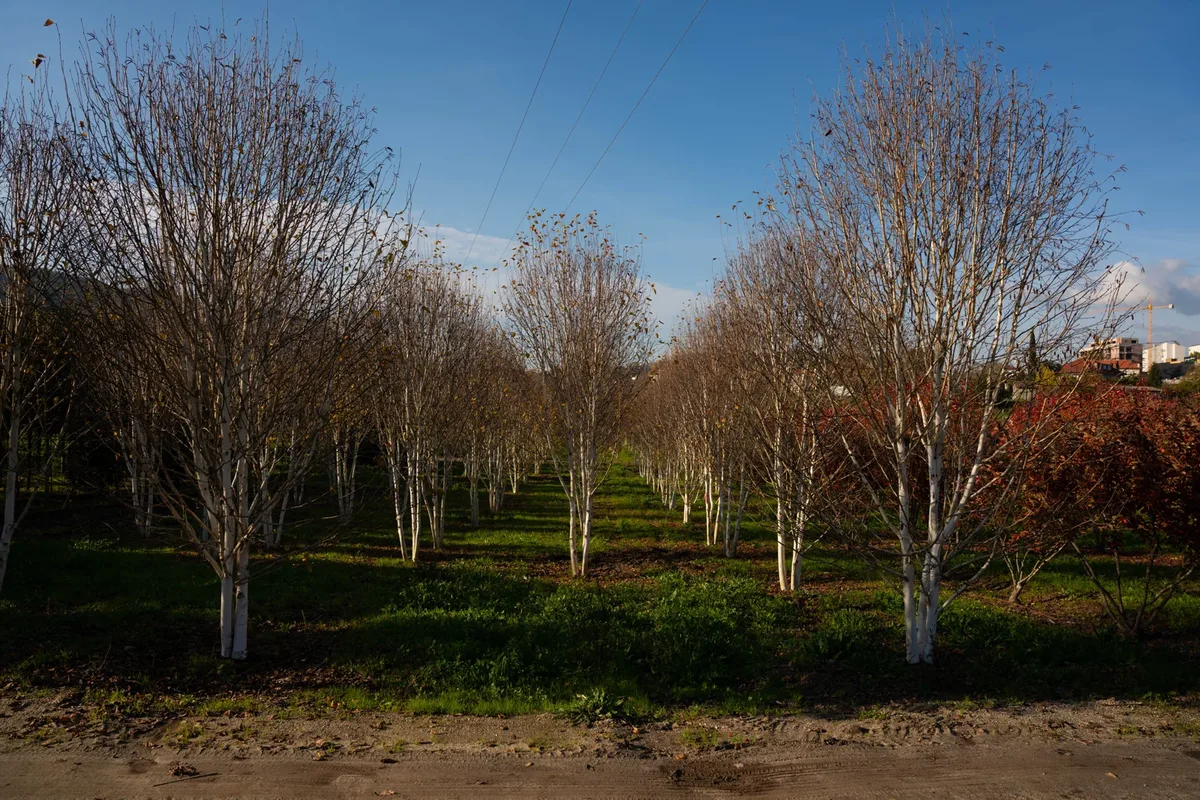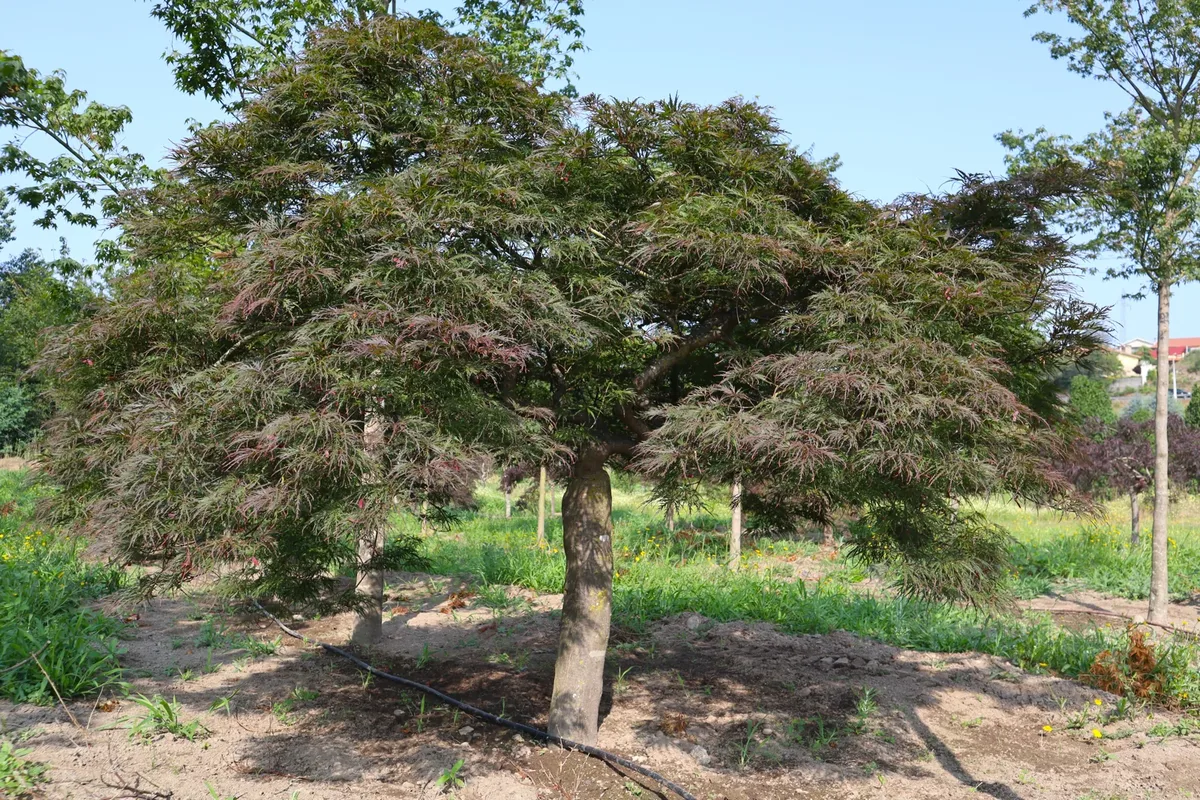
Acer palmatum dissectum 'Garnet' — one of the species compared in the article.
Trees for small gardens should be assessed by width, height, root and relationship with buildings.
Trees for small gardens should be assessed by width, height, root and relationship with buildings. A columnar form takes up little width, but can become very tall. A compact crown may still need distance. This collection distinguishes small trees from narrow trees.
The species below should be read as design alternatives. Soil, climate, space and availability determine the final decision.
The species in the collection
| Species or cultivar | Role in the composition | Reference conditions | Main limitation |
|---|---|---|---|
| Acer palmatum | small tree with a light crown and a great diversity of forms | bright partial shade, shelter from wind and moist soil | sensitive to reflected heat, dryness and the wrong choice of cultivar |
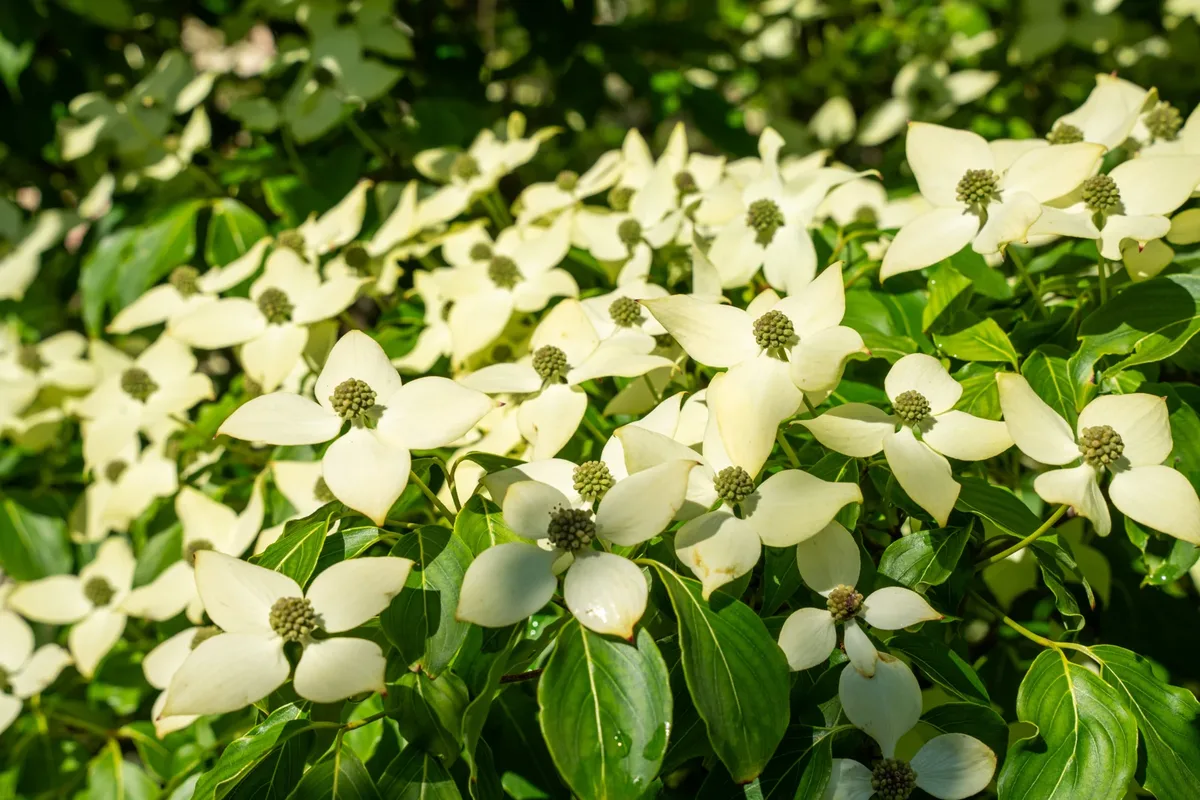
| Cornus kousa | small tree with bracts, fruit and autumn interest | gentle sun or partial shade, moist, well-drained soil | sensitive to water stress and reflected heat |
| Lagerstroemia indica | small tree or large shrub for summer flowering and bark | sun and heat, well-drained soil with enough water during establishment | flowering depends on heat and pruning; sensitive to cold depending on the cultivar |
| Magnolia ‘Susan’ | compact magnolia with spring flowering | gentle sun or partial shade, moist soil | compact does not mean tiny; confirm cultivar and width |
| Liquidambar styraciflua ‘Globosa’ | compact form with a rounded crown | sun, moist, well-drained soil | confirm graft height and final size; still needs water |
| Ginkgo biloba ‘Blagon’ | narrower cultivar for spaces of restricted width | sun, well-drained soil | keeps growing in height and needs rooting space |
| Cupressus sempervirens ‘Stricta’ | columnar conifer for vertical rhythm and little width | sun, well-drained soil | narrow but tall; not suited to sites without depth of soil or with waterlogging |
How to combine them in the project
Acer palmatum, Cornus kousa, Lagerstroemia and Magnolia ‘Susan’ suit gardens of a smaller scale, depending on climate. Liquidambar ‘Globosa’ creates a rounded crown; Ginkgo ‘Blagon’ and Cupressus ‘Stricta’ take up less width, but work with verticality.
In a courtyard, the priority may be shade and the view from indoors. In a side passage, width and root govern. In a front garden, the relationship with the façade and infrastructure is decisive.
Conditions of use
The final choice should confirm mature dimensions and graft height. Narrow does not mean small; compact does not mean no pruning.
Selection at Diaplant
At Diaplant, trees for small gardens are compared by predictable width, height, crown form and relationship with buildings. ‘Compact’ or ‘columnar’ is no substitute for reading the mature size.
Sources
- Forest Research. Urban Tree Manual. (2018).
- Relating the climate envelopes of urban tree species to their drought and thermal tolerance. (2021).
- Functional traits are better than climate niche approach at predicting the vital growth and mortality rates of urban tree species. (2026).
- Flora-On — Flora de Portugal interativa. Sociedade Portuguesa de Botânica. (2025).
Tags