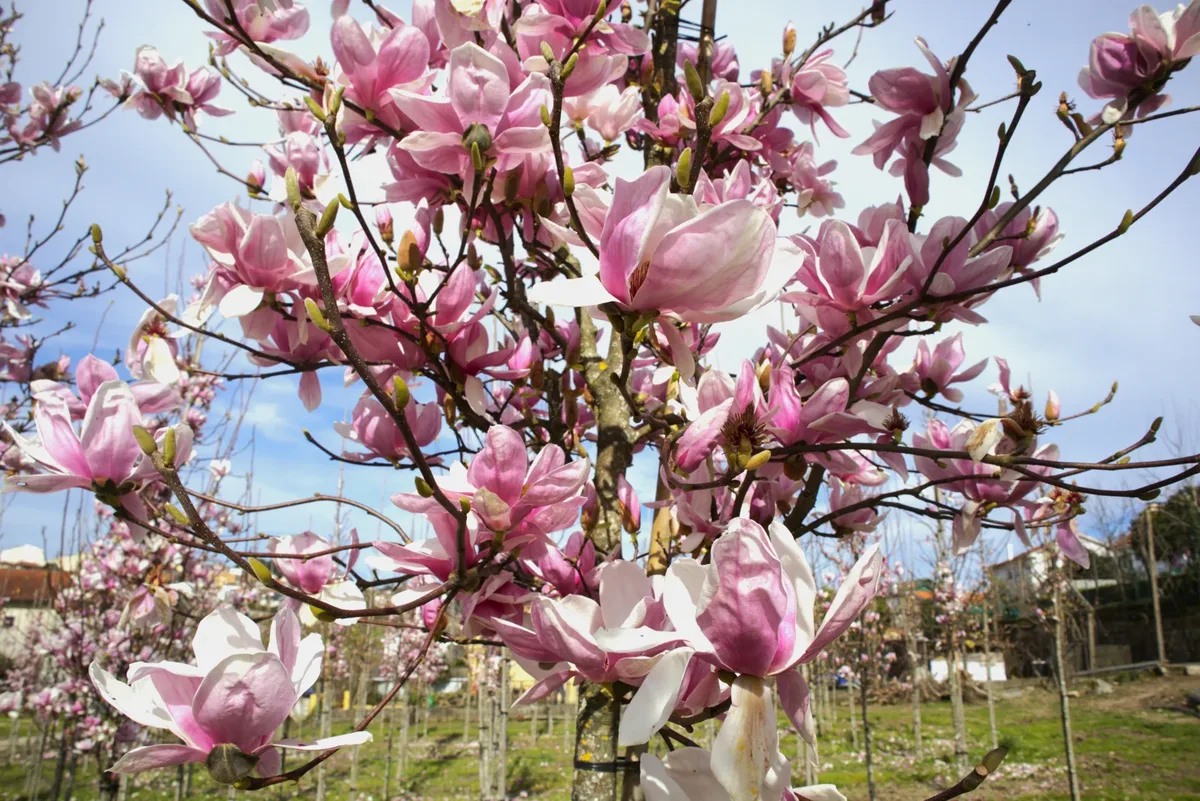
Magnolia × soulangeana in flower, Diaplant nursery.
Magnolia × soulangeana offers early flowers and a broad crown, but it needs well-drained soil and care with its roots. Get to know the species.
Magnolia × soulangeana is a deciduous magnolia known for the large flowers that appear before, or along with, the first leaves. The hybrid takes in many forms and selections, with white, pink or purple flowers and differences in size that should be confirmed before choosing.
Flowering is the most visible moment, but the tree occupies the garden all year round. The crown broadens, the foliage forms a dense mass in summer and the branch structure stays present in winter. It therefore needs room to grow without relying on regular pruning.
An early flowering, vulnerable to the weather
The flowers open in late winter or spring, depending on the region and the year. They are goblet- or tulip-shaped and can be very large.
The ornamental period varies. High temperatures speed up opening; rain and wind damage the petals; late frosts can scorch buds and flowers already open.
This risk does not mean the tree is unsuitable. It means the flowering should not be treated as a guaranteed effect with a fixed length and date.
After the flowers, the crown fills with green leaf. The interest becomes more structural and should be allowed for in the design.
Tree form or multi-stem
Magnolia × soulangeana often develops a broad crown and low branching. As a multi-stem, the flowers come close to eye level and the specimen takes up a good deal of width from the base.
When trained as a standard tree, the space beneath is freer, but the species should not be forced onto an excessively long trunk. Removing thick branches alters the architecture and leaves significant wounds.
Selecting at the nursery lets you choose a more open specimen, a more upright one or one with several leaders, to suit the place.
Soil
The magnolia prefers deep soil with organic matter, steady moisture and good drainage. The RHS gives its conditions as moist but well-drained soil, generally neutral to acid.
In Portugal, it pays to look at the actual profile. A clay soil can work if it keeps its structure and lets water drain away. A planting hole backfilled with light material inside compacted ground can become saturated.
The root system should not be subjected to excavation, raised soil levels or heavy traffic after planting. Protecting the surrounding area is particularly important with mature specimens.
Aspect
Sun and partial shade are both possible. Sun favours flowering, but a very hot, dry position can lead to poorer foliage and greater dependence on watering.
The flowers benefit from some shelter from wind and late frosts. A cold valley, or an area where freezing air collects, can increase the risk of damage.
Next to façades, allow for the mature spread. The tree should not be placed close to the house in the expectation that pruning will keep it narrow.
Roots and transplanting
Magnolias are sensitive to root cutting. The crown can carry a large leaf area, and the roots kept in the rootball need to be enough to meet that demand.
In the production of mature trees, the interval between transplantings, the size of the rootball and the recovery all need attention. At final lifting, handling should keep the rootball intact and prevent it drying out.
After planting, a wilting crown should not automatically lead to more watering. You need to check whether the rootball is dry or whether the soil is still saturated and starved of oxygen.
Where it works best
The magnolia is well suited as the main specimen in a lawn, in a generous courtyard or in an area seen from the house.
It can form part of a composition with evergreens that give the flowers a backdrop, but it should not be squeezed between vigorous plants.
Petal fall is heavy and concentrated. Next to paving or swimming pools, this should be accepted as part of the cycle and not treated as a fault.
In medium-sized gardens, a multi-stem can take the place of a large tree where presence is wanted without excessive height. Even so, the spread needs to be allowed for.
Planting
The area should be prepared wide and tied into the existing soil. The root collar stays at ground level, and the base of the hole should not give way under the weight.
The first watering settles the soil and wets the rootball. In the months that follow, moisture is checked at depth.
An organic mulch reduces evaporation and protects the roots, without touching the trunk. Staking should stabilise the rootball without completely immobilising the crown.
Pruning
Pruning is light and directed at damaged branches, crossing branches and early structural corrections. The RHS recommends minimal intervention and, where it is needed, at the right time for deciduous magnolias.
Large cuts are avoided. A tree placed in the right space should be able to form its crown without being held back every year.
The value of Magnolia × soulangeana lies in the combination of flowering and structure. To keep both, the place has to be chosen with the same care given to the flowers.
Related content
Sources and supporting references
- Royal Horticultural Society — plant profile for Magnolia × soulangeana.
- Plants of the World Online, Royal Botanic Gardens, Kew.
- Trees and Shrubs Online, International Dendrology Society.
- Diaplant’s experience of growing and monitoring magnolias.
Tags