Diaplant
Avoiding months without food for pollinators takes a sequence of accessible flowers, with nectar and pollen, spread through the year.
Avoiding months without food for pollinators takes a sequence of accessible flowers, with nectar and pollen, spread through the year. The mere presence of many species does not guarantee continuity: they may all flower in the same season or offer resources that are not readily available to certain groups.
Building the calendar by resources
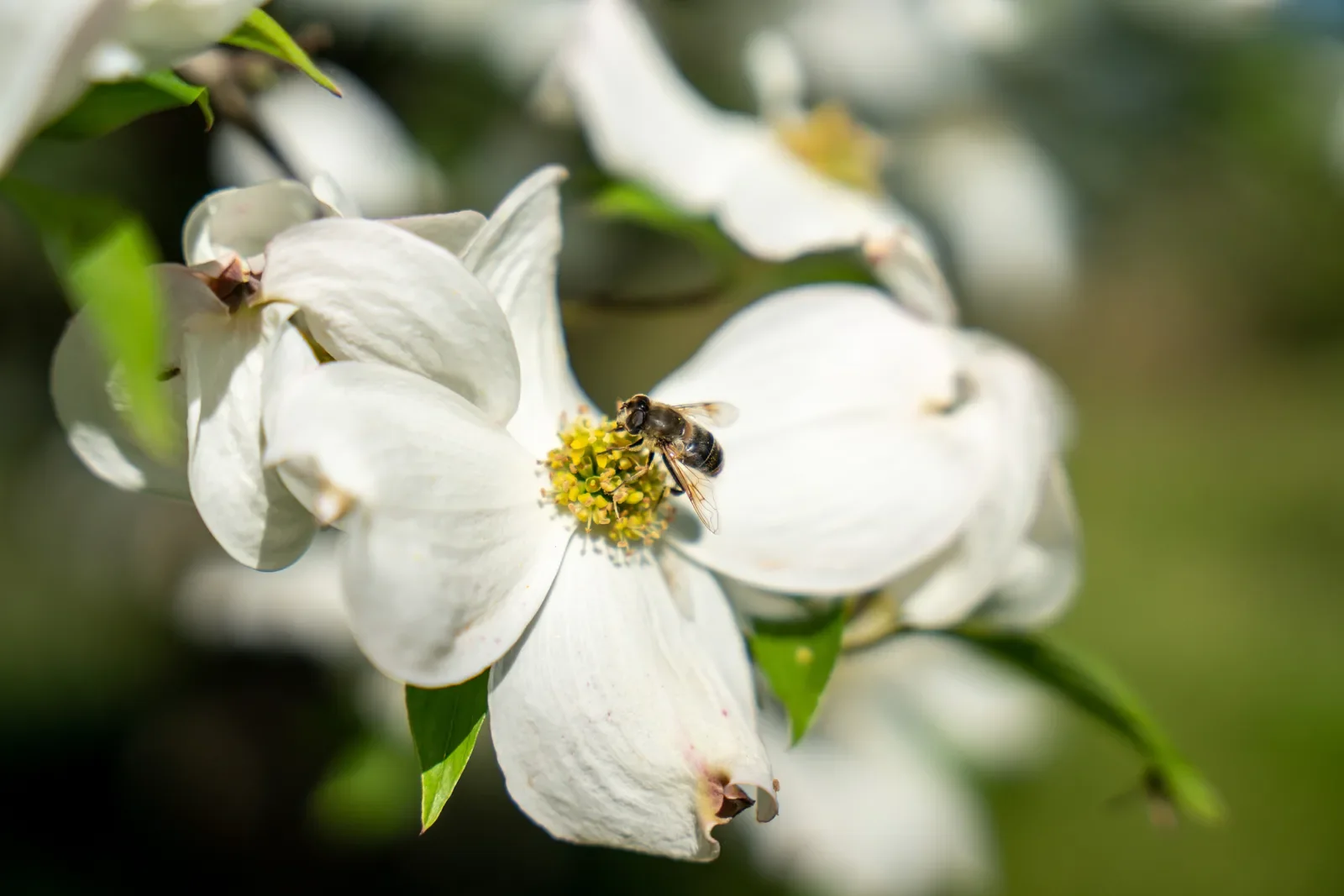
The record should distinguish the start, peak and end of flowering and, where the information exists, the type of resource. Bees, flies, butterflies and other visitors do not use all flowers in the same way. Shape, depth, colour, scent and the amount of nectar or pollen influence visitation. [C1]
Woody plants can be decisive at the start and end of the season, while perennials and subshrubs fill the summer. The combination should be observed locally.
The most common gaps
In many gardens there is abundance in spring and scarcity in late summer or winter. Early species, such as Cornus mas and some Mahonia, can open the calendar; Koelreuteria, Lagerstroemia, Myrtus and Caryopteris can contribute later; Arbutus unedo extends the autumn.
These candidates should not be treated as a fixed list. Cultivar, watering and microclimate change flowering and value.
Keeping the resource available
A flowering only does its job if it stays in the garden. Cutting back, pruning, treatments and water stress can reduce the supply. The maintenance plan should identify sensitive periods and avoid blanket interventions.
To assess the result, the team can record visitors at regular intervals, always with a simple, comparable method. The aim is not to count everything, but to see whether there are months with no activity or whether a single plant accounts for most of the visits.
Where the approach fails
The most common mistakes are counting species without looking at the months; inferring the resource from flower colour alone; ignoring sterile or double cultivars; and pruning during peak flowering.
Applying it to the project
At Diaplant, the pollinator calendar cross-references trees, shrubs and subshrubs and identifies the months with the least on offer. The selection is reviewed at the level of species and cultivar, because the presence of flower does not guarantee the same resource.
Continuity comes from a calendar checked on the ground. It is that sequence, and not a list of pollinator-friendly plants, that makes the project more consistent.
Sources
- Trillo, A. et al. Year-round pollinator visitation of ornamental plants in Mediterranean urban parks. (2026).
- Vitt, P. et al. Temporal variation in the roles of exotic and native plant species in plant–pollinator networks. (2020).
- Monthly Alternations of Core Plant Species in Dynamic Plant-Pollinator Networks of an Urban Botanical Garden. (2025).
- European Commission. Pollinators and EU Pollinator Monitoring Scheme. (2025).
Tags