Diaplant
A dry summer often leaves a gap in the garden: many species have already finished their spring flowering and others come under stress.
A dry summer often leaves a gap in the garden: many species have already finished their spring flowering and others come under stress. To keep flowers and resources going, you need to select plants suited to the period, spread out the demand for water and accept that some watering may be essential to sustain flowering.
Tolerating drought is not the same as flowering in drought
A plant can survive the summer on little water and still cut back sharply on flowering, nectar or growth. Research shows that origin and watering can change floral value and visitation. The design should therefore separate survival, ornamental performance and ecological resource. [C7; C8]
In unirrigated areas, the strategy can favour species whose natural phenology coincides with the dry summer. Elsewhere, a supporting hydrozone can keep flowering going without watering the whole garden.
Candidate species and staggered flowering
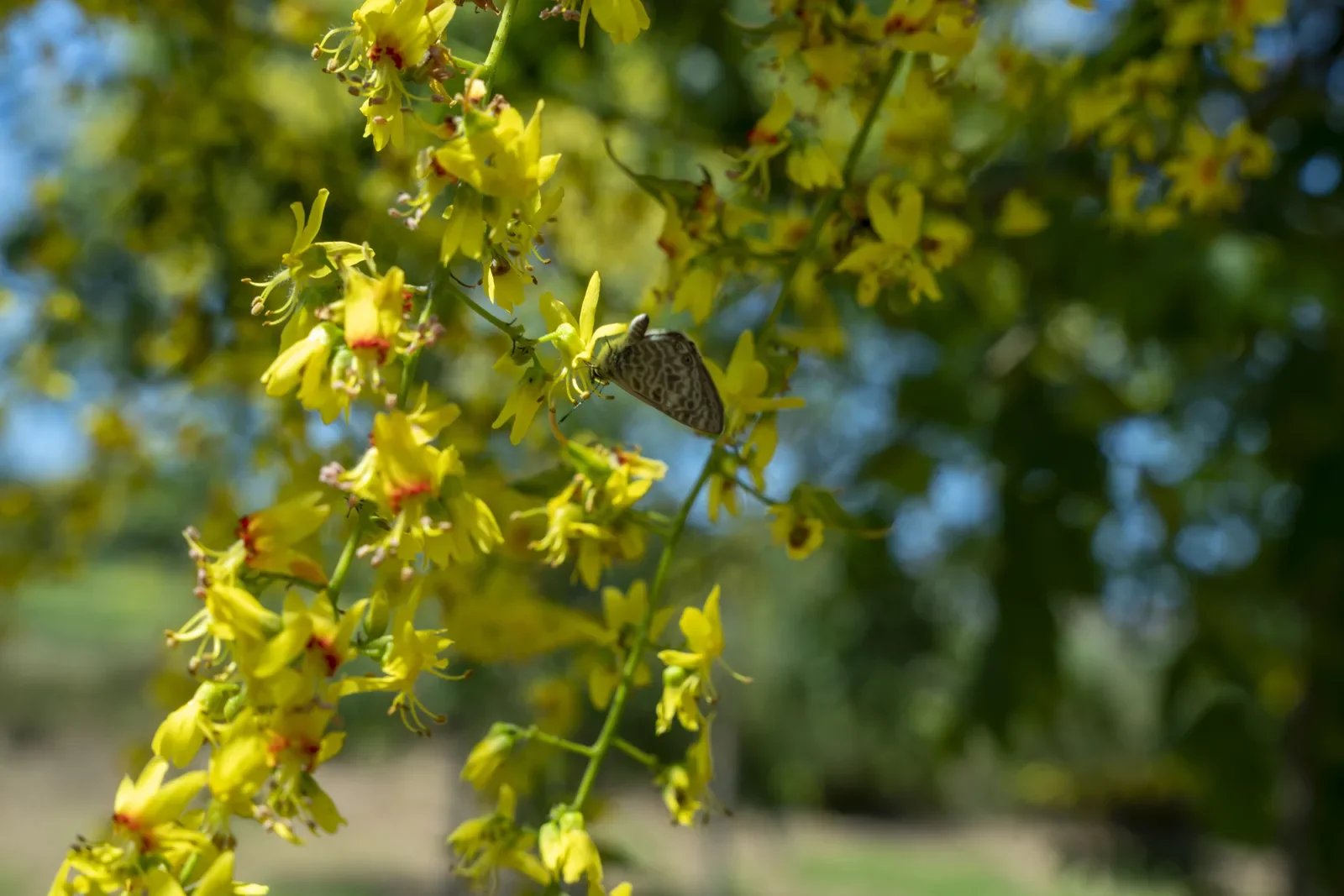
Koelreuteria paniculata and Lagerstroemia indica can extend tree flowering into summer. Arbutus unedo shifts part of the interest into autumn. Myrtus communis, Caryopteris and some Mediterranean subshrubs can fill different windows. The selection should be checked against cultivar, aspect and local climate.
It is better to combine several flowering periods than to depend on one species described as long-flowering. A sequence copes better with heatwaves, the failure of one plant and differences between years.
Design water in where it has most effect
A summer-flowering area can be given drip irrigation and improved soil, while structural areas use less demanding species. Mulch, ground cover and partial shade reduce evaporation. Watering should be matched to the establishment phase and to the aim, not kept up out of routine.
It is also important that maintenance does not remove flowers at their peak. Pruning and cutting back need to be coordinated with the calendar, especially in species that flower on new wood or on the current year’s shoots.
What undermines the result
The most common mistakes are confusing survival with abundant flowering; watering every area equally; selecting only spring species; and pruning during the main resource window.
Applying it to the project
At Diaplant, we combine trees, shrubs and subshrubs that extend interest through the summer without concentrating all the watering in the garden. The final choice depends on the soil, the heat and the water available during establishment.
The summer gap is solved by phenology, water and management working together. The result does not depend on one tough plant, but on a sequence able to get through the most demanding period.
Sources
- Trillo, A. et al. Year-round pollinator visitation of ornamental plants in Mediterranean urban parks. (2026).
- Complex floral traits shape pollinator attraction to ornamental plants. (2022).
- Evaluation of the most popular annual flowers sold in the United States and Europe indicates low visitation rates by pollinators and large variation among cultivars. (2024).
Tags