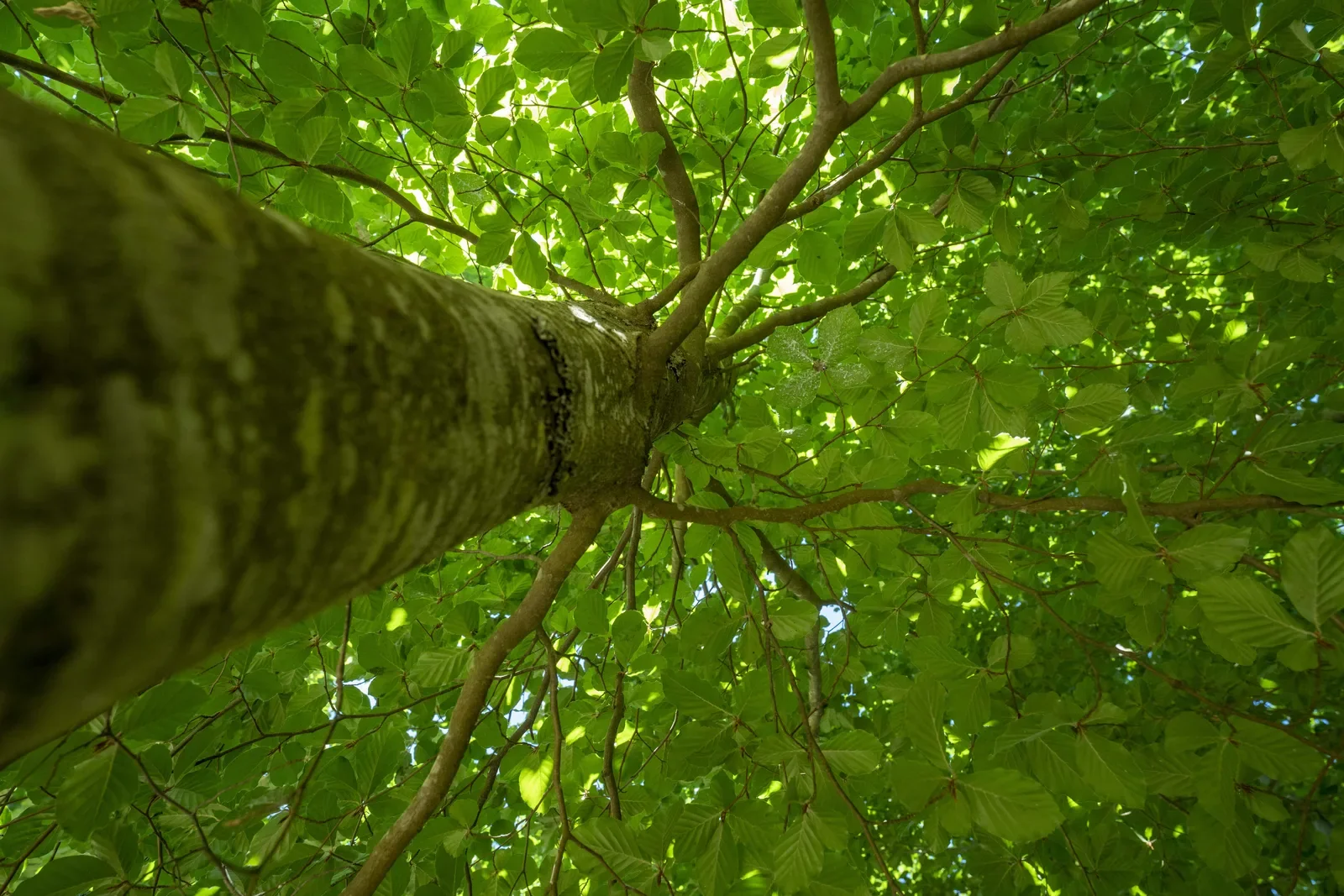
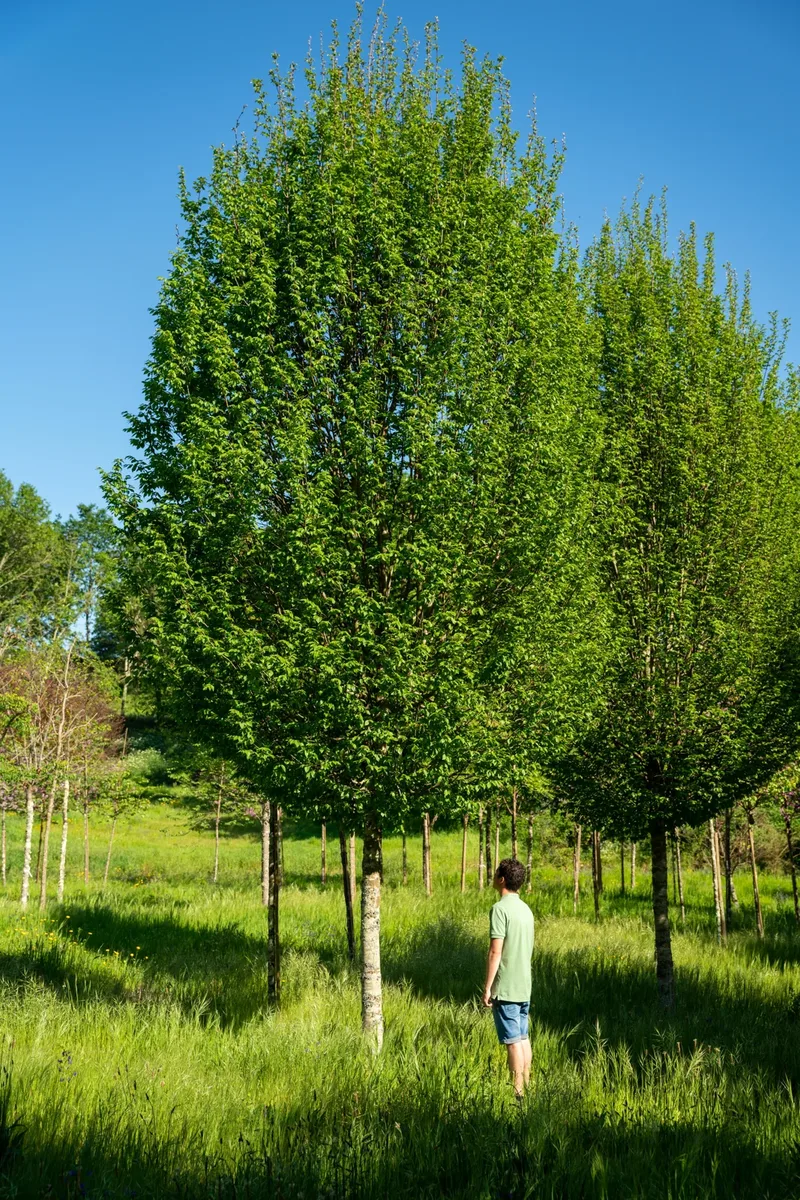
The 3–30–300 rule proposes three benchmarks for the presence of urban nature: seeing at least three trees from every home, school or workplace.
The 3–30–300 rule proposes three benchmarks for the presence of urban nature: seeing at least three trees from every home, school or workplace; living in a neighbourhood with 30% canopy cover; and having a public green space within 300 metres.
It was put forward as a simple guideline for bringing visibility, cover and access together. It is neither a universal technical standard nor a substitute for a tree-planting design.
The 3 component
Seeing trees from a window is an attempt to measure everyday contact with nature. Applying it depends on the position of the observer, the height of the building, the size of the trees and the season.
Counting visible trunks does not assess condition, crown or permanence. Three very young trees give a different kind of contact from one mature crown, even though they meet the count.
The 30 component
The 30% cover is intended to secure the presence of trees in the neighbourhood. It is more informative than the number of trees because it takes account of the area occupied by the crowns.
How the neighbourhood is delimited, the resolution of the imagery and whether private trees are included all change the result. An average can also hide streets with no shade.
The target can also be physically difficult in dense historic centres, where trees have to be combined with other forms of greenery and shade.
The 300 component
Distance to a green space is an attempt to measure access on foot. A straight line does not represent barriers, gradients, fast roads or closed entrances.
Nor does it assess the quality, safety, size and capacity of the park. A space that is close but hard to use does not offer the same benefit.
Evidence and recent application
Cecil Konijnendijk’s paper, published in 2022, presented the rule as a guideline based on different areas of evidence.
A global study published in Nature Communications in 2024 applied the benchmark to eight cities and found acute deficits, above all on the cover criterion. The authors showed how useful the rule is for revealing local inequalities that city-wide averages hide.
Other work from 2024 discussed practical limitations and the scale of physical transformation needed to meet all three components at once in existing cities.
It is not a rating of overall quality
The rule does not assess diversity, tree health, soil volume, water availability or climate risk. An area can meet the cover target with an ageing, vulnerable tree population.
Nor does it distinguish suitable trees from invasive or badly planted species.
How to use it in the project
The benchmark can serve as an initial diagnosis and as a language for communication. It helps to ask where green views, cover and access are lacking.
After that, the project needs to go deeper: who benefits, what space there is, which trees can grow and how they will be maintained.
The Portuguese context
In Portuguese cities, exposure to heat, shortage of soil and water availability need to come into the analysis. The target should not lead to planting where the conditions are missing or to counting trees that will never reach maturity.
It is better to use the rule as a direction and to measure progress transparently, recognising the physical limits of each area.
How to report results
An assessment should state the area analysed, the source of the canopy cover data, the distance method and the date of the data.
Presenting only a compliance percentage can hide inequalities within the neighbourhood. Maps and results by component help to turn the rule into a decision-making tool rather than a simplified badge.
Sources and supporting references
- Konijnendijk, C. C. (2022). Evidence-based guidelines for greener, healthier, more resilient neighbourhoods: Introducing the 3–30–300 rule. Journal of Forestry Research.
- Croeser, T. et al. (2024). Acute canopy deficits in global cities exposed by the 3-30-300 benchmark for urban nature. Nature Communications.
- Meeussen, C. et al. (2024). Opportunities and constraints of implementing the 3–30–300 rule for urban greening. Urban Forestry & Urban Greening.
Tags