Diaplant
A tree planting scheme should not be judged only by the number of trees planted. What matters is how many manage to last, form a crown and deliver.
A tree planting scheme should not be judged only by the number of trees planted. What matters is how many manage to last, form a crown and deliver the expected services over the following decades.
Choosing the species is one part of the work. Before that, you need to understand where there is space above and below ground, which streets most need shade, which trees are already there and what capacity for irrigation and maintenance is available.
Knowing the existing tree stock
The inventory records species, size, condition, approximate age, conflicts and gaps. The survey should include trees in public space and, where possible, the cover that comes from private properties.
The total number can hide inequalities. A city with heavily treed parks may still have neighbourhoods and everyday routes with almost no shade.
Porto’s Plano Municipal de Arborização (municipal tree plan) cross-references the presence of trees with street dimensions, climate, movement, soil and ecosystem services. This approach is useful because it avoids treating every street as an equivalent site.
Setting spatial objectives
The scheme may aim for thermal comfort, continuity of streets, biodiversity, water management or a stronger identity. Each objective needs to be given a location.
A street that is highly exposed to heat may take priority, but planting only goes ahead if the physical conditions exist. When they do not, the scheme may have to gain soil, change parking, reorganise services or combine trees with built shade.
Reserving space for the roots
The mature tree intended for the future depends on the volume and quality of the soil available from planting.
Small tree pits, compacted sub-bases and nearby services limit growth. A species classed as large will not form the expected crown if its roots stay confined.
The design should represent the underground space with the same rigour used to represent paving and infrastructure.
Choosing species, cultivar and form
Selection takes account of climate, soil, water availability, street width, exposure to wind and maintenance. Fruit, thorns, structural strength, invasive potential and compatibility with the space are also assessed.
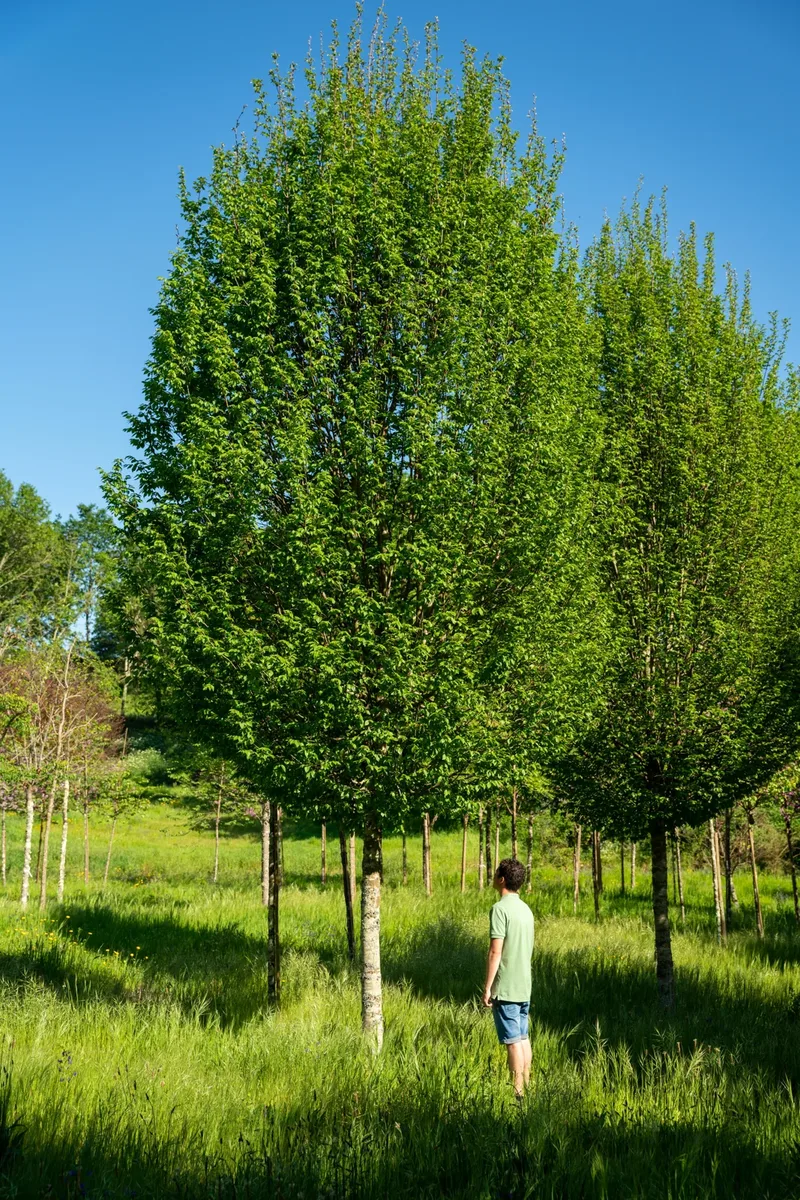
Columnar cultivars can solve the question of width above ground, but they do not remove the need for root space. Standard trees make movement easier, provided the crown height has been prepared and continues to be formed.
Preparing the plant material at the nursery
Programmes with many trees benefit from early selection. It is possible to follow batches, set crown heights and reserve specimens with compatible characteristics.
This coordination reduces last-minute substitutions and lets the scheme work with real material. It also helps to prepare the logistics and the planting season.
Diversity and coherence
Diversity reduces vulnerability to a pest, disease or climatic event that affects a dominant species. It does not mean mixing trees without criteria.
Landscape units can be defined by street, neighbourhood or type of space. Coherence can come from form, rhythm and scale, even when several species are used.
Planting and establishment
The scheme includes soil preparation, drainage, staking and irrigation. Planting does not end with the delivery of the tree.
The first years call for water, inspection and formative pruning. Without this phase, mortality and conflicts increase and the expected canopy cover takes even longer to appear.
Monitoring results
Up-to-date inventories make it possible to assess survival, growth, diversity and the distribution of canopy. The municipality can see which species work best in each condition and correct future choices.
The London Urban Forest Plan, published in 2020, received an actions update in February 2025. The principles of the update include resilience, equity, collaboration and capacity to deliver. This kind of review shows that a tree plan needs to keep track of results and changes of context.
Planning the supply
Tree planting programmes with many specimens benefit from early selection. Reserving and following batches makes it possible to set crown height, form and dispatch schedule with greater predictability.
The planned diversity should be compatible with what nurseries can produce to a good standard. A very long list, finalised only when work starts on site, tends to result in substitutions with no coherence.
Sources and supporting references
- Plano Municipal de Arborização do Porto, presented in 2023.
- Trees for Life: Master Plan for Barcelona’s Trees 2017–2037, Ajuntament de Barcelona.
- Plan Arbre 2021–2026, Ville de Paris.
- London Urban Forest Plan and Actions Update 2025, London City Hall.
Tags