

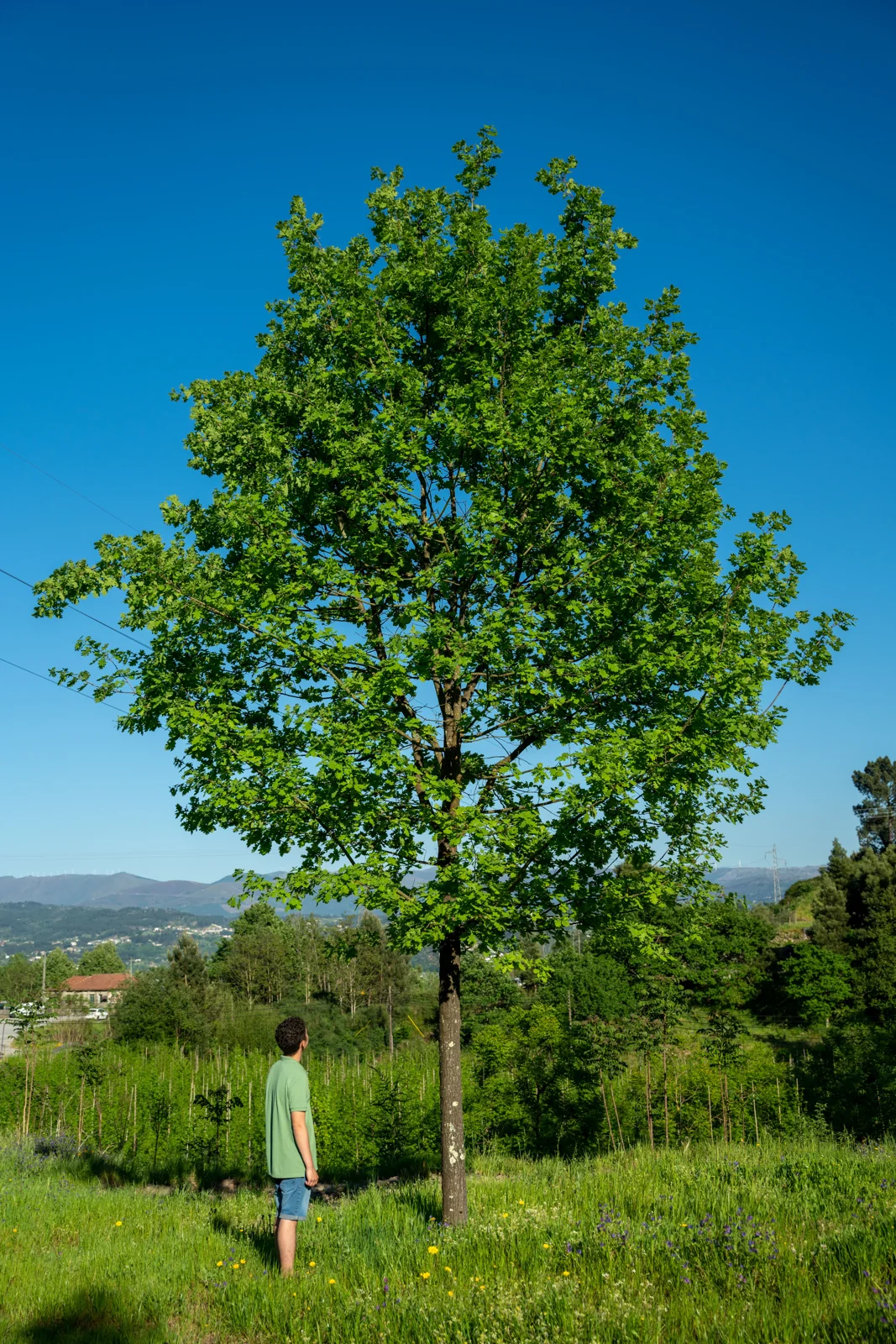
Quercus roburEnglish oak
A native species with a broad, rounded crown that takes the place of the shade specimen in parks, generous central reservations and banks, where there is room for a crown of fifteen to twenty-five metres to develop stem and structure.
- Broad, rounded crown that gives generous shade at maturity
- Deep roots that keep it firm in open, exposed ground
- Tolerates heavy clay as well as deep, fertile loam
About this species
A deciduous oak of medium growth, with a rounded, spreading crown that can reach twenty to thirty-five metres in height by fifteen to twenty-five in spread in a favourable situation. For the professional preparing a specification, the decisive argument is its native status: it belongs to the native flora of mainland Portugal and meets…Read moreShow less
A deciduous oak of medium growth, with a rounded, spreading crown that can reach twenty to thirty-five metres in height by fifteen to twenty-five in spread in a favourable situation. For the professional preparing a specification, the decisive argument is its native status: it belongs to the native flora of mainland Portugal and meets the quotas for native species increasingly required in PDM (municipal master plans) and in municipal tree-planting programmes. In a confined avenue planting it is not the obvious choice, because of its crown spread; its field of application is the single specimen, the framing group and urban parks where the mature structure justifies setting the space aside.
On site, it behaves as a species of moist, deep soils, performing well in clay and in well-drained loams. It tolerates dry periods once established, thanks to the taproot system that explores at depth, but its tolerance of water stress is moderate, not absolute: in prolonged summers inland, and in the first summers after planting, establishment requires supplementary watering. It withstands seasonal waterlogging better than most oaks, which makes it a defensible choice on the margins of watercourses and in poorly drained areas where other structural species fail.
The taproot system constrains the logistics of transplanting large girth sizes, but, once established, it reduces the risk of paving being lifted compared with shallow-rooted species. The foliage is dense and dark green, turning yellow and coppery brown in late autumn, with marcescent leaves that persist for part of the winter, and it gives full shade in the warm months. Full exposure is the condition for full vigour.
In plant-health terms it is considered robust and low-maintenance, with no pressure equivalent to that of ash dieback on the ash or canker stain on the plane. In humid climates it can show powdery mildew on new foliage, with no structural consequence. Planted in full sun and in soil that does not dry out completely in summer, it is a low-risk, long-lived choice.
Advice on this species
Want to know more about Quercus robur?
Tell us about your project and we will advise on this species — where it does well, what size makes sense and what to expect once it is planted.
- Own production
- Mature specimens
- Reply within 1–2 days
No obligation · tailored quote