

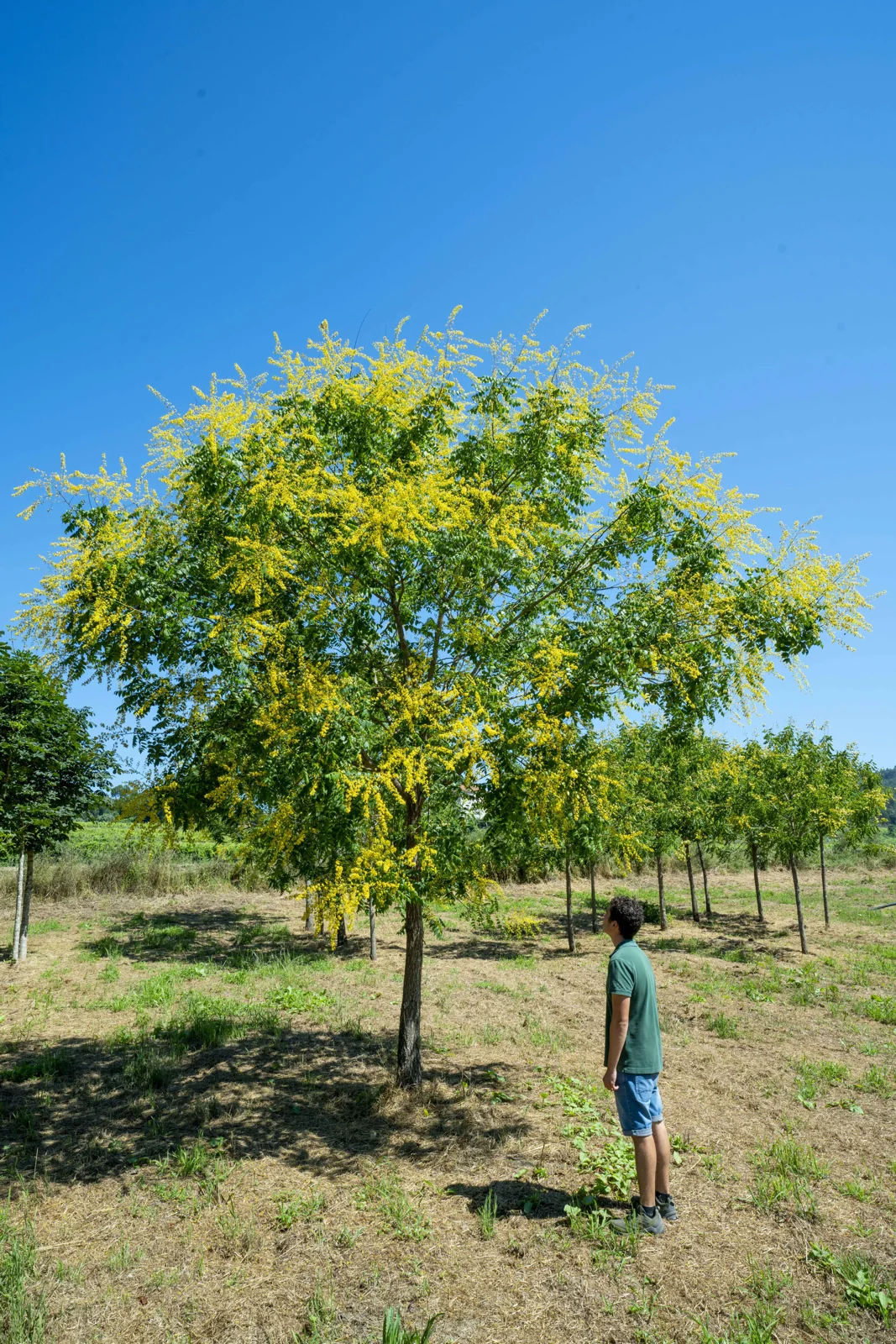
Koelreuteria paniculataPride of India
A medium-sized species suited to street planting, central reservations and urban parks in continental or coastal conditions, where it carries yellow summer flowering at a time when most shade trees no longer offer ornamental interest.
- Large terminal clusters of bright yellow flowers in July and August
- Chinese-lantern-shaped capsules that persist until early winter
- Pinnate compound foliage with a light, feathery texture, light shade
About this species
In avenue planting, Koelreuteria occupies a place comparable to that of a Celtis australis or a Sophora japonica of smaller size, with a rounded, spreading crown that settles at between 8 and 12 m in height and a similar width in Portuguese conditions. The pinnate compound foliage, at 15 to 45 cm, gives a light texture and dappled shade compatible with a herbaceous…Read moreShow less
In avenue planting, Koelreuteria occupies a place comparable to that of a Celtis australis or a Sophora japonica of smaller size, with a rounded, spreading crown that settles at between 8 and 12 m in height and a similar width in Portuguese conditions. The pinnate compound foliage, at 15 to 45 cm, gives a light texture and dappled shade compatible with a herbaceous understorey, a recognised advantage in squares where the dense shade of plane or lime compromises the lawn.
Ornamental interest is concentrated in July and August, with terminal panicles of yellow flowers of 30 to 40 cm, at a point in the calendar when few structural trees are still in flower. They are followed by papery, three-valved capsules resembling small lanterns, which turn from green to yellow and light copper and remain on the tree until winter. The autumn colour is golden yellow, variable from season to season, and the brownish-grey bark with shallow fissures keeps a discreet presence during dormancy.
Its behaviour in the soil is its main technical advantage. It adapts to chalky soils, compacted clays and poor sands, provided there is minimal drainage, tolerating the alkaline pH of the Estremadura limestones. The deep taproot ensures high drought tolerance once established, behaviour suited to projects in Lisbon and the Alentejo interior without permanent irrigation, and the root system is not very aggressive in a 1.5 m tree pit. It accepts urban pollution and full exposure, withstanding minimum temperatures close to minus 15 °C with no winter stress documented in mainland Portugal.
The species has no significant plant-health problems in the Portuguese context, a useful contrast at a time of known pathogen pressure on Platanus, Fraxinus and Castanea. The wood is brittle, a factor to consider in places exposed to strong wind or close to parking, and one that steers formative pruning towards balanced crowns. It can self-seed spontaneously on disturbed ground, with no formal invasive status, but it deserves monitoring in projects bordering sensitive natural areas.
Growth is medium to fast. Full exposure is recommended for regular flowering, and early formative pruning to correct the low-branching tendency characteristic of youth.
Advice on this species
Want to know more about Koelreuteria paniculata?
Tell us about your project and we will advise on this species — where it does well, what size makes sense and what to expect once it is planted.
- Own production
- Mature specimens
- Reply within 1–2 days
No obligation · tailored quote