

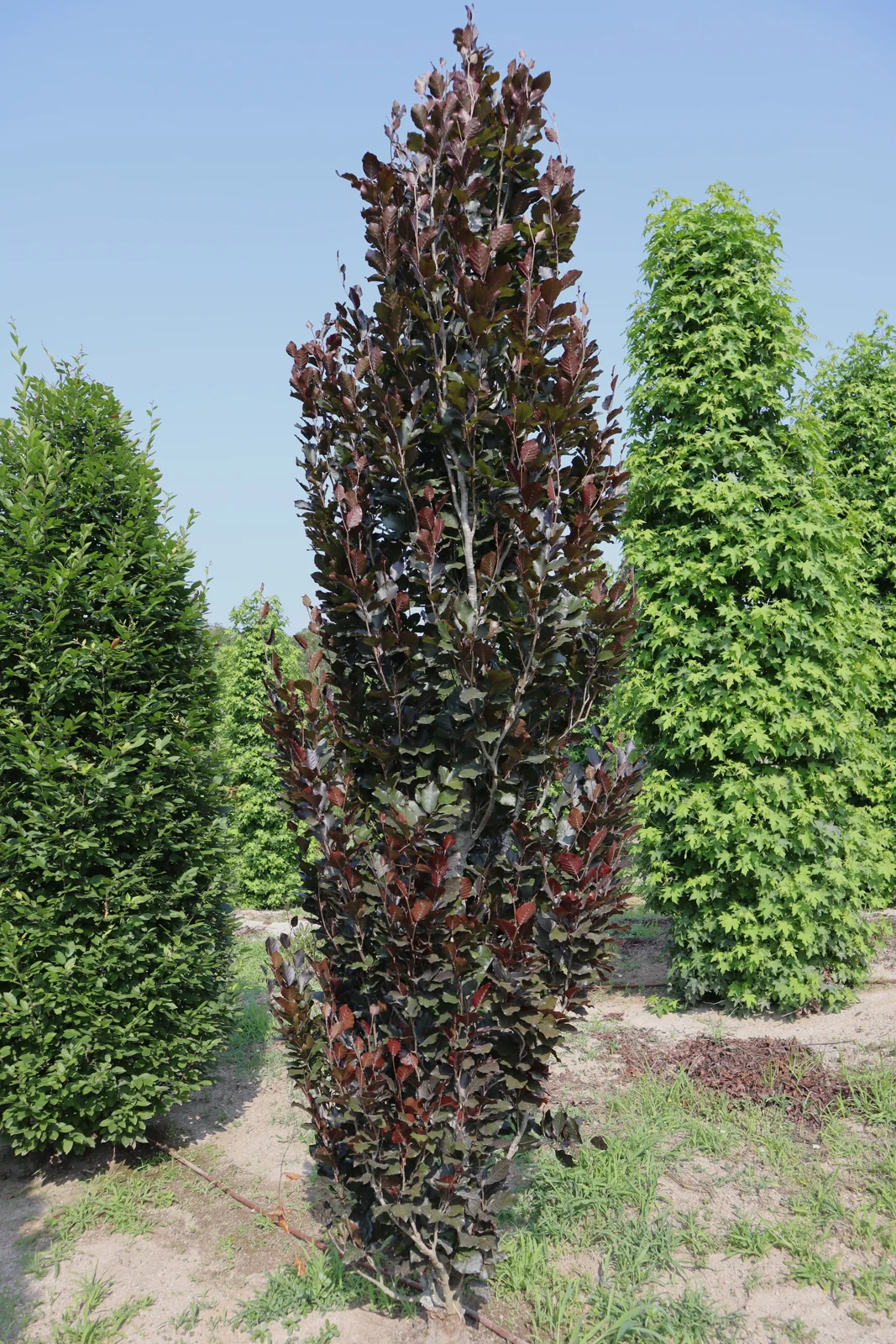
Fagus sylvatica 'Dawyck Purple'European beech
A fastigiate cultivar of the European beech, with lasting purple foliage and a narrow columnar silhouette. Suited to projects in the Atlantic north, at altitude, or in gardens with moist, deep soil, where it is at its best.
- Narrow columnar habit, twelve to eighteen metres by three to five in width
- Purple foliage sustained from early spring to autumn
- Turns a reddish copper that lasts until the first heavy rains
About this cultivar
'Dawyck Purple' solves a specific design problem: the search for a narrow vertical accent, in purple foliage, without resorting to Prunus cerasifera 'Nigra' or Acer platanoides 'Crimson Sentry', both shorter-lived and with a less disciplined silhouette. The fastigiate crown keeps a width of 3 to 5 m for a mature height of 12 to 18 m, with no need…Read moreShow less
'Dawyck Purple' solves a specific design problem: the search for a narrow vertical accent, in purple foliage, without resorting to Prunus cerasifera 'Nigra' or Acer platanoides 'Crimson Sentry', both shorter-lived and with a less disciplined silhouette. The fastigiate crown keeps a width of 3 to 5 m for a mature height of 12 to 18 m, with no need for formative pruning to preserve the habit. The tree keeps its columnar habit genetically, not through nursery intervention.
The climatic envelope is the limiting factor. As a beech, it demands a cool summer, a humid atmosphere and deep, fertile, well-drained soil, preferably acidic to neutral. It performs reliably in the Minho, the Douro Litoral, the Serra de Sintra, at altitude in the Beira Interior and in the Gerês. In avenue planting in Lisbon, in the Algarve, in the interior of the Alentejo or in any situation of compacted chalky soil and hot exposure, the result is chronic water stress and early leaf drop. It is not a tree for a Mediterranean project.
In a favourable situation the foliage keeps a stable dark purple from bud burst to late summer, turning to reddish-copper tones in autumn, with partial marcescence in winter, which gives structure back to the composition in the bare season. The smooth, light grey stem, with the texture characteristic of the genus in a mature tree, contributes to winter interest in a historic park or walled garden. The density of the crown gives full shade in a mature scheme, with the transparency typical of young beeches in the first years after transplanting.
The genus is not under active plant-health pressure in the Portuguese context, which sets 'Dawyck Purple' apart from the alternatives in Fraxinus (under ash dieback) or Platanus (under canker stain) when the project calls for a long-lasting vertical accent. The species does not appear on the ICNF (Portugal’s Institute for Nature Conservation and Forests) lists of invasive or native species, which makes it neutral with regard to PDM (municipal master plans) with native quotas: usable in gardens of ornamental character, in historic parks and in demanding private projects, within the climatic envelope that the beech tolerates.
Advice on this species
Want to know more about Fagus sylvatica 'Dawyck Purple'?
Tell us about your project and we will advise on this species — where it does well, what size makes sense and what to expect once it is planted.
- Own production
- Mature specimens
- Reply within 1–2 days
No obligation · tailored quote