

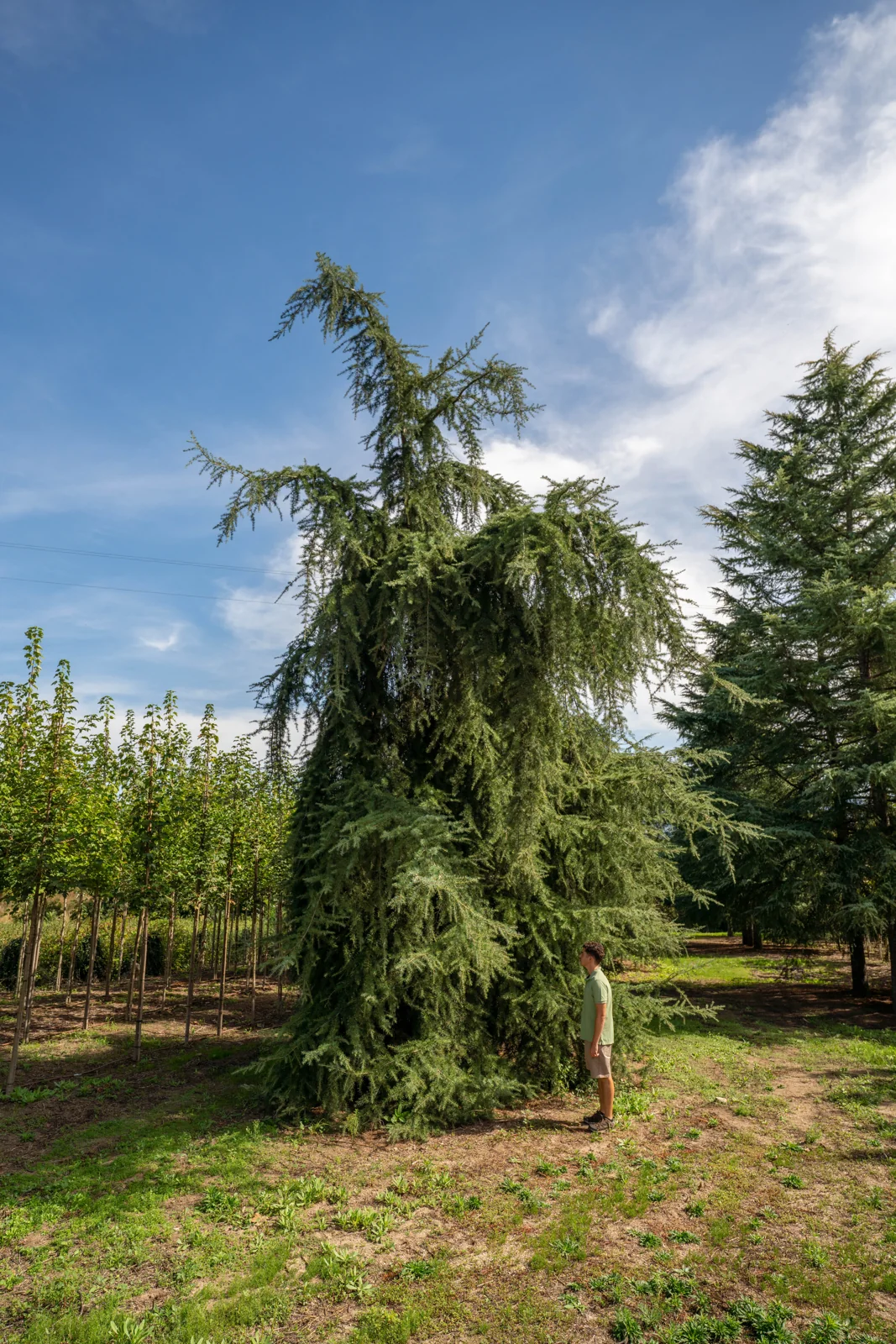
Cedrus deodara 'Pendula'Deodar cedar
An evergreen conifer of slow growth and deeply weeping form, it develops long branches that arch over and descend to the ground, forming a broad green dome. Each specimen acquires a singular silhouette, determined by the initial training of the leader and the natural development of the branching.
- Long weeping branches that form curtains of foliage
- A sculptural silhouette, unrepeatable in each specimen
- Broad dome-shaped crown, often clothed to the ground
About this cultivar
It has an irregular, markedly weeping growth, without the pyramidal crown typical of the species. When the leader is trained vertically during the first years, the tree gains height before letting its branches fall; without this training, it tends to develop a lower, wider, prostrate form. This plasticity makes it possible to create specimens with very different architectures.Read moreShow less
The main branches arch and extend horizontally before descending, while the secondary branches form dense curtains of foliage. Over time, the structure becomes a broad dome, capable of creating a sheltered interior space beneath the crown. It can reach approximately 4 to 6 metres in height and a similar spread, although the dimensions depend on training and the space available.
The needles are long, flexible and gathered in dense tufts along the branches. They are dark green to bluish green and remain on the tree all year round. The soft texture of the foliage accentuates the downward movement of the branches and gives the crown an appearance that is at once dense and fluid.
It grows best in full sun, in a sheltered position, and in deep, moist, well-drained soils. Its form needs lateral space to develop freely, and it is especially suited as a free-standing specimen in gardens, beside lakes, on banks or in compositions where the branches can fall over walls and hard surfaces.
In Diaplant’s mature specimens, the architecture resulting from years of training and growth is already fully visible. Selection can therefore be made on the actual form of each tree, immediately introducing a unique living sculpture, with volume, movement and weeping branches that a young plant would take many years to develop.
Advice on this species
Want to know more about Cedrus deodara 'Pendula'?
Tell us about your project and we will advise on this species — where it does well, what size makes sense and what to expect once it is planted.
- Own production
- Mature specimens
- Reply within 1–2 days
No obligation · tailored quote